

Is there a gap between the skills your employees have and the skills your organisation needs – now and in the future? Then you're dealing with a skills gap.
Fortunately, you can close a skills gap by conducting a skill gap analysis. This keeps your organisation innovative and successful in the future. And it ensures people can make the most of their talents. But how do you approach such an analysis? And how do you bridge the skill gap? Read on to find out.
👉 Want to see examples of skills? Download this template with 38 soft skills, expressed in behaviour
When do you speak of a skill gap?
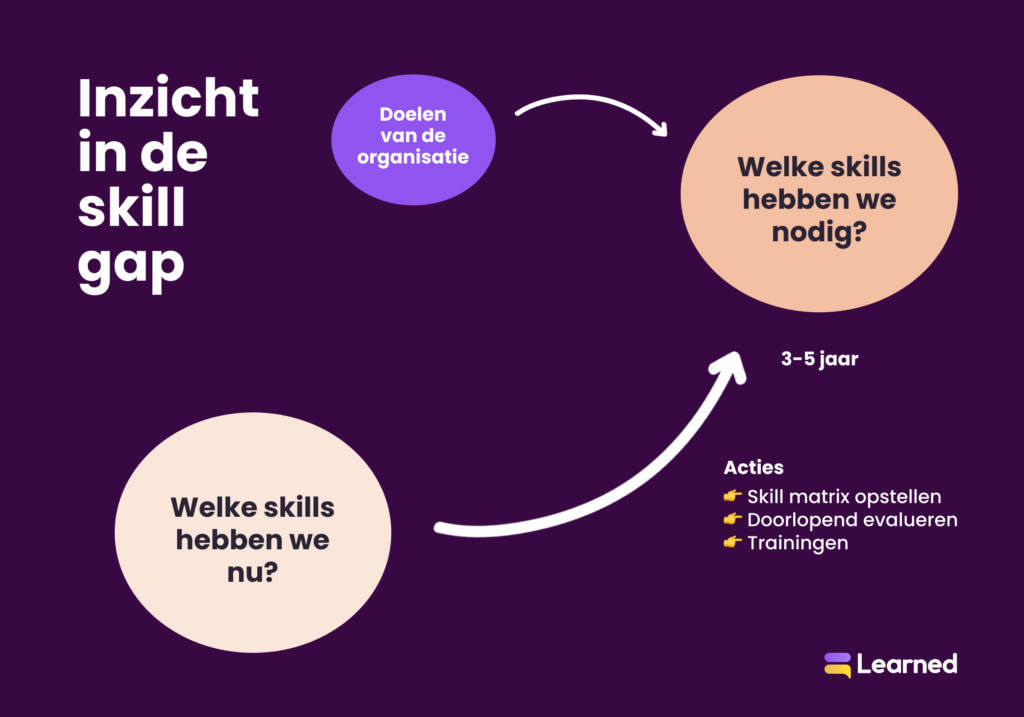
A skill gap or skills gap is the difference between the current skills of your employees and the skills needed to achieve your organisation's goals – including future goals.
The gap in skills or competencies can consist of: 1) soft skills or interpersonal, transferable skills, such as communication and organisational skills; 2) hard skills or job-specific, technical skills, such as knowledge of a particular method, machine or software.
If employees in your organisation do not possess all the required skills to perform their role well now or in the future, you can speak of a skill gap.
Such a 'gap' can occur at multiple levels:
• Individual: when an individual employee does not have the right skills to perform well
• Organisational: within an entire team, department or organisation, (a number of) required skills are missing to achieve organisational goals
🔎 Want to know if there's a skill gap in your organisation? Watch our masterclass 'Insight into the skills gap'
How a skills gap can develop
Skill gaps can occur in any type of organisation and at any job level.
This is simply due to the speed of technological developments: the skills required in certain roles are changing faster than ever, making it harder for employees to keep their skills up to date. According to the World Economic Forum, 44% of core skills will change in the coming years.
Due to these technological changes, accelerated by AI, we see 2 trends in skill gaps:
• A gap in technical skills, because new technical skills keep emerging;
• Soft skills or interpersonal skills are becoming increasingly important, as they set you apart amidst all that technology.
Where technical skills used to retain half their market value for 10-15 years, that's now just 2.5 years (source: IBM).
Looking at soft skills, the most important ones for reskilling are:
1. Analytical and logical thinking
2. Problem-solving skills
3. Learning ability and speed
4. Leadership
5. Resilience and stress tolerance
Factors that can contribute to a skills gap:
• Difficulty finding the right people: in a tight labour market, you may need to hire more junior profiles or career changers
• Lack of experience: sometimes employees don't yet have the years of experience to develop their skills. (And that's okay, as long as you offer development and evaluate based on skills.)
• High employee turnover: when top performers leave quickly, an organisational skill gap can emerge.
• Insufficient training, coaching and feedback: without room for development, e.g. through a Performance Management cycle, employees can't improve their skills.
• Unclear expectations: if employees don't know which skills their job profile requires, they can't take action to develop them.
Example of a skill gap
Here are 2 examples of a skills gap that can occur:
a) Senior project manager
Mark has over 10 years of experience in project management, but his knowledge of new AI tools is lacking. He therefore lacks the technical skills to make processes more efficient.
b) Team of junior developers
An IT agency works with a team of relatively inexperienced software developers hired because they've been trained in the latest coding languages. But they are still inexperienced when it comes to collaboration, planning and communication: there is a skills gap in their soft skills. The developers receive coaching from a senior colleague.
Why you want to address the skills gap
The world of work could look completely different in 5 years. And the only solution is to prepare your organisation for it as best as possible.
Due to the tight labour market and rapidly changing technological skills, only the best-performing organisations can remain productive and profitable. And you as HR can play a key role – by addressing the skill gap.
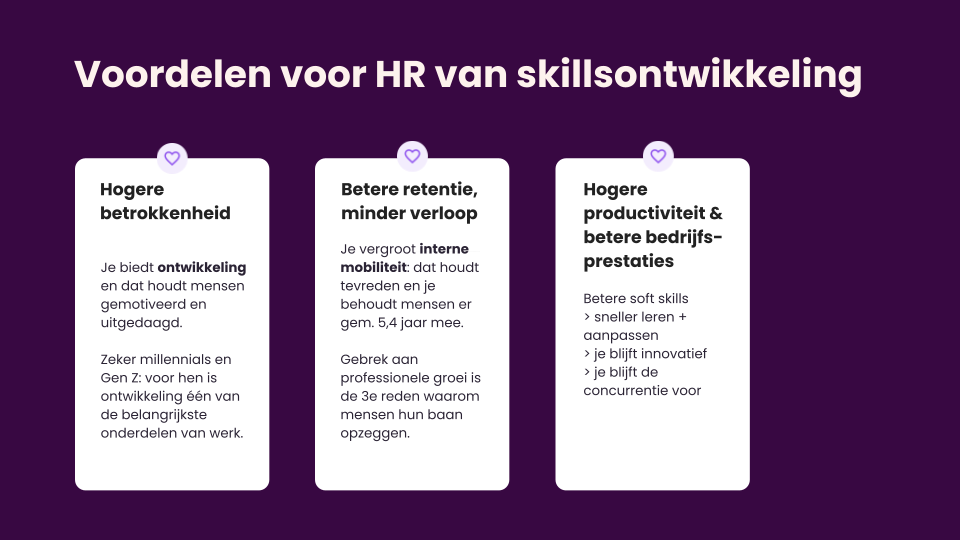
The benefit of improving skills in your organisation is that you can do more with fewer people. You keep upskilling employees in the skills they need to work as effectively and efficiently as possible.
More benefits of bridging the skills gap:
• You retain internal knowledge: making you more productive, innovative, and giving you a competitive advantage
• You stimulate internal mobility, retaining more people
• You gather insights on skill levels and performance for strategic workforce planning
• You become a more attractive employer, showing you invest in employee development
👉 Read more about the benefits of improving skills in your evaluation process
Insight into the gap: how to set up a skill gap analysis
In summary: if you do nothing about improving skills in your organisation, you can fall behind competitors, miss out on talent and lose your best performers.
You want to prevent a skills gap from forming. Or if there is one, you want to bridge it as quickly as possible.
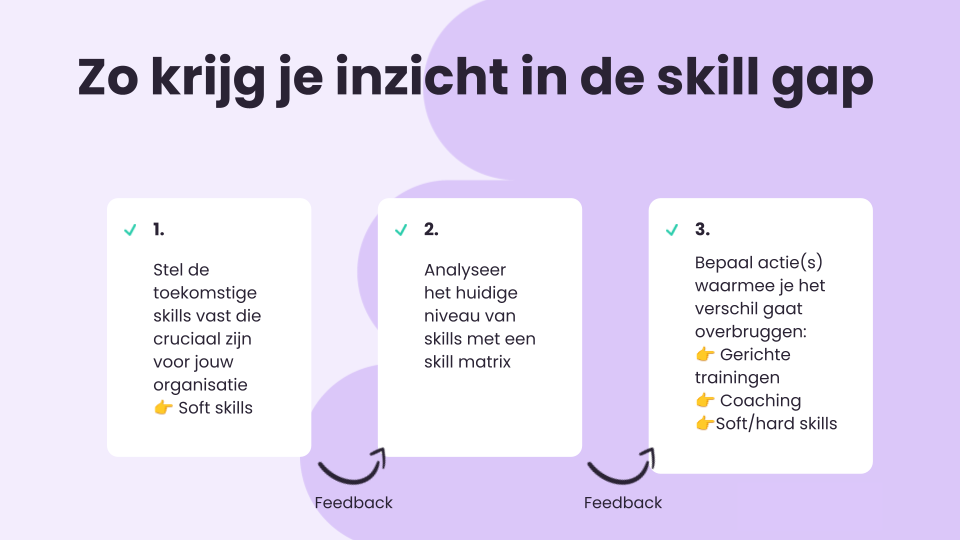
The first step is more insight: you get this through a skill gap analysis. In short, you then determine:
1. The future skills that will be needed in your organisation
2. The difference with the current skills you have in-house
3. What actions you will take to bridge that difference
Here's exactly how to carry out such an analysis 👇
1. Identify the most important skills for your organisation (including future ones)
Addressing the skills gap starts with planning ahead. You can't predict the future, but you can think strategically about skills that will be crucial in your sector in the next 5-10 years.
Points to consider:
• What goals do we want to achieve? Which skills are most valuable?
• What skills do employees need to perform their role effectively?
• Which skills are currently emerging in our industry?
• Are there new technologies employees need to be proficient in?
• What future roles don't exist yet but will be needed?
💡 Tip: it helps enormously if you've already documented which skills are needed for each role in the job profile.
2. Map out your employees' current skills
The next step is to measure the current level of skills in your organisation.
You can measure skills in several ways:
a) With assessments of soft skills, behaviour and cognitive ability: for example a motivation test like TMA, a Big Five personality test, a traditional assessment, or a neuro-cognitive test like Equalture.
b) With evaluation and performance reviews, including 360-degree feedback for the most complete and fair picture
c) With interviews, for more qualitative insight. But note this gives the least objective results.
These 3 methods are complementary; you can combine them.
Whatever method(s) you choose, the most important thing is to document current skill levels. You do this in a skill matrix.
• You immediately see if there's a skills gap in current required skills
• You can view skill levels at individual, team, department or organisation-wide level
3. Document future skills and determine the 'gap'
Then we go back to the crucial skills from step 1.
Now you create an overview of the future skills needed in your organisation.
• It's most practical to link them to a job profile (often more efficient than linking skills to individual employees).
• This way you also see the skills gap per role for skills to develop in the next 5-10 years.
Since these are future skills, you can't measure the current level yet.
But you can document these future skills in your process for evaluating, coaching and developing employees: your Performance Management process.
Don't forget to ask which skills employees themselves want to develop.
Then track progress using job profiles, development goals and career paths.
According to Gartner research, 6 out of 10 employees don't receive the on-the-job coaching they need to maintain key skills in their role.
– Source: HBR 2024
4. Action: ways to reduce the skills gap in your organisation
And now the final and most important step: supplementing employees' knowledge and skills to close any skills gap.
You could address the gap by smart recruiting, looking for rare people with exactly the skills that will become important.
But that's theory – in a tight labour market, finding the right people is a major challenge.
Therefore, the solution is to offer the right guidance, upskilling and internal mobility.
HR interventions you can take:
• Content-based guidance or on-the-job coaching from mentors, coaches or managers
• Internal training for larger groups, for both technical skills and soft skills like leadership
• External training: make a training budget available
• Job crafting: help colleagues shape their role to best match their talents
• Set up a learning and development programme with an easy-to-use software tool
Also ensure you document learning and development in KPIs and development goals, and include it as a discussion point in 1-on-1 meetings.
This creates ownership rather than leaving it to chance.
Evaluate progress regularly
How are your colleagues' skills developing? Are they demonstrating the behaviour that matches their level?
A final tip is to keep evaluating the progress of new skill development.
You need (team) managers, colleagues, mentors and their feedback for this. So integrate skills evaluation into your review conversations and conversation cycle.
💡 Then you can smartly track current skills, skill levels and progress in a Performance Management tool.
Ontvang de nieuwste HR-tips
Krijg 1 keer per maand onze tips, e-guides en templates direct in je mail.

Related articles
Discover more about this topic