

As an employer, you want to get the best out of your people, and the 9-grid helps you with this. It is a model to visualize the performance and potential of employees.
You can use the 9-box method to visualize your talent review, or to see at a glance who deserves a promotion before the semi-annual evaluation meetings take place. In short: super handy for your strategic personnel plan.
But how do you fill in the 9-grid model exactly? Here you will find an explanation in Dutch
👉 Also check out: Strategic workforce planning: how to tackle it
What is the 9-Grid?
You use the 9-grid model to evaluate employees based on their performance, talents, and their potential for growth. The method originally comes from consulting firm McKinsey.
You visualize performance and potential by plotting them on a matrix, a type of graph.
A 9-grid therefore consists of 2 important axes:
- Performance (x-axis): assessment of employees' performance and achieved KPIs in their current role. It shows how well they perform their tasks and contribute to organizational goals.
- Potential (y-axis): an employee's potential for growth within the organization. Do they have the capacity to handle more responsibility and more complex tasks? You assess this based on their knowledge, skills, and the behavior they demonstrate.
This way, you can clearly discuss which employees in a team or department have performed (less) well during a talent review.
And you have a clear overview of which people you want to promote to another position and which people you want to let go for your strategic workforce planning. Because a 9-grid is based on your evaluation process, it helps to make data-driven HR decisions.
💡 Want to know how to evaluate someone's skills, competencies, and concrete behavior? Also read: How to create a job profile based on skills
Why is the 9-Grid valuable for talent management?
Here you see an example of a 9-grid model.
The rule is always: the top right box shows the best performing employees, the bottom left box shows the least performing. (Our colleague Sylvano from Customer Success has been a consistent star 🏅 for 2 evaluation rounds in a row)
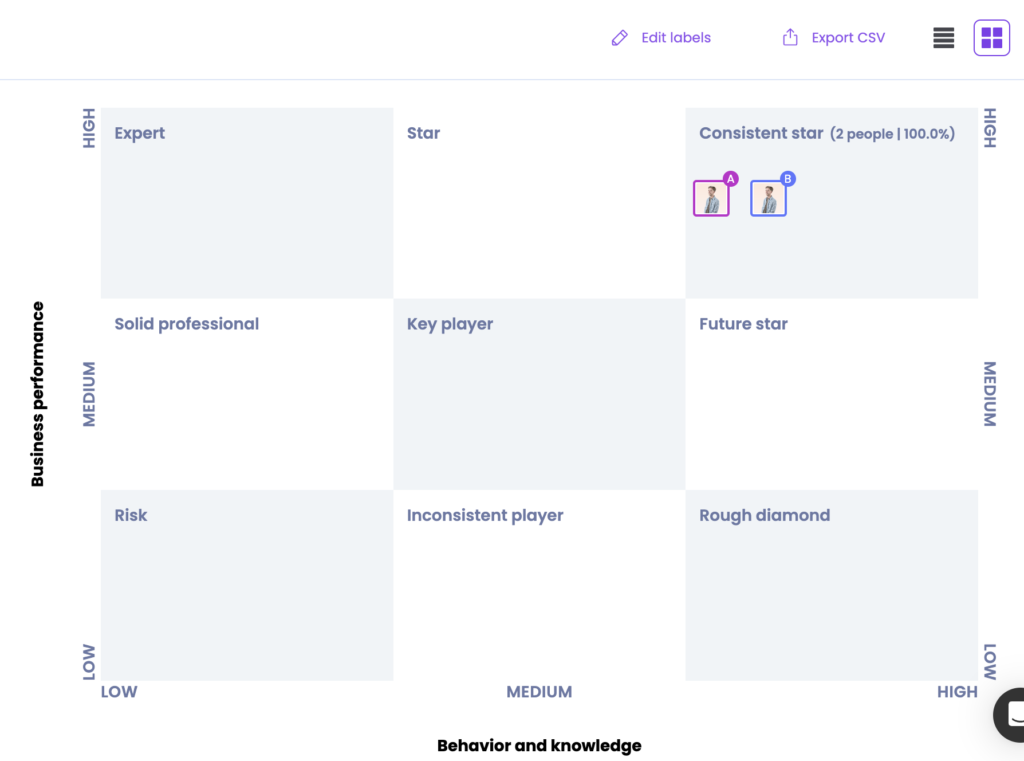
Example of a 9-grid in our Performance Management software
What the 9 boxes mean
As the name suggests, a 9-grid consists of 9 boxes that show who the best performing employees with the greatest potential are, and who the least.
Top: best performers
1. Consistent star
2. Star player
3. Expert
Middle: good performers
4. Future star
5. Key player
6. Solid professional
Bottom: less good performers
7. Rough diamond
8. Inconsistent player
9. Risk
Combining the 9-Grid and fleet review
The 9-grid method is often combined with a talent review. This is a meeting where managers from an organization come together to discuss the performance and potential of their employees – often prior to the (semi-)annual performance reviews in their review cycle.
During a talent review, the completed 9-grid matrix serves as a visual aid to gain an overview of the greatest talents within the organization, evaluate their potential, and set priorities for their further development and succession planning.
Learned facilitates the use of the 9-Grid
If you consistently fill in the 9-grid, based on ongoing, objective evaluations, this has many advantages for your talent management:
- Objective assessments: the model provides a structured framework for evaluating employees, reducing subjective assessments.
- Identifying growth potential: the 9-grid provides insight into employees who show the potential to grow and can be prepared for leadership roles.
- Stimulating development: it helps in drawing up effective development plans for employees in all different quadrants. You also see who can perform better quickly with the right guidance.
- Workforce planning: the 9-grid method is useful for succession planning, determining successor candidates for important positions within the organization. And also for strategic workforce planning: you gain insight into opportunities for internal advancement, but also into which employees are not performing well enough to retain them (outflow).
In this way, a 9-grid model helps HR and managers to determine who is ready for more responsibility, but also who needs that little bit of extra guidance to turn someone with a lot of potential into a high-performing professional. Or maybe even a star. 🚀
Want to know more? 👉 You can find the option to create a 9-grid by default in our Performance Management software

Ontvang de nieuwste HR-tips
Krijg 1 keer per maand onze tips, e-guides en templates direct in je mail.

![Strategic workforce planning: how to approach it [+example]](/images/blog/hero-09.png)