![Strategic workforce planning: how to approach it [+example]](/images/blog/hero-09.png)
HR is called 'human resources' for a reason: your people are your most important asset. At least, if you want to keep your organization future-proof.
One tactic to deploy your staff as effectively as possible in the long term is strategic workforce planning. With it, you not only get the best out of your people, but you also ensure that they get the most out of their job.
Read here what a strategic personnel plan entails, and how to create such a strategic plan.
👉 Also check out: Skill gap analysis: bridge the skills gap in your organization
What is strategic workforce planning?
With strategic workforce planning (abbreviated SWP) you anticipate your future staffing needs.
It is a way to align developments in your organization with your staffing as well as possible: you want to ensure you have the right people with the right skills in the right place, and at the right time.
The 4 principles of SWP
- The right people
- With the right skills
- In the right place
- At the right time (and within budget, with the right costs)
A strategic workforce plan consists of the decisions you make now about your staffing later, within 3 to 5 years. All to (continue to) achieve your organization's goals.
So the word says it all: that requires a lot of foresight and planning.
- Where does your organization want to be in 5 years?
- What developments do you expect?
- What should your workforce look like by then?
- What (additional) skills do employees need, and what is the expected skill gap?
By planning ahead in this way, you make the best possible use of your workforce and get the most out of their knowledge and competencies. Moreover, you can reduce turnover.
❗Strategic workforce planning is therefore different from operational workforce planning. That is not about planning for the next 5 years, but about the 'now': planning services and creating rosters.
Example of strategic workforce planning (SWP)
This is an example of what strategic workforce planning can look like.
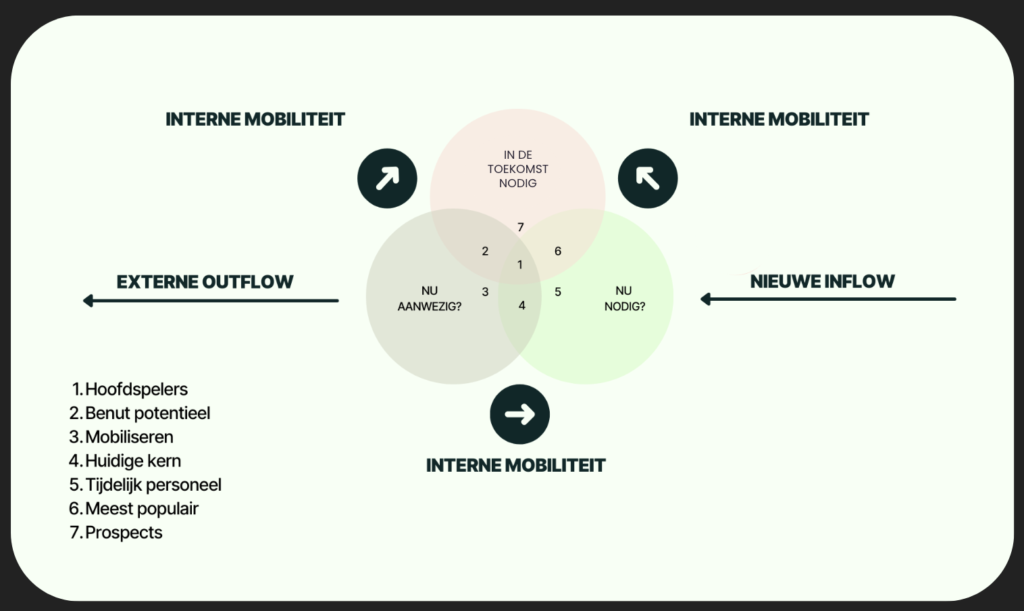
From our masterclass 'Managing Future Skills'
You can see a few indispensable components. Based on the questions above, you make strategic choices about:
- Recruiting new people
- Internal mobility or progression
- The occupancy of the most important (leadership) positions
- Outflow: which people do you let go?
And you see that a human resources strategy is dependent on your business strategy: what do you want to achieve as an organization? What, or rather who, do you need for that – which people and which skills?
💡 An important part of a strategic workforce plan is also conducting a skills gap analysis
Creating a strategic workforce plan
You create a strategic workforce plan based on these 4 components:
1. Start with your organizational goals
The first step of your workforce plan is your broader strategy. What (financial) goals does your organization want to achieve in the next 3, 5, or even 10 years? Do you need rapid revenue growth, or do you want to acquire other companies?
What organizational changes might you want to implement? How much budget is available?
Your workforce strategy also flows from these goals, so you have the right people in the right positions at the right time – or can recruit them.
This way, HR and business are aligned, and you truly contribute to strategic goals.
2. Map your current workforce
Just as important as your broader business strategy is the talent you already have in-house.
A first question: what exactly does your workforce look like? What are the employees' ages, have they been employed for a long time, are they relatively experienced or junior?
Also determine: what are their ambitions and development goals? And what are their strengths and unique skills?
If we then refer back to the model above, you'll see that you also need to think about:
- New inflow: who do I need to hire? 👈 What skills do I need now and in the future to achieve organizational goals, that my employees do not possess (and will not develop)?
- Outflow: which employees do I need to let go? 👈 Who possesses skills that we will no longer need in the future, or who does not show enough potential to learn the skills we will need in the future?
3. Conduct a gap analysis
Now you will zoom in on the specific skills you will need in the future.
First, look at the employees who already possess the required future skills, or have the potential to learn those skills.
👉 What is their current skill level? And what is the gap with future skills?
👉 To gain more insight into the skill level of your current workforce (or a skill gap), you can create a skills matrix, or perform a skill gap analysis.
Also, don't forget the new roles.
Which roles need to be filled in the next 3-5 years? Also consider roles that may not yet exist in your organization, and important positions at management level.
🔎 You can visually represent employee potential in a 9-grid
4. Develop your plan or strategy
The last and most important step is developing your action plan. This consists of the 3 pillars we saw earlier:
a) Internal mobility
You can move the people who show the right skills or potential to where you need them by encouraging growth through internal mobility.
Also consider succession planning: timely identification or recruitment of candidates for crucial leadership positions.
b) New hires
c) Outflow
5. And then: take action regarding internal mobility, outflow, and recruitment
By answering all these points, you ensure that your workforce strategy and thus your organization are prepared for the future.
Ultimately, you do this not only by hiring new people in time, but also by composing a smart workforce mix of permanent and flexible employees, and by further developing your current employees.
This is also a win-win: by creating room for internal growth, you minimize outflow.
Possible obstacles
Unexpected developments
⛔️ An obstacle in the field of where you want to go.
Of course, you cannot fully anticipate what happens in the world with your workforce strategy. That's why it's smart to focus on developing your staff's soft skills: transferable skills such as communication, leadership, agility, and learning ability.
Lack of data on performance & skills
⛔️ An obstacle in the field of what you currently have in-house.
Because if you don't know what you currently have in terms of existing workforce, you cannot create strategic workforce planning.
Therefore, ensure you continuously collect data on your employees' performance, goals, and skills.
You do this, for example, by already focusing on skills when drawing up job profiles, through a continuous evaluation cycle, and by tracking skills in a skill or competency matrix.
Tip 💡 You can easily track the performance (and potential) of your employees in Performance Management software
Benefits of SWP
Ultimately, you want to optimally deploy employees and get the most out of your available workforce.
Ideally, you safeguard your employees' knowledge, ensure limited turnover, and proactively fill key positions to maintain the effectiveness of your company or organization.
These are the benefits of strategic workforce planning:
- Future-proofing: In our world, technological advancements and market developments happen quickly, very quickly. Therefore, you must look ahead. With a strategic workforce plan, you keep your organization agile: you can quickly adapt to changing circumstances.
- Better performing employees
- More effectiveness: Because you strategically plan and deploy your workforce - as part of your broader strategy - you are more effective and have a greater chance of achieving organizational goals.
- Efficiency: Strategic workforce planning ensures that you can use your resources (your people and your recruitment budget) smarter - with precisely enough and the right employees. It also ensures better cooperation between all departments, because your HR plans are also aligned with the business strategy: 'all pulling in the same direction'.
- Talent retention: Just as important as attracting talented employees is retaining them. Because strategic planning offers your employees growth opportunities, it also increases their motivation and engagement.
- Internal mobility and talent development: You plan ahead for the skills, positions, and responsibilities you will need in the future. And initially, you look at the internal talent that can fill those positions - through internal advancement. This way, you create a pipeline of internal talent.
Read more 👉 The benefits of honest, development-oriented Performance Management
Ontvang de nieuwste HR-tips
Krijg 1 keer per maand onze tips, e-guides en templates direct in je mail.

Related articles
Discover more about this topic