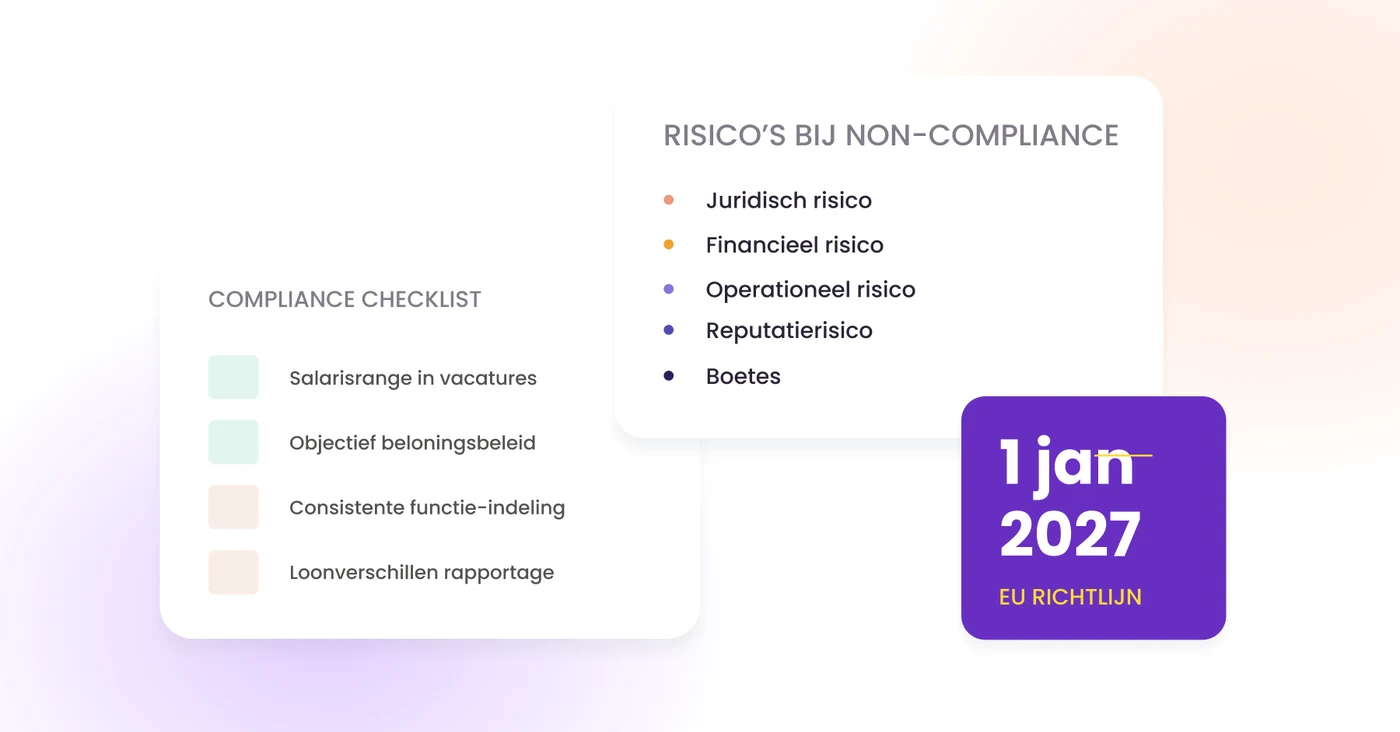
The Pay Transparency Act is coming. This means that your compensation must not only be fair, but also demonstrable. Otherwise, you risk fines and salary corrections that can amount to millions of euros. In this blog, you'll read what the Pay Transparency Act entails, what you need to comply with, and what the risk is if you're not compliant.
👉 Curious where you stand? Take the risk assessment
What does the Pay Transparency Act entail?
The Pay Transparency Act is a European directive that strengthens equal pay for equal (or equivalent) work and aims to reduce the pay gap between men and women.
The core is simple: organizations must become more transparent about salary and compensation decisions, and be able to justify that compensation is based on objective and gender-neutral criteria. In practice, you'll see this reflected at 3 moments:
- In job postings and applications: Salary information must be clear upfront and you can no longer ask about salary history.
- During employment: Employees gain the right to insight into their compensation and average compensation levels within comparable roles (broken down by gender).
- At organizational level: Larger organizations must report pay differences and when an unexplainable difference of more than 5% exists within equal work, action is required.
When does the Pay Transparency Act take effect?
The Pay Transparency Act is expected to take effect in the Netherlands on January 1, 2027. That may seem far away, but if you only start in 2027, you'll be too late. Job profiles, pay scales, compensation data and justification cannot be organized in just a few weeks.
What do you need to comply with under the Pay Transparency Act?
Recruitment process: transparent and repeatable
Specifically, you want job postings and pre-interview communications to clearly state the salary range or scale. You also need one fixed method for placing someone within that range, so it doesn't depend on negotiation or preference. Additionally, asking about salary history must be removed from your processes, templates, and conversations.
Compensation policy: objective and explainable
You want your compensation policy set up so you can explain why someone receives what they receive. This means rules for starting salary, growth, allowances and variable compensation are pre-determined and apply equally to everyone.
Data and job classification: consistent and comparable
To properly compare equal (or equivalent) work, job profiles and levels must be accurate and consistently used. You want jobs logically organized into levels and scales. Your compensation data must be complete and reliable.
📋 Curious how far your organization is with pay transparency? Download the free Pay Transparency Checklist!
Risks of non-compliance with the Pay Transparency Act
If you're not compliant with the Pay Transparency Act, it quickly becomes about provability. On top of that come other consequences, which can be divided into five risks:
- Legal risk: once someone asks questions or suspects unequal pay, you must be able to show how compensation is determined.
- Financial risk: you face salary corrections and possible compensation, causing costs to escalate quickly.
- Operational risk: you need to organize additional analysis and decision-making.
- Trust and reputation: ambiguity or differences in compensation can damage internal trust and external employer brand.
- Fines: exact fine amounts are not yet known.
What does non-compliance with the Pay Transparency Act cost?
With the Pay Transparency Act, the biggest costs usually aren't in a fine, but in salary corrections and possible compensation you still need to implement.
Say you have 500 employees. The pay gap is rarely in one role, but spread across multiple job groups. Take a conservative scenario where 250 employees fall in groups with an unexplainable pay gap of 5%. The average gross annual salary in that group is €55,000.
- 5% of €55,000 = €2,750 per employee per year
- €2,750 × 250 employees = €687,500 per year in structural correction
And this is the most favorable scenario. If you don't correct this in time:
- ± €1,375,000 in corrections over 2 years, excluding legal costs
The bottom line: even at 5%, the total impact with 500 employees can quickly reach millions.
Step-by-step plan: how to become compliant with the Pay Transparency Act
Step 1. Put your compensation rules in writing
Document per job group what the salary range/scale is and what rules apply for classification, growth, allowances and bonuses. Also agree on who may deviate from the range and how such exceptions are justified and documented.
Step 2. Make jobs comparable
Update your job profiles and link each role to a level and scale/range. Document which roles you compare as equal (or equivalent) work.
Step 3. Check your biggest risks with a pay gap analysis
Measure pay differences per job group and include allowances and bonuses. Check where you're approaching or exceeding 5% and note per difference whether you have an objective explanation.
Step 4. Set up transparency processes
Ensure that job postings always have a salary range ready before the first interview and remove questions about salary history from your scripts and templates. Also set up one fixed process for employee pay inquiries: who provides what information, within what timeframe, and how do you ensure privacy/GDPR compliance.
Step 5. Create a plan for corrective measures
If differences cannot be objectively explained, document what you're correcting, when, and with what budget. Assign an owner, plan evaluation moments, and document decisions.
Are you ready for the Pay Transparency Act?
Want to know where your organization currently stands? The Pay Transparency risk assessment is a useful first step. You'll see at a glance what's already in order, where you're at risk, and what needs attention first.
👉 Curious if you're ready for the Pay Transparency Act? Take the risk assessment
FAQ Pay Transparency Act
What must you have arranged as an employer by January 1, 2027?
Ensure your compensation decisions are explainable and demonstrable. This means: roles and levels are clearly classified, salary scales are fixed, compensation criteria are objective and consistently applied, and you can measure and explain pay differences per job group.
What is the 5% rule in the Pay Transparency Act?
If within equal work there is a pay gap of more than 5% that you cannot objectively explain, you must take measures.
Who does the reporting obligation apply to?
The reporting obligation applies to employers with 100 or more employees. For organizations with 250+ employees reporting is annual, and for 100-249 employees it is every three years.
Ontvang de nieuwste HR-tips
Krijg 1 keer per maand onze tips, e-guides en templates direct in je mail.

Related articles
Discover more about this topic