

Career paths are structured trajectories that guide employees in their professional growth within an organization. They include successive positions with increasing responsibilities and challenges and define the necessary steps, skills and experiences for advancement. Setting up career paths requires a deep understanding of the organization's goals and the individual ambitions of employees.
The benefits of career paths include increased employee satisfaction, talent retention, attractiveness to potential talent, personal and professional development, effective succession planning and increased productivity. HR plays a vital role in guiding employees through these paths, plus coordinating training, conducting performance reviews, and facilitating coaching and mentoring. Want to know more? Read on! Prefer to get started right away? Try Learned free for 14 days and start developing career paths in our career framework module.
What are career paths?
A career path is a structured, clearly defined trajectory that employees can follow within their job to achieve professional growth and advancement. This usually includes successive positions, roles or tasks with increasing responsibilities and challenges. It defines the necessary steps, skills and experiences needed to move to another position. Effectively planned career paths help employees visualize and achieve their career goals while helping organizations retain and develop talent.
This helps organizations prevent high employee turnover. Curious about your organization's employee turnover? Download our e-guide on employee turnover. This e-guide contains tips to prevent high employee turnover and a calculator to compute your organization's turnover.
What components make up a career path?
Setting up an effective career path can be complex, as it requires a deep understanding of both the organization's goals and the individual needs and ambitions of employees. Nevertheless, there are some crucial steps you can follow to shape an effective career path:
- Role definition: It all starts with a clear understanding of the different roles within your organization. Identify the skills, qualifications, and experiences needed for each of these roles.
- Growth and development opportunities: Determine which roles have potential for upward mobility. This means identifying which positions can lead to higher positions based on the skills and experiences they offer.
- Training and education: Consider what types of training, education or certification may be needed to help employees achieve their career goals. Provide opportunities for continuous education and professional development within your organization.
- Mentor programs: Mentor programs can help employees receive guidance and support while acquiring new skills and advancing in their careers.
- Feedback and evaluation: Regular evaluations and performance reviews can help employees measure their progress and identify potential areas for improvement.
- Transparency: Make career paths visible and accessible to all employees. This allows them to plan their own career goals and understand what steps they need to take to achieve them.
Each of these components plays a crucial role in shaping an effective career path. But don't forget that success also depends on the ability to be flexible and responsive – to address changes in both the organization's needs and the employee's ambitions.
What are the benefits of working with career paths?
Designing effective career paths offers numerous benefits for both employees and the organization. Here are the key benefits:
- Employee satisfaction and engagement: Career paths provide employees with a clear picture of their future within the organization. This can contribute to higher satisfaction and engagement as employees see that the organization invests in their growth and development.
- Talent retention: By offering clear career opportunities, your organization can retain valuable employees. People are less likely to look for other opportunities when they see a future for themselves within their current organization.
- Attracting talent: Potential employees often look for companies that offer growth opportunities. By showing career paths, your organization can become more attractive to highly qualified talent.
- Personal and professional development: Career paths enable employees to develop themselves, both professionally and personally. They can acquire new skills, expand their capabilities and better understand their role within the organization.
- Succession planning: With clearly defined career paths, your organization can more effectively plan for future leadership roles and ensure a smooth transition when current leaders depart or retire.
- Increased productivity: When employees clearly understand what is expected of them and what the potential for advancement is, they are likely more motivated to perform, which can lead to increased productivity.
Defining career paths is therefore not only beneficial for employees, but also for the overall health and growth of the organization.
What is HR's role in the employee's career path?
Human Resources (HR) plays a vital role in guiding employees through their career paths. HR is responsible for establishing possible career trajectories within the organization, identifying specific skills, experiences and education needed for each career step. They also coordinate training and development programs, essential for expanding competencies and promoting growth. Additionally, HR arranges performance reviews to measure employee progress and identify potential areas for improvement.
They initiate coaching and mentoring programs to provide extra support on employees' professional journeys. HR is also crucial in communicating these career paths, ensuring every employee understands the necessary steps and opportunities. Finally, HR plays a key role in succession planning, timely identifying and preparing potential leadership for future key positions within the organization.
Learned makes career paths transparent and accessible
As mentioned earlier in this blog, it all starts with role definition. With Learned's career framework, you provide your employees with insight into the expectations for their current role, while also giving relevant recommendations for the most relevant future roles they can fill internally. Ready to start facilitating career paths for your employees?
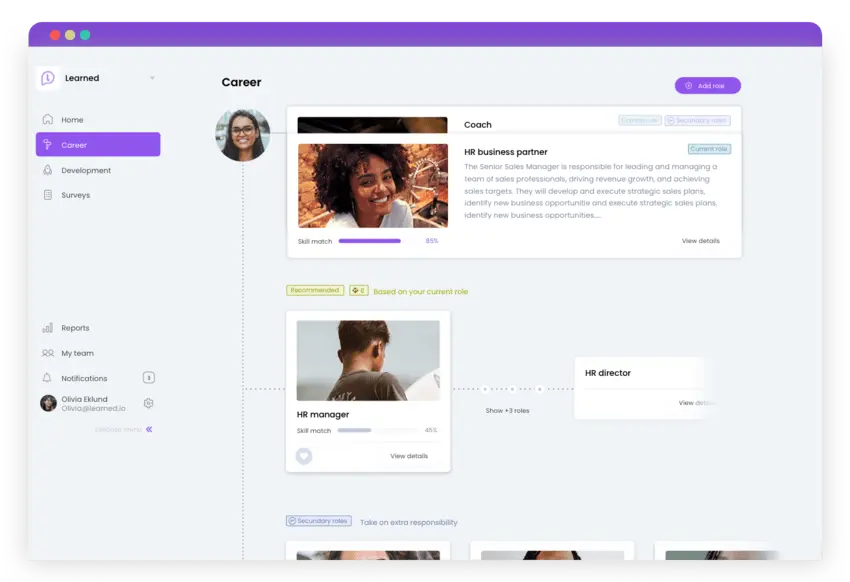
With Learned's career software, you can easily generate a modern job architecture based on market data. This makes evaluations objective and growth opportunities transparent, ensuring motivated employees and low employee turnover.
Ontvang de nieuwste HR-tips
Krijg 1 keer per maand onze tips, e-guides en templates direct in je mail.

Related articles
Discover more about this topic