


The solution? Add a competency profile to a job profile: a profile based on skills, expressed in concrete behavior and results. Discover what a competency profile is and how to use it.
What is a competency profile?
You can see a competency profile as part of a job profile. And it is also a supplement to it. Traditional job profiles have the disadvantage of focusing on tasks, responsibilities and hierarchy: all things that have little predictive value for employee performance.
What much more accurately predicts whether someone is successful in a role are competencies: cognitive ability (knowledge) and behavior (soft skills).
You can add a competency profile to a job profile with:
- Competencies (soft skills, transferable)
- Professional knowledge and experience (hard skills, role-specific)
- And – very importantly – the behavior someone must demonstrate to meet these competencies
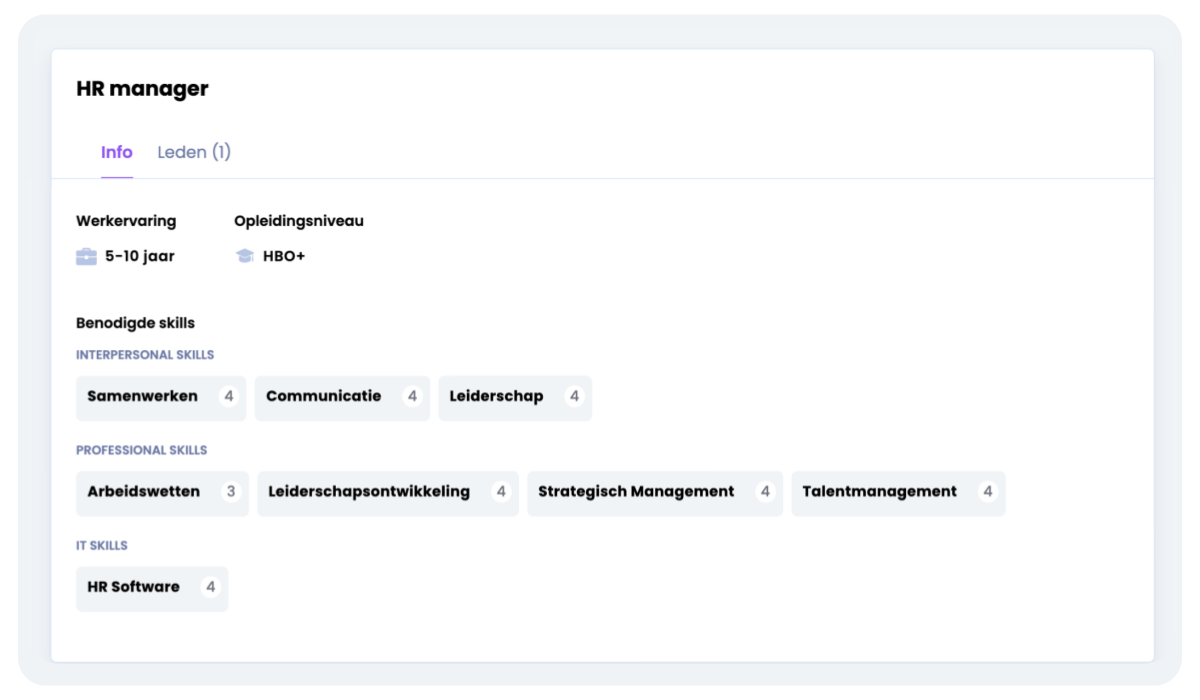
Example of a competency profile
This is an example of a competency profile for an HR manager:
How to create a competency profile
Traditionally, a job profile contains the job title, the tasks an employee must perform, their authority and position within the organization.
You can make it a skills-based job profile by adding which competencies and soft skills are needed to perform well in that role.
These are the elements you include in a competency profile:
1. Define the performance indicators or KPIs
How do you measure success in a role? Determine which measurable achievements and objectives an employee must reach to perform the role properly.
2. Determine the right competencies or soft skills
Competencies are the transferable, non-role-specific competencies that someone must possess to perform the role successfully. These include, for example, communication skills or leadership skills.
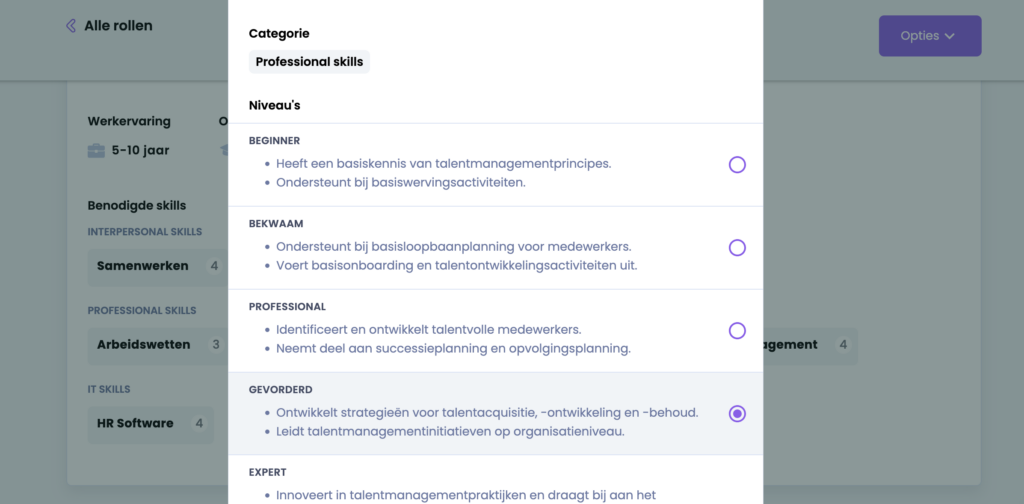
You describe competencies based on the concrete behavior that fits the level of the role.
3. Required professional skills and hard skills
Hard skills are the specific skills, experience, and knowledge needed to successfully perform the job.
Optionally, you can separately mention certain technical skills to clarify the required experience, such as knowledge of:
- Languages
- Software systems
- Machines and operating systems
Want to know more? 👉 Here you can read all about the difference between skills and competencies
4. Choose the right tool to determine competencies and skills
Want to know how to determine the required skills, competencies and KPIs? Read more in our blog about creating skills-based job profiles.
In any case, use the right (software) tool to create competency profiles.
The most convenient is one software tool to bring together all job profiles of your organization. This keeps all data easily up-to-date and allows you to link the right job profile to the right employee.
Example of a job profile in Learned showing the different competency levels, expressed in concrete behavior:
🎯 If your HR tool automatically contains competency profiles for the most common roles, you don't have to create them yourself. With Learned we offer 2000 job profiles, generated by AI and based on industry-specific data, in our free job architecture.
What do you use competency profiles for?
All job profiles of your organization together form your job architecture. And that is the foundation of talent management and performance management in HR.
These are more benefits of using competency profiles:
1. Clear expectations
A competency profile is a structured way to determine the requirements for the same or similar roles. This way, managers and employees know exactly what is expected of their performance.
2. Recruitment and selection
In recruitment, a job profile serves as the basis for the vacancy, to hire the right person with the right knowledge and skills.
3. Performance reviews
A skills and competency-based job profile is the basis for performance evaluation: you set objective standards to measure how well an employee performs compared to role requirements.
4. Employee development
With competencies, you create clear expectations of what someone must know, be able to do and achieve to be ready for a next role. Additionally, you can create targeted training plans to help employees improve their skills in specific areas.
Get started with competencies in your organization
What competencies and skills are there? And which are relevant for the roles in your organization?
If you want to get started with creating competency profiles, we'll help you on your way!
👉 Download our free template with 38 competencies to quickly start with competency profiles
Ontvang de nieuwste HR-tips
Krijg 1 keer per maand onze tips, e-guides en templates direct in je mail.

Related articles
Discover more about this topic

![Job matrix: insight into job levels [+example]](/images/blog/hero-19.png)
![Competency matrix and skill matrix: how to use it [+ example]](/images/blog/hero-20.png)