

The solution is a job profile based on skills, expressed in concrete behavior and results. This way, employees clearly know what is expected of them, and you gain better insight into how to best deploy the talents in your organization. Discover here how to create skills-based job profiles for your organization – with examples.
What is a job profile?
A job profile is an overview of everything someone in a specific role needs to do and be able to do to perform that role successfully. It consists of a structured description of the tasks, responsibilities, level, and skills required.
Some organizations also add reporting lines and the position within the organization to a job profile.
A job profile contains this information:
- How success in this role is measured, in the form of KPIs
- Which skills and competencies are needed for the role
- What behavior someone needs to demonstrate to meet these competencies
Example of a job profile
This is an example of a job profile with competencies for an HR manager:
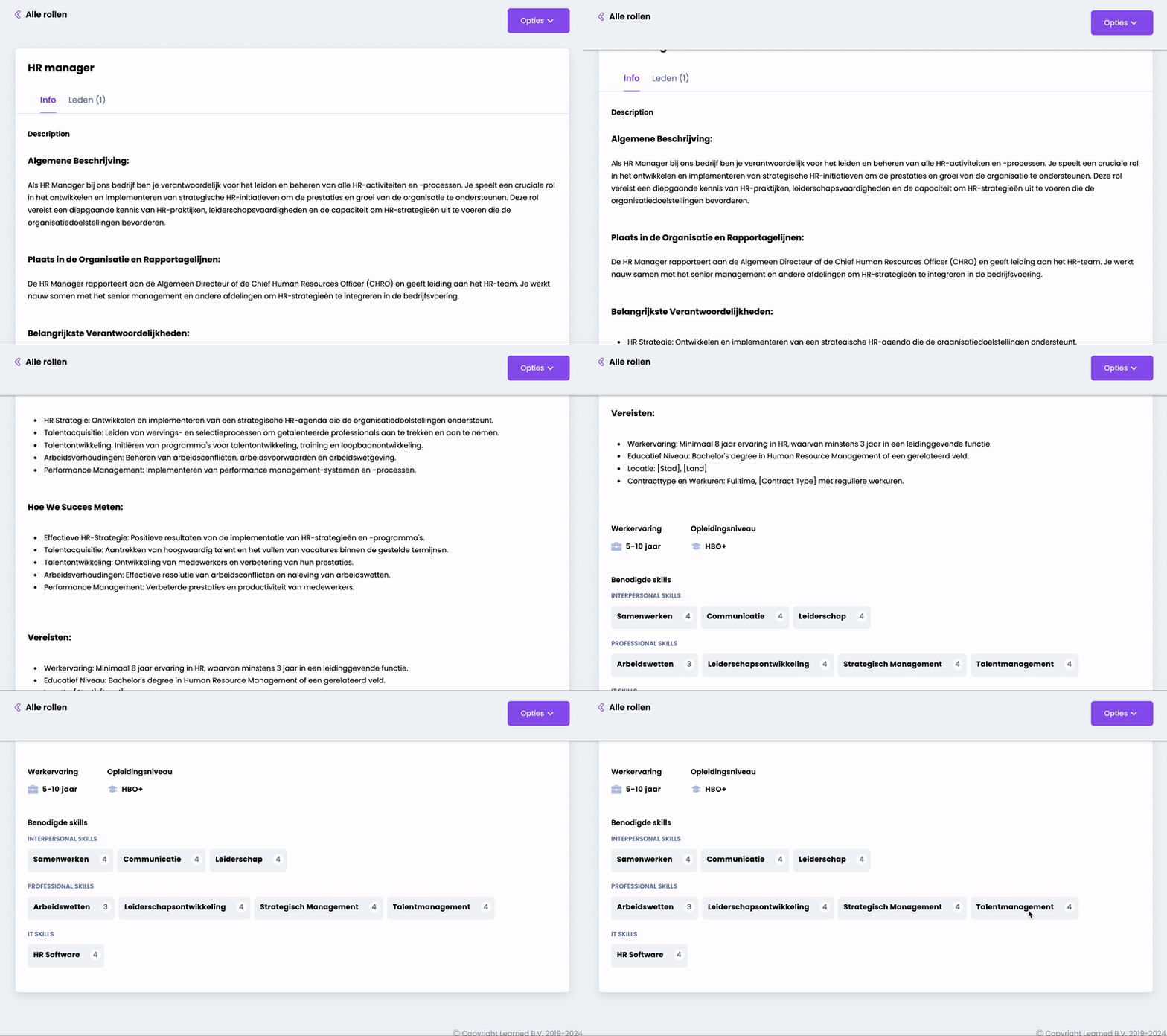
💡 What it is not: a job profile is not a job description
Job profiles are broader than a job description, because they contain more information than just an overview of tasks and responsibilities.
What do you use job profiles for?
Job profiles are the foundation of your talent management and performance management in HR: all job profiles of your organization together form your job architecture.
Additionally, you use job profiles for:
1. Clear expectations
A job profile is a structured way to determine the requirements for the same or similar positions. This way, managers and employees know exactly what is expected of their performance.
2. Recruitment and selection
In recruitment, a job profile serves as the basis for the vacancy, to hire the right person with the right knowledge and skills.
3. Performance reviews
It is the basis for performance evaluation: in a job profile, you set objective standards to measure how well an employee performs compared to the job requirements.
4. Employee development
With competencies, you create clear expectations of what someone needs to know, be able to do, and achieve to be ready for a next role. Additionally, you can create targeted training plans to help employees improve their skills in a specific area.
A job profile 2.0 based on skills
Traditional job profiles have one major disadvantage: they focus on the tasks, responsibilities, and hierarchy of a position. These are all things that have little predictive value for job performance.
What much more accurately predicts whether someone is successful in a role are competencies: cognitive ability (knowledge) and behavior (soft skills). That's why it's more effective to also add competencies, skills, or abilities to your job profiles.
This way you turn a job profile into a competency profile with:
- Competencies (soft skills, transferable)
- Professional knowledge and experience (hard skills, job-specific)
What to include in a job profile
A skills-based job profile contains the tasks an employee must perform and the competencies required. When creating a profile, it's also important to keep it concise and consistent.
These are the components you include:
a) The basics
1. Job title: This gives a clear picture of the role within the organization.
2. Purpose of the role: This describes the main objective of the position and how it contributes to organizational goals.
3. Position within the organization: Indicates where the role sits in the organizational hierarchy, including reporting lines.
4. Authorities: this describes the decision-making authority associated with the role.
b) Competencies, skills and KPIs
5. Performance indicators or KPIs: how do you measure success in a role? Determine what measurable achievements and objectives an employee must meet to perform the role properly.
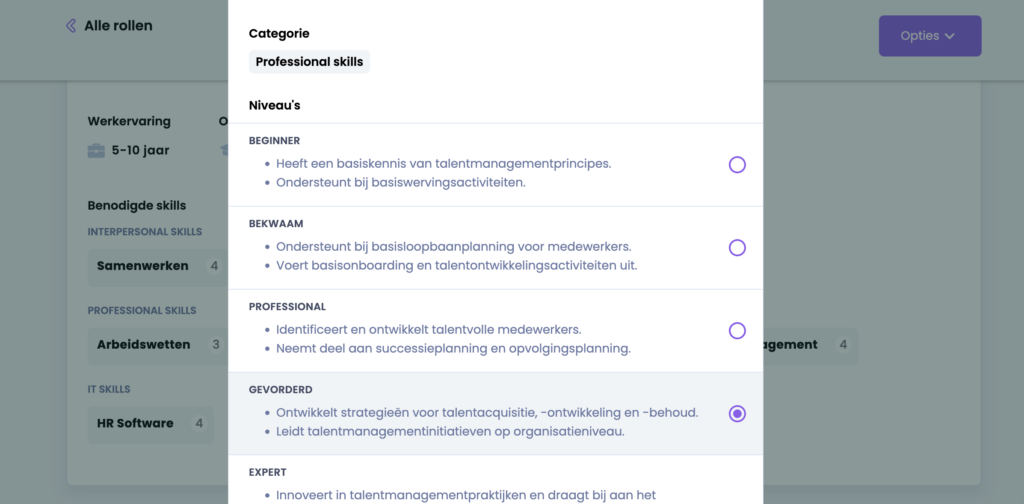
6. Competencies or soft skills: The transferable, non-job-specific competencies that a person must possess to perform the role successfully. These include, for example, communication skills or leadership skills.
You express competencies in concrete behaviors appropriate to the level of the role. And this part of a job profile can also be called a competency profile.
7. Professional skills and hard skills: the specific skills, experience, and knowledge required to perform the role successfully.
Optionally, you can mention certain technical skills separately to clarify the required experience, such as knowledge of:
- Languages
- Software systems
- Machines and operating systems
💡 Want to know how to determine the required competencies for a role? Also read: How to create a competency matrix
c) Optional
8. Work experience
The advantage of a job profile based on competencies and KPIs is that you don't need to specify years of work experience. That experience is already embedded in the level of competencies (soft skills) and skills (hard skills and technical knowledge).
9. Educational requirements
Depending on the nature of the role, you can include a minimum education level or specific educational requirement (e.g., for a teacher, nurse, surgeon, lawyer).
📝 In a competency-based job profile, you leave out a description of tasks and responsibilities. A task description quickly becomes outdated, and if it doesn't precisely describe the tasks employees perform in daily practice, it can lead to discussion. A job profile is broader and therefore stays up-to-date longer.
Creating a job profile in 4 steps
We now know what a job profile entails, but how exactly do you create one? 👇
Step 1. Determine the required competencies and skills
Create a job profile with competencies and skills for every position in the organization.
Pay attention to:
- Describe the required competencies (soft skills) using a concrete description of the behavior someone needs to demonstrate
- Also document (hard) skills and any technical abilities
- Keep it to a maximum of 10 competencies and skills per job profile
Step 2. Objectively determine how to measure success
Determine how you measure success and which KPIs and organizational goals a position contributes to.
Setting the right KPIs is not that simple, because you need very specific subject matter knowledge of a role. For that knowledge, HR depends on (operational) managers, who often base their idea of good performance on their own opinion – rather than on an objective KPI.
That's why it helps to use an HR software tool that provides automatic suggestions for useful KPIs based on market data from a specific industry.
For example:
- Project Manager 🎯 KPI: X number of projects completed within deadline
- Developer 🎯 KPI: X number of tickets completed without bugs
- HR Manager 🎯 KPI: Increase satisfaction to eNPS score X
Step 3. Choose the right tool for creating job profiles
Also think about the method – or the tool – you want to use to create the profiles. There are roughly 3 options:
a) A consultancy
Consultancy firms often work with traditional methods. The downside is that this can lead to your job profiles quickly becoming outdated, and the costs can be high.
b) AI or Artificial Intelligence
You can now also have AI tools like ChatGPT generate a job architecture with all profiles for your organization. That's fast and you can do it entirely yourself.
The downsides of AI are:
- Creating job profiles is quite labor-intensive, as you generate an Excel or CSV file with ChatGPT that you need to organize, edit, and structure yourself;
- It still takes a lot of time to keep the profiles up-to-date, that doesn't happen automatically
- It's difficult to create truly realistic profiles for your industry and organization size, because you can't choose which databases to base your profiles on
c) Modern HR software
It's most clear and user-friendly to bring all job profiles of your organization together in one software tool.
The advantage is that you easily keep all data up-to-date, even when something changes in a role, and that you can link the right job profile to the right employee.
Moreover, colleagues immediately have insight into their own job profile through the tool, which creates clear expectations.
Step 4. Check job profiles with team managers and employees
Make sure you don't only involve HR in creating job profiles, but also the employees who currently hold the positions. With their input, you create realistic job profiles.
Then ask team members and managers to review those job profiles:
- Which goals and KPIs are important for the team's success?
- Which skills and competencies does someone need in the role?
This saves you a lot of time compared to manually creating job profiles together with managers and employees. Moreover, you ensure that profiles of similar positions don't differ per manager, but are consistent and objectively measurable.
The benefits of objective job profiles
The next step is to effectively deploy competency profiles in your organization.
Because you can use job profiles as a basis for recruitment, but also for clear expectations in a role, employee development, and fair performance reviews. All benefits for your Performance Management.
With these 3 tips, you get the most benefit from competency profiles 👇
a) Use job profiles as the basis for an objective evaluation process
You do this by using the skills, competencies, and KPIs from job profiles as the basis for your HR conversation cycle and evaluation process.
By incorporating the competencies and KPIs from the job profile in every conversation between manager and employee, you base feedback, evaluations, and performance on measurable results and concretely observable behavior. You make your Performance Management or evaluation cycle objective.
This way, managers can objectively determine how a team member is performing and coach them in a targeted way to further develop the right competencies.
b) Map out career paths
In a job profile itself, you don't yet need to specify what the growth opportunities are.
But do use your job architecture with job profiles as a basis for mapping out possible career paths for each position.
- This gives you an overview of which employees are eligible for a vertical move to a higher position, but also which employees possess skills that would be better utilized in a horizontal move to another department.
- Employees themselves also see exactly which skills, competencies, and KPIs they need to further develop to grow.
Moreover, insight into development opportunities is important for the motivation, engagement, and performance of employees – and it helps you retain more high-performers and younger workers.
c) Keep profiles up-to-date
Over time, the required competencies or goals for a position may change – due to company growth, technological developments, or industry changes.
So, if managers or employees discover during their discussions that a certain skill or KPI is no longer relevant, have them report it back to HR and update the job profile.
👉 Want to know more? Read on about the benefits of honest Performance Management
Ontvang de nieuwste HR-tips
Krijg 1 keer per maand onze tips, e-guides en templates direct in je mail.

Related articles
Discover more about this topic
![Job matrix: insight into job levels [+example]](/images/blog/hero-19.png)
![Competency matrix and skill matrix: how to use it [+ example]](/images/blog/hero-20.png)