

Career development is invaluable for employees and organizations. It's about shaping your career, discovering new opportunities and improving your skills. But why is it so important for companies to invest in the growth of their employees? In this blog we look at the benefits of investing in career development, such as retaining talent, increasing motivation and productivity, enhancing employee value in the labor market and fostering a culture of learning.
We also share practical tips on how organizations can invest in career development, such as career development programs, training, job rotation and coaching. By investing in career development, you reduce the chance of high employee turnover. Want to know the costs of employee turnover in your organization? Download this e-guide to calculate it. It also contains 10 practical tips, fully supported by research, to reduce employee turnover in your organization.
What is career development?
Career development refers to the process in which individuals shape and improve their careers through targeted actions and growth. It involves identifying goals, acquiring new skills, expanding knowledge and exploring opportunities for advancement. Career development also means making conscious choices to promote your professional growth and satisfaction. This can include taking on new responsibilities, networking, pursuing education and challenging yourself to reach your potential. Career development is a continuous process that helps individuals achieve their professional goals and be successful in their work.
What are other terms?
This is of course a widely discussed topic that has become increasingly important in recent years. Perhaps you know this term under a different name. We also see these at other organizations:
- Career planning: This refers to the process of planning and managing someone's career in the short and long term. It includes setting goals, identifying required skills and making strategic decisions to achieve those goals.
- Career management: This focuses on actively managing and directing someone's career path. It includes evaluating skills, interests and values, making decisions about career direction and adapting to changing circumstances.
- Personal development: This refers to striving for growth and improvement on both professional and personal levels. It includes developing new skills, improving existing skills, increasing self-awareness and striving for personal growth and well-being.
What does investing in career development yield?
This sounds great of course, but these kinds of processes also cost a lot of time (and therefore money). Fortunately, investing in career development also brings a lot of value to the organization.
First, it contributes to retaining talented employees. By offering opportunities for growth and advancement, employees feel valued and motivated to stay with the company. This reduces employee turnover and the associated costs of recruiting and onboarding new employees.
Second, career development leads to greater engagement and productivity. When employees have the opportunity to develop and improve their skills, they feel motivated to contribute more and perform their work at a higher level. This results in increased productivity and quality of work.
Additionally, investing in career development improves employee employability. By teaching them new skills and exposing them to various learning experiences, you increase their value in the labor market. This makes them more resilient in an ever-changing economy and increases their chances of external growth opportunities. This also has a positive impact on the company's image as an attractive employer.
Career development contributes to a learning organization culture. When companies invest in the growth of their employees, they encourage a culture of continuous learning and development. This promotes innovation, knowledge sharing and the company's ability to adapt to changing market conditions.
Investing in employee career development is beneficial for companies because it helps retain talent, increases engagement and productivity, improves employability and promotes a learning organization culture. It is an investment that pays off in the long term by creating a win-win situation for both employees and the company.
How can companies invest in career development?
As an organization, it is essential to create a culture of career development through various activities. First, a clear career development program must be established, with individual development plans for employees. This includes identifying their strengths and interests, and formulating goals that help them grow. Additionally, there must be room for training and education, both internal and external. Organizing workshops, seminars and conferences enables employees to acquire new skills and knowledge. Coaching and mentoring are also valuable to guide employees and support their growth.
Furthermore, there must be room for job rotation and gaining new experiences. By enabling employees to take on different roles or projects, they can broaden their skills and develop new perspectives. An open communication and feedback culture is also crucial. Employees should feel comfortable sharing their ambitions and development needs, while managers should regularly provide feedback and appreciation.
Finally, organizations must consider individual needs and ambitions when designing career paths. Flexibility and customization are important to create a stimulating and inclusive environment where every employee has the opportunity to grow and thrive.
With Learned, your employees are in the lead of their career development
Learned can support making expectations and evaluations transparent. Using AI, you can easily create market-conform job profiles with objectives, competencies and skills. But you also let everyone take control of what they want to develop and when with the various solutions for learning & development.
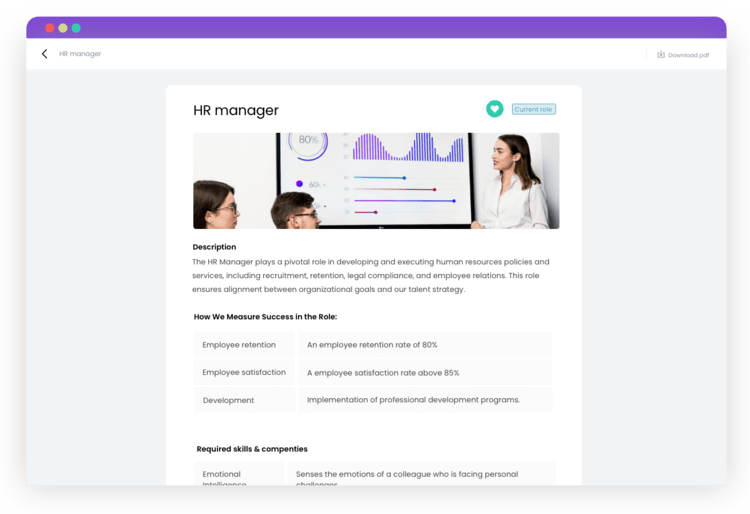
Explanation: In this example you can see the job profile for an HR manager. This profile and over 4000 other profiles are freely available in Learned. You can see how success in this role can be measured and which behavior is needed for which competencies and skills. Try Learned free for 14 days!
Ontvang de nieuwste HR-tips
Krijg 1 keer per maand onze tips, e-guides en templates direct in je mail.

Related articles
Discover more about this topic