

The eNPS, or Employee Net Promoter Score, is a measurement tool to map employee engagement and loyalty within your organisation. It is also very valuable in HR.
Inspired by the Net Promoter Score from the marketing world, the eNPS specifically focuses on employees' willingness to recommend your company as an employer. In this blog, you'll discover why the eNPS is crucial, how to measure it, and the benefits it offers for improving your work environment and organisational performance.
What is the eNPS and why is it important?
The eNPS is a measurement tool used to gauge employee engagement and loyalty. It is based on the Net Promoter Score (NPS), a well-known method in the marketing world used to measure customer loyalty. The eNPS specifically focuses on employee engagement and their willingness to recommend the company as an employer to others.
The idea behind the eNPS is that employees who actively recommend the company are likely more engaged, satisfied, and loyal. Conversely, employees who would not recommend the company may indicate potential issues with engagement and employee experience.
For companies, the eNPS is useful because it provides a simple and quick way to measure employee engagement and identify potential areas for improvement. A high eNPS indicates a positive work culture, while a low eNPS may point to issues such as dissatisfaction, lack of engagement, or communication problems.
How do you calculate the eNPS?
Calculating the eNPS starts with asking employees one key question: "On a scale of 0 to 10, how likely would you be to recommend our company as an employer to friends or family?" Based on the answer, employees are placed into three categories:
- Promoters (score 9-10): These are the enthusiastic employees who would actively recommend the company.
- Passives (score 7-8): These are satisfied employees, but they are not as engaged as the Promoters.
- Detractors (score 0-6): These are dissatisfied employees who would not recommend the company.
The eNPS is calculated by subtracting the percentage of Detractors from the percentage of Promoters. The result therefore ranges between -100 and +100.
Calculation example of the eNPS:
Suppose you have conducted an employee satisfaction survey and asked all employees the question: "On a scale of 0 to 10, how likely would you be to recommend our company as an employer to friends or family?" Below you can see a fictitious result of the answers:
- Promoters (score 9-10): 75 employees
- Passives (score 7-8): 50 employees
- Detractors (score 0-6): 25 employees
To calculate the eNPS, follow the formula: eNPS = Percentage Promoters – Percentage Detractors. Let's perform the calculation:
Calculate the percentage for each category:
Percentage Promoters: (Number of Promoters / Total number of respondents) * 100
In this case: (75 / 150) * 100 = 50%
Percentage Detractors: (Number of Detractors / Total number of respondents) * 100
In this case: (25 / 150) * 100 = 16.67%
Subtract the percentage of Detractors from the percentage of Promoters:
eNPS = Percentage Promoters – Percentage Detractors
= 50% – 16.67%
= 33.33%
In this example, the eNPS would be 33.33.
The scale runs from -100 to +100. The higher the eNPS result, the more positive the engagement and loyalty of employees. In our example, we have a positive eNPS of 33.33, indicating a good level of employee engagement and satisfaction, but there is also room for improvement.
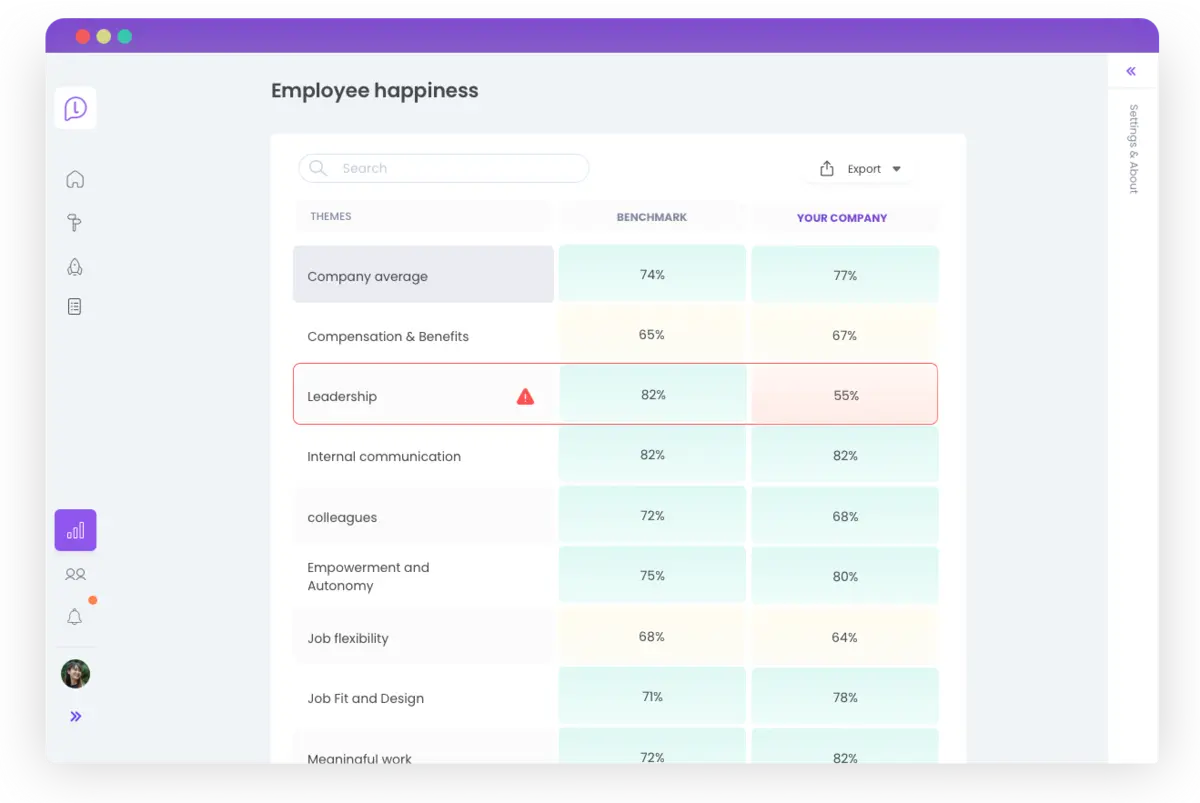
With Learned, you can measure employee satisfaction across various areas. This way, you know which results require action by comparing scores with similar organisations. With the Learned Engagement Model, all results are benchmarked against comparable organisations.
How do you interpret the results?
The interpretation depends on the context and the industry in which the company operates. Generally, an eNPS of +50 or higher can be considered excellent, while a score of -10 or lower indicates significant problems within the organisation. A positive eNPS indicates higher employee engagement and satisfaction, which can lead to improved performance and reduced staff turnover.
What can you do to improve the results?
You can take various actions to increase the eNPS and improve employee engagement. An effective approach is conducting additional employee satisfaction surveys (MTO) or pulse surveys. A pulse survey is a short and frequent survey specifically aimed at measuring employee engagement and satisfaction. It provides valuable insights into the current state of affairs and enables an HR team to take targeted actions. Below are some tips:
1. Communicate the results
Make sure you communicate the survey results to employees. Transparency in the process shows that their feedback is taken seriously and increases engagement in the improvement process.
2. Involve employees in creating action plans
Organise meetings or workshops to discuss results and possible improvements with employees. This increases engagement and gives employees a voice in the process. This way, you can create action plans together that align with employees' needs and concerns.
3. Improve work culture
Create a positive and supportive work environment where employees feel valued and heard. You can achieve this by encouraging open communication, recognising and rewarding achievements, and offering opportunities for professional growth and development.
4. Support employee wellbeing
Provide programmes and initiatives that promote employee wellbeing, such as flexible working hours, health and wellness programmes, and a good work-life balance. Employee wellbeing has a direct impact on their engagement and satisfaction.
5. Conduct regular follow-up surveys
Conduct regular pulse surveys to measure progress and evaluate whether the actions taken have been effective. This enables you to make adjustments and identify new areas for improvement. By conducting additional employee satisfaction surveys or pulse surveys, and taking targeted actions based on the results, you can increase the eNPS and improve employee engagement.
With Learned you can easily measure and improve the eNPS:
Learned is a tool that helps companies measure and improve the eNPS. With Learned, you can create and send surveys to employees, including the eNPS question and additional questions to gain insight into the underlying reasons for the scores. The tool also offers advanced analysis capabilities and reports to interpret results and formulate improvement actions. Try Learned free for 14 days and experience the ease of measuring and improving your eNPS.
Ontvang de nieuwste HR-tips
Krijg 1 keer per maand onze tips, e-guides en templates direct in je mail.

Related articles
Discover more about this topic