Last updated: 29 October 2026
This article is about the Dutch pay transparency act: the Dutch implementation of the EU Pay Transparency Directive.
In short
- The Dutch pay transparency act is the Dutch implementation of the EU Pay Transparency Directive (EU 2023/970).
- The target date was 1 January 2027, but that date no longer seems achievable. The Dutch House of Representatives will debate the bill in December 2026 and January 2027.
- Employers must be able to explain pay: in job vacancies, to employees who ask for it and, from 100 employees, in a gender pay gap report.
- If there is an unexplained pay gap of 5% or more that is not resolved within six months, a joint pay assessment follows.
- Delay does not mean cancellation. Organisations with 100 or more employees will report on 2027, so you need to record that data properly from the start of that year.
When does the Dutch pay transparency act take effect?
The bill (parliamentary paper 36949) has been with the Dutch House of Representatives since 21 May 2026. The government aimed for it to take effect on 1 January 2027. That date no longer seems achievable: the legislative committee meeting in the House is scheduled for 14 December 2026 and the plenary debate for 11 January 2027. After that, the Senate still has to consider the bill.
| Date | Step |
|---|---|
| 6 June 2023 | EU Pay Transparency Directive enters into force |
| 7 June 2026 | Deadline for transposition into national law |
| 21 May 2026 | Bill submitted to the House of Representatives |
| 14 December 2026 | Legislative committee meeting, House of Representatives (scheduled) |
| 11 January 2027 | Plenary debate, House of Representatives (scheduled) |
| After that | Senate review and entry into force |
Do not wait for the final date. A job framework, a well-founded salary structure and reliable pay data take months to set up. And the first reports will cover the year 2027.
We will update this page as soon as there is news about the bill.
What is the Dutch pay transparency act?
The Dutch pay transparency act aims to ensure equal pay for equal work or work of equal value, regardless of gender. Unequal pay was already prohibited, but in practice the gender pay gap persisted, partly because employees could not see whether they were paid fairly.
The act changes that at three moments: during recruitment, during employment and at organisational level. The core: employers must be able to explain how pay is determined, and back that up with objective, gender-neutral criteria.
What changes for employers?
Recruitment: salary up front and no questions about pay history
Applicants have the right to information about the starting salary or the pay range for the role. That information must be available before the job interview, for example in the vacancy. In addition, you may no longer ask applicants what they earned with their current or previous employer.
An objective job evaluation system
Pay must be based on a job evaluation and classification system with objective, gender-neutral criteria, such as skills, effort, responsibility and working conditions. A well-designed job framework with a salary structure is the foundation for this.
Transparent criteria for pay progression
Employers with 50 or more employees must make accessible the criteria that determine how employees progress in pay. Think of the rules for periodic increases, performance reviews and promotions.
Right to information for employees
Employees can request information about their own pay level and about the average pay level of colleagues doing equal work or work of equal value, broken down by gender. You do not have to share individual salaries of colleagues. You must inform employees of this right every year. Under the directive, you answer a request within two months.
Gender pay gap reporting
Employers with 100 or more employees must report on the gender pay gap. How often and from when depends on the size of the organisation (see the table below). Also read how to calculate the gender pay gap.
The 5% rule and the joint pay assessment
Does the report show a difference of 5% or more within a group of employees doing equal work or work of equal value, which you cannot objectively explain and do not resolve within six months? Then you must carry out a joint pay assessment together with employee representatives and take measures.
The burden of proof lies with the employer
If an employee makes a plausible case of unequal pay, the employer must prove that this is not so. That principle is already in the law, but becomes more important with the directive. Without documented criteria and well-founded decisions, your position is weak.
Who does the Dutch pay transparency act apply to?
Most obligations, such as the rules for recruitment and the right to information, apply to all employers. For reporting and the criteria for pay progression, it depends on size:
| Number of employees | What applies | First report |
|---|---|---|
| Fewer than 50 | Recruitment, job evaluation, right to information | No reporting obligation |
| 50 to 100 | In addition: criteria for pay progression accessible | No reporting obligation |
| 100 to 150 | In addition: gender pay gap report, once every three years | By 7 June 2031 (on 2030) |
| 150 to 250 | Gender pay gap report, once every three years | By 7 June 2028 (on 2027) |
| 250 or more | Gender pay gap report, every year | By 7 June 2028 (on 2027) |
What are the risks if you are not prepared?
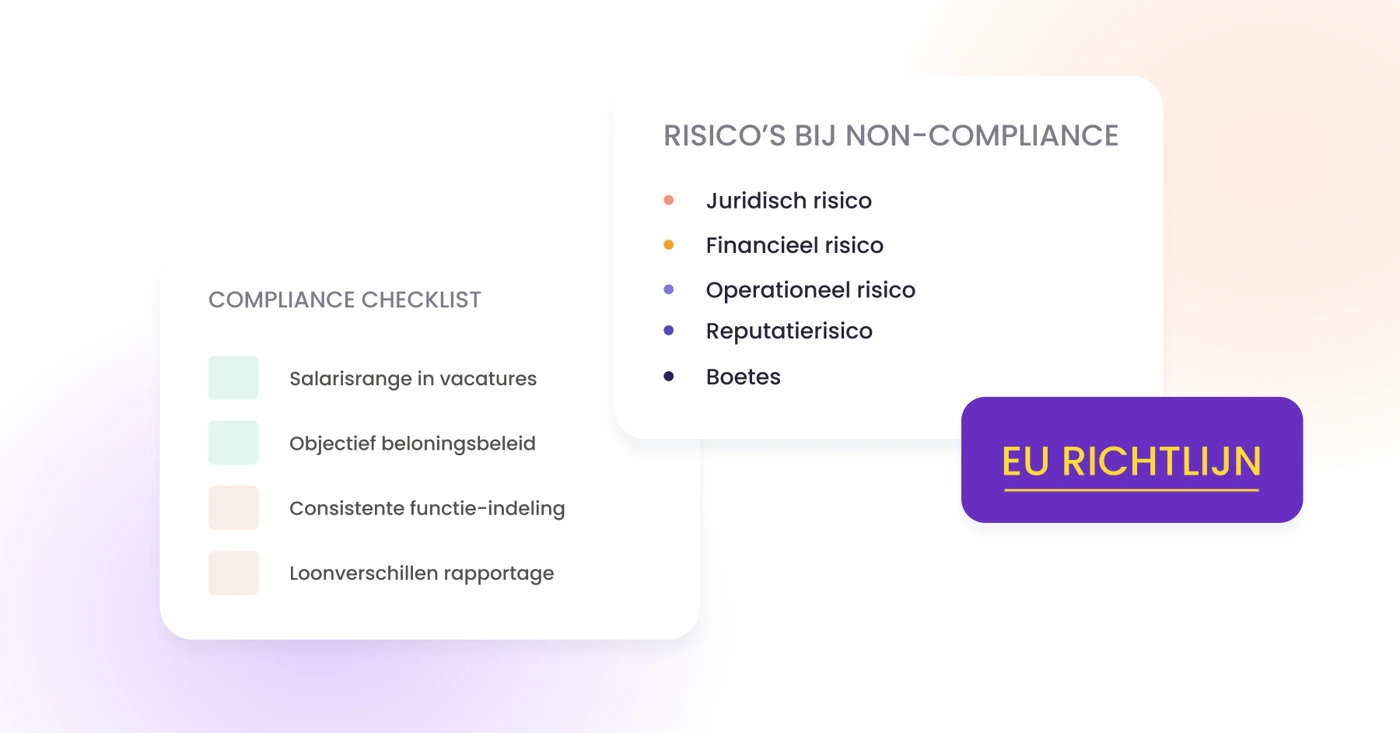
The biggest cost is not a fine, but correcting pay differences you cannot explain. An example calculation:
- An organisation with 500 employees has 250 employees in job groups with an unexplained difference of 5%.
- The average gross annual salary is € 55,000.
- 5% of € 55,000 is € 2,750 per employee per year.
- € 2,750 × 250 employees = € 687,500 per year in structural correction.
On top of that come possible claims from employees, who can demand missed pay retroactively, plus legal costs and internal hours.
The last word on enforcement and fines has not yet been said. In September 2026, MP Marjolein Moorman tabled an amendment to allow fines for employers who pay men and women unequally. Whether it will be adopted is not yet known.
Employee trust is also at stake. Research by Learned shows that 33% of employees think the colleagues with the loudest voice earn the most. And 77% are not yet familiar with the pay transparency act. As soon as salaries become more visible, it also becomes visible how strong or weak the system behind them is.
Step-by-step plan: how to prepare for the Dutch pay transparency act
Step 1. Map your roles
Make sure you have up-to-date job profiles with a clear level. Determine which roles are equal work or work of equal value. That is the basis for every comparison. Read how to create a job framework.
Step 2. Link roles to salary scales
Set a salary scale for each job level, based on job evaluation. That way you can explain why someone falls into a particular scale. Read how to build a salary structure in seven steps.
Step 3. Document your pay rules
Write down how you place new hires in a scale, how employees progress within their scale and how you handle allowances, bonuses and exceptions. Agree who may deviate and how that is recorded.
Step 4. Calculate your gender pay gap per job group
Measure the difference between men and women per group doing equal work or work of equal value, including variable pay. For every difference of 5% or more, look for an objective explanation and record it.
Step 5. Set up your processes
Include a salary indication in every vacancy, remove questions about pay history from your application process and agree how you handle employee requests for pay information, within the deadline and with attention to privacy.
Step 6. Make performance reviews objective
Pay progression is often linked to performance reviews. Make sure they are based on criteria set in advance and compare them across teams, for example in a calibration session. That way you prevent the loudest voice from winning.
Are you ready for the Dutch pay transparency act?
Want to know where your organisation stands? Complete the risk assessment and see right away which areas are in order and where the biggest risks are. Or see how Learned makes pay transparency and equal pay visible.
Frequently asked questions about the Dutch pay transparency act
When does the Dutch pay transparency act take effect?
The target date was 1 January 2027, but that date does not seem achievable. The House of Representatives will debate the bill in December 2026 and January 2027, followed by the Senate. A new date is not yet known.
Has the Dutch pay transparency act been postponed?
Implementation is delayed compared to the European deadline of 7 June 2026. Delay does not mean cancellation: the directive requires the Netherlands to introduce the rules.
Does the act also apply to small employers?
Yes. The rules for recruitment, job evaluation and the right to information apply to all employers. The reporting obligation applies from 100 employees, and the obligation to make criteria for pay progression accessible from 50 employees.
Do I have to make employee salaries public?
No. Individual salaries remain private. Employees do have the right to information about their own pay and about the average pay level of colleagues doing equal work or work of equal value, broken down by gender.
Can I still ask applicants about their salary?
You may no longer ask applicants about their current or previous salary. You must, however, inform them in advance about the starting salary or the pay range for the role.
What is the 5% rule?
Is there a pay difference of 5% or more between men and women within a group of employees doing equal work or work of equal value, which you cannot objectively explain and do not resolve within six months? Then a joint pay assessment with employee representatives follows.
What is the difference between the EU directive and the Dutch pay transparency act?
The EU Pay Transparency Directive (EU 2023/970) sets the rules for all EU countries. The Dutch pay transparency act is the Dutch implementation, including the exact thresholds and reporting dates.
What should I do now?
Get your roles and salary scales in order, document your pay rules and calculate your gender pay gap per job group. Organisations with 100 or more employees must also make sure their pay data for 2027 is complete and reliable.
This page provides general information and is not legal advice. The bill may still change during its review by the House of Representatives and the Senate.
Step-by-step plan: how to become compliant with the Pay Transparency Act
Step 1. Put your compensation rules in writing
Document per job group what the salary range/scale is and what rules apply for classification, growth, allowances and bonuses. Also agree on who may deviate from the range and how such exceptions are justified and documented.
Step 2. Make jobs comparable
Update your job profiles and link each role to a level and a salary scale. Document which roles you compare as equal (or equivalent) work.
Step 3. Check your biggest risks with a pay gap analysis
Measure pay differences per job group and include allowances and bonuses. Check where you're approaching or exceeding 5% and note per difference whether you have an objective explanation.
Step 4. Set up transparency processes
Ensure that job postings always have a salary range ready before the first interview and remove questions about salary history from your scripts and templates. Also set up one fixed process for employee pay inquiries: who provides what information, within what timeframe, and how do you ensure privacy/GDPR compliance.
Step 5. Create a plan for corrective measures
If differences cannot be objectively explained, document what you're correcting, when, and with what budget. Assign an owner, plan evaluation moments, and document decisions.
Are you ready for the Pay Transparency Act?
Want to know where your organization currently stands? The Pay Transparency risk assessment is a useful first step. You'll see at a glance what's already in order, where you're at risk, and what needs attention first.
👉 Curious if you're ready for the Pay Transparency Act? Take the risk assessment
FAQ Pay Transparency Act
What must you have arranged as an employer by January 1, 2027?
Ensure your compensation decisions are explainable and demonstrable. This means: roles and levels are clearly classified, salary scales are fixed, compensation criteria are objective and consistently applied, and you can measure and explain pay differences per job group.
What is the 5% rule in the Pay Transparency Act?
If within equal work there is a pay gap of more than 5% that you cannot objectively explain, you must take measures.
Who does the reporting obligation apply to?
The reporting obligation applies to employers with 100 or more employees. For organizations with 250+ employees reporting is annual, and for 100-249 employees it is every three years.
Ontvang de nieuwste HR-tips
Krijg 1 keer per maand onze tips, e-guides en templates direct in je mail.

Related articles
Discover more about this topic