
Last updated: 14 October 2026
A salary structure is an overview of the salary bands within an organisation, linked to job grades or job levels. Each salary band has a minimum and maximum amount and sets out the range within which employees can be paid. A well-designed salary structure establishes how roles, responsibilities and pay relate to one another. This helps you make better-informed salary decisions and explain differences in pay.
With the Dutch pay transparency bill, providing a clear rationale is becoming increasingly important. Employers need to prepare for stricter requirements regarding job evaluation, salary information and equal pay. But how do you determine appropriate salary bands, what role does your job architecture play, and how do you prevent unexplained pay differences? This guide explains how to develop a salary structure in seven steps, including a practical example for an organisation with 120 employees.
What is a salary structure?
A salary structure is a coherent framework of salary bands that an organisation uses to define the remuneration associated with different roles or job grades. It shows how salaries are structured, what differences exist between roles and how employees can progress within a salary band.
A salary structure typically includes an overview of job grades, salary ranges and rules for salary placement and progression. For each band, you set a minimum and maximum, optionally including a midpoint. You also determine when employees are eligible for a salary increase and how to handle promotions or exceptions.
The aim is not to give every employee in the same role exactly the same salary. However, you must be able to explain why employees are paid differently and which objective criteria inform those differences.
What is the difference between a salary structure and a pay structure?
In practice, the terms salary structure and pay structure often mean the same thing: a structured overview of salary bands within an organisation. Some employers use the term pay structure for a formal salary framework set out in a collective labour agreement (CAO), while other organisations refer to a salary structure.
There is no universally prescribed distinction. What matters more is that the structure makes clear which roles fall within which salary bands and how the salary ranges are determined.
What is the difference between job architecture and a salary structure?
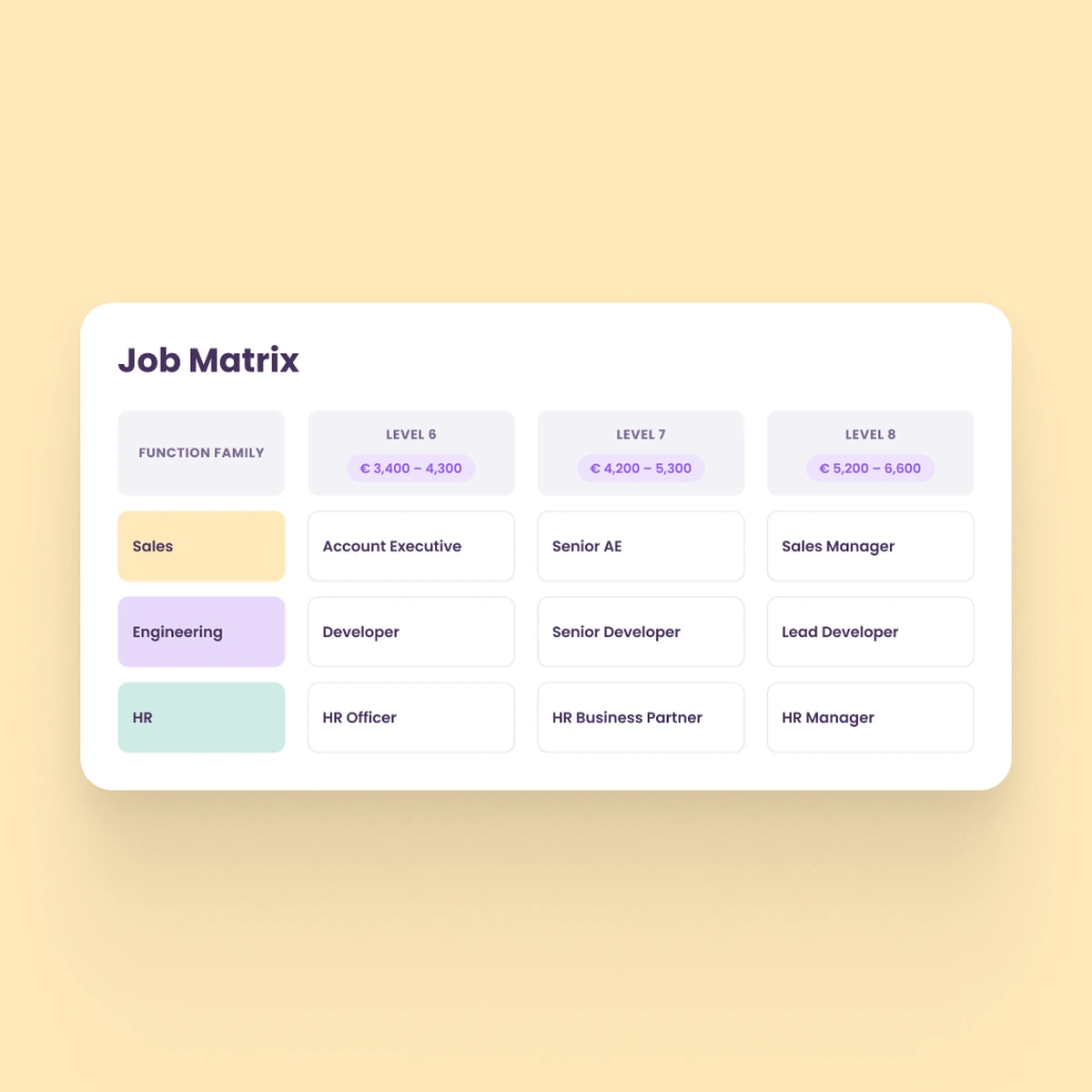
Job architecture describes which roles exist within the organisation, the responsibilities associated with them and how roles are classified into families and levels. The salary structure then links appropriate salary ranges to that classification.
Suppose your organisation has an HR Administrator, an HR Adviser and a Senior HR Business Partner. The job architecture describes the differences in the scope and responsibilities of these roles. Job evaluation determines their relative weight, after which you assign them to the appropriate salary bands.
Job architecture therefore forms the underlying basis for your salary structure. The process follows four steps:
Why establish a salary structure now? Pay transparency legislation
A well-founded salary structure helps employers prepare for the new requirements on equal pay and pay transparency. The European Pay Transparency Directive aims to better safeguard the principle of equal pay for men and women for equal work or work of equal value.
The Netherlands is working to implement this directive. The bill was submitted to the Tweede Kamer on 21 May 2026. According to Tweede Kamer dossier 36.949, the parliamentary process has not yet been completed. Rendement reported on 22 September 2026 that the plenary debate is scheduled for week 50 of 2026 and week 2 of 2027. As the Eerste Kamer must also approve the bill afterwards, the intended commencement date of 1 January 2027 no longer appears feasible. A postponement to 1 July 2027 or 1 January 2028 is possible, but no final decision has yet been made.
Please note: as of 14 October 2026, the legislation has not yet been passed. The obligations and reporting dates below are based on the bill and may still change.
From our Nationaal Werkgeversrapport 2026
Commissioned by Learned, Norstat surveyed 1,012 employees at Dutch organisations with more than 50 employees. 47 per cent of them are unaware of the pay transparency legislation. And one in three employees (33 per cent) says that colleagues who shout the loudest receive the highest salaries. Employers therefore have work to do: soon, they will need to be able to explain not only salaries, but also the system behind them. Read the full Nationaal Werkgeversrapport 2026.
What is changing for employers?
The bill includes several obligations that directly affect how organisations document jobs and salaries. Among other things, employers must have an objective, gender-neutral system for job evaluation and classification. Applicants must also receive timely information about the starting salary or salary range, and employers may not ask about their salary history.
Employees will also gain broader rights to information about pay criteria and pay levels. For employers with 50 or more employees, additional requirements are proposed concerning the accessibility of pay progression criteria. Larger employers will also be required to report on pay differences between men and women.
A salary structure helps you record this information in a structured way. You can clarify which jobs are comparable, which salary ranges apply to them and which rules govern employees' progression within their salary band.
Which obligations apply to each organisation size?
Not every employer will face the same reporting obligations. The bill distinguishes between different organisation sizes, with the number of employees determined under the proposed methodology using annual work units for the previous year.
| Number of employees | Pay progression criteria accessible | Pay gap reporting | First report |
|---|---|---|---|
| Fewer than 50 | No separate obligation for pay progression | No | Not applicable |
| 50 to 99 | Yes | No | Not applicable |
| 100 to 149 | Yes | Every 3 years | By 7 June 2031, covering 2030 |
| 150 to 249 | Yes | Every 3 years | By 7 June 2028, covering 2027 |
| 250 or more | Yes | Annually | By 7 June 2028, covering 2027 |
Source: VDT Advocaten, Pay transparency for 50, 100, 150 or 250 employees, September 2026. Based on the current bill; the final rules may still change.
The principle of equal pay for equal work or work of equal value remains relevant for smaller employers too. The absence of a reporting obligation does not mean that unexplained pay differences do not warrant attention. Under the bill, employers with fewer than 50 employees will also face general obligations regarding pay transparency and objective job classification.
Want to know exactly what the bill entails? Read our in-depth blog on pay transparency legislation, or watch our webinar on pay transparency legislation.
Prepare your organisation for pay transparency
Do you already know which elements of your job architecture, salary structure and remuneration policy are in order? Use the pay transparency legislation checklist to identify the steps your organisation still needs to take.
Step 1. Get your job architecture in order
A sound salary structure starts with an up-to-date job architecture that clearly defines which roles exist, what their responsibilities are and how they relate to one another. Without this foundation, you risk building salary bands around existing pay differences rather than the intrinsic value of the work.
Start by mapping all roles within the organisation. Gather existing job profiles and check whether they still reflect day-to-day practice. Consider the purpose of each role, its key responsibilities, the knowledge and skills required, decision-making authority and the complexity of the work.
The next step is to organise roles into logical job families and levels. Examples include Sales, Finance, HR and Operations, with different levels for operational, autonomous, specialist and strategic roles.
Do not base this classification solely on job titles. A Senior Specialist role may carry greater weight than a Team Manager role, depending on its responsibilities and complexity. By focusing on job content, you create a stronger foundation for a fair salary structure.
Outcome: an up-to-date overview of roles, job families and levels that you can use for job evaluation.
Do you still need a clear job structure? Read how to create a job architecture in eight steps →, including an example of a job matrix.
Step 2. Assess roles using job evaluation
Job evaluation determines the relative weight of roles based on predefined, objective and gender-neutral criteria. These include the skills, effort, responsibilities and working conditions required.
You can use an established method, such as ORBA or Hay, or a carefully substantiated points-based system of your own. The chosen method must be applied consistently and align with any applicable collective labour agreement (CAO) provisions.
The aim is to be able to explain why one role is given greater weight than another. The outcome forms the basis for assigning roles to comparable job grades.
Our guide to creating a job architecture explains in more detail how job evaluation works and which methods you can use. Would you like to see how this works in practice? Watch our on-demand webinar Transparent job evaluation and remuneration.
Result: a substantiated comparison of the relative weight of roles.
Step 3. Create job grades
Job grades consist of roles that are comparable in terms of their job weight. Following job evaluation, you can determine which roles belong in the same grade and therefore qualify for the same salary range.
A job grade is not the same as a job family. The HR job family, for example, may include several job grades, while an HR role and a Finance role may fall within the same grade based on their job evaluation.
This distinction is important. When each department develops its own salary structure, unnecessary differences can arise between roles of equivalent value. Establishing job grades across the organisation makes it easier to compare roles.
How many job grades do you need?
There is no fixed number of job grades that suits every organisation. The number depends on the diversity of roles and the differences in job weight.
Too few job grades can result in roles with significantly different responsibilities being placed in the same salary band. Too many grades make the salary structure complex and can lead to discussions about minor differences.
Only create a separate grade if you can substantiate the difference in job weight. Then check whether the classification makes sense and can be explained clearly to HR, managers and employees.
Result: an overview of job grades that bring together roles of comparable weight.
Step 4. Define a salary band for each job grade
A salary band describes the salary range associated with a job grade. It usually consists of a minimum, midpoint and maximum, making it clear within which limits pay can progress.
The lower limit is the lowest standard salary within the band, taking statutory requirements and collective labour agreement (CAO) provisions into account. The maximum forms the upper limit. The midpoint is a reference point that you can link to full proficiency in the role, for example.
The meaning you assign to the midpoint is a policy choice. Document that choice so that managers interpret the band consistently.
How do you determine the width of a salary band?
The band width is the difference between the minimum and maximum of a salary band. You can express it in euros or calculate it as a percentage.
Band width (€) = maximum salary − minimum salary.
A wide salary band gives employees relatively significant scope for pay progression without moving to a different job grade. A narrower band makes it clearer when a move to a role with greater responsibility or complexity is needed, but offers less scope for salary progression within the same role.
The right width depends on your remuneration policy, differences between roles, market data and any collective labour agreement (CAO) provisions. Above all, ensure that the chosen ranges are consistent and that you can explain why certain job grades offer more scope for salary progression than others.
Can salary bands overlap?
Yes, salary bands can overlap. This means that someone near the top of a lower band may earn more than an employee who is just starting in a higher band.
This is not necessarily wrong. Differences may, for example, relate to relevant experience, proficiency in the role or other objective pay criteria. However, you must be able to explain why the difference exists.
You should therefore document how employees are placed within salary bands, when they progress and what happens when they are promoted. This prevents salary decisions from depending on individual negotiations.
Do not overlook other pay components
A salary structure often focuses on fixed base salary, but a comprehensive remuneration policy must also take other pay components into account. These include variable pay, allowances and additional payments.
You should therefore make it clear whether your salary bands refer to gross monthly or annual salaries, what full-time working hours you use and whether holiday allowance is included. Use the same definitions for all roles so that the amounts remain comparable.
Result: a provisional salary range for each job grade.
Step 5. Compare your salary bands with the market and your collective labour agreement (CAO)
Market data and collective labour agreement (CAO) provisions help you assess whether the proposed salary bands are appropriate and practical. Job evaluation determines the relative weight of roles; market data shows how comparable work is rewarded outside your organisation.
For a reliable comparison, you can use salary benchmarks, sector-specific pay surveys, collective labour agreement (CAO) pay tables and up-to-date recruitment data. However, check that you are assessing genuinely comparable roles. A job title alone does not tell you everything about responsibilities, complexity or the expertise required.
Also consider differences in sector, region, organisation size and working hours. The definition of salary matters too: you cannot directly compare a gross annual salary including variable pay with a gross monthly salary excluding allowances without making adjustments.
What if your organisation is covered by a collective labour agreement (CAO)?
Where a collective labour agreement (CAO) applies, you need to check which provisions govern job classification, job evaluation and salary bands. A collective labour agreement (CAO) may, for example, include prescribed job grades, pay tables and rules for periodic pay increases.
Your salary structure must comply with the applicable collective labour agreement (CAO). Check whether there is scope for additional arrangements and under what conditions. Introducing an entirely bespoke salary structure without checking this first is not advisable.
What should you do if the market pays more?
Sometimes, certain roles command higher pay in the labour market than your own salary bands allow. In that case, investigate whether the band needs adjusting, whether the role profile is still accurate or whether an exception policy is necessary.
Establish organisation-wide arrangements for this. If managers can make individual salary exceptions, there is a risk that comparable employees will be paid differently without clear justification.
Document when exceptions are permitted, who must approve them and how you will review them. This allows you to account for labour market developments without compromising the consistency of your salary structure.
Result: salary bands that are both internally justified and externally validated.
Step 6. Define how employees progress within their salary band
A salary structure is only complete when it is clear how employees are placed within it and which criteria determine their salary progression. Alongside the salary amounts, you therefore need to set out rules for starting salaries, incremental increases, performance-related increases and promotions.
Salary placement on joining
Decide in advance which criteria you will use to determine a new employee's starting salary. Consider relevant work experience, demonstrable proficiency in the role and specific knowledge required for the position.
Apply these criteria consistently. Under the Dutch pay transparency bill, employers will also be prohibited from asking applicants about their previous salary. This makes it even more important to be able to justify a salary offer based on the role and its associated salary range.
Progression through increments or performance
Under an incremental pay system, salaries increase in predefined steps. The conditions may be set out in a collective labour agreement (CAO) or an internal remuneration policy. The advantage is that employees can better predict how their salary will develop.
You can also link salary progression to performance or proficiency in the role. If you do, ensure that assessment criteria are clear and that managers apply them consistently. A subjective impression alone is not a sufficient basis for a salary decision that can be clearly explained.
Some organisations opt for a combination of incremental and performance-related increases. In that case, distinguish between general salary adjustments, individual development and promotions.
Prevent negotiation from determining who progresses
If salary progression depends primarily on who asks for it, inequality arises. Our Nationaal Werkgeversrapport 2026 shows that 23 per cent of women find it difficult to ask for a higher salary, compared with 16 per cent of men. This means that performance is not the only factor: confidence, timing and self-presentation also count. Fixed criteria for salary progression make remuneration less dependent on negotiation, helping to prevent a pay gap.
Make the criteria accessible
The Dutch pay transparency bill includes additional obligations for employers with 50 or more employees to make pay progression criteria accessible. This requires more than an internal spreadsheet that only HR can access.
Use plain language to explain how employees are placed within the salary structure, which conditions apply to salary progression and how promotions are assessed. Also ensure that managers provide consistent explanations and that decisions are documented.
This is not an unnecessary luxury: in our research, 28 per cent of employees say that their hard work is not reflected in their salary or remuneration.
"Employees want criteria, not vague promises."
A transparent remuneration policy does not mean that every employee automatically receives an increase. However, it must be clear which rules the organisation applies and why a particular decision is made.
Result: a consistent approach to salary placement and progression.
Step 7. Assess your salary structure for the pay gap
A salary structure must be checked for unexplained pay differences between men and women performing the same work or work of equal value. A salary structure may be consistent on paper, while differences still exist in practice between employees within the same job grade.
It is therefore important to analyse the gender pay gap regularly.
What is the gender pay gap?
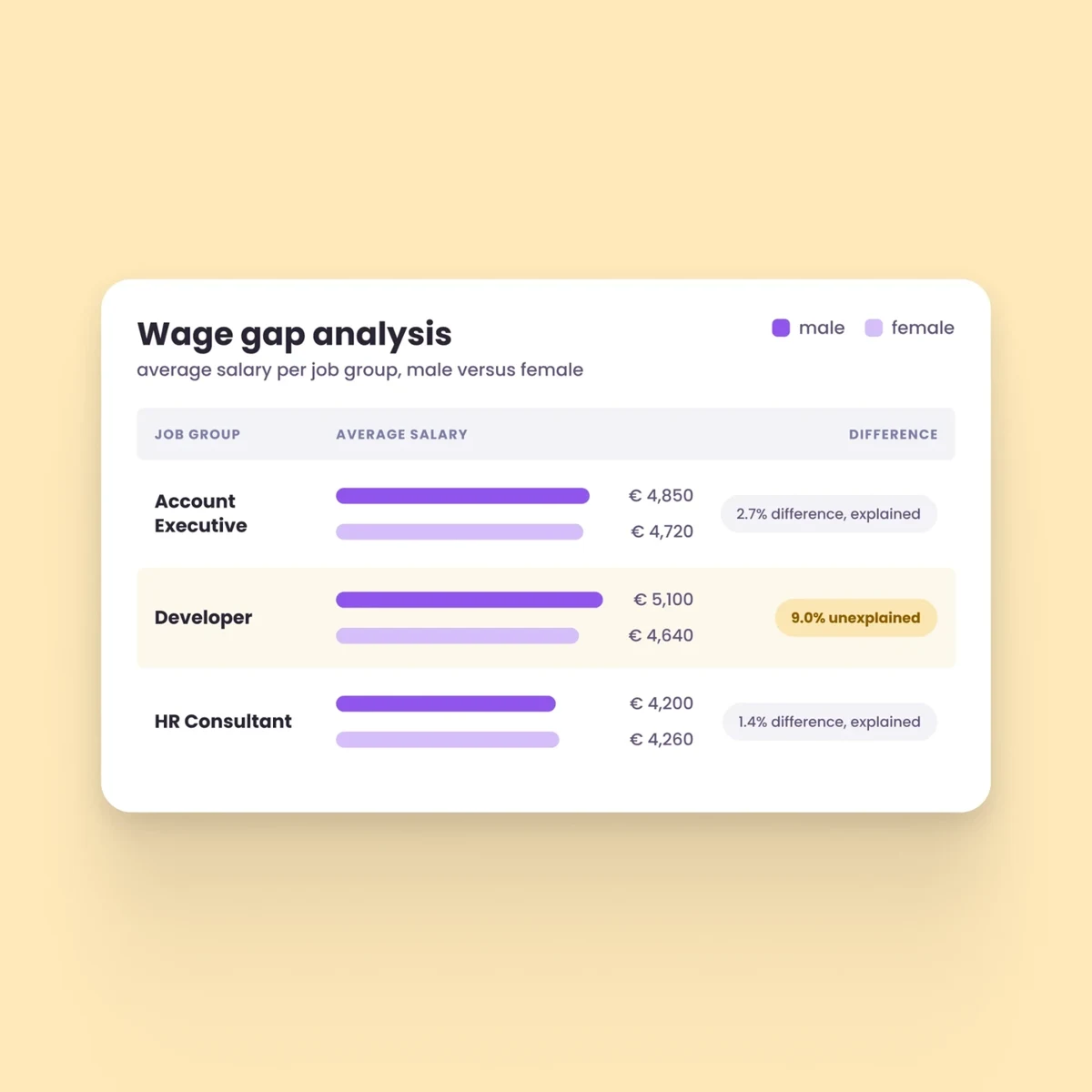
The gender pay gap describes the difference in average pay between men and women. An unadjusted pay gap compares these averages without fully accounting for factors such as differences in roles.
When assessing equal pay, an analysis by category of the same work or work of equal value is more important than the organisation-wide average alone. This involves examining the extent to which differences can be explained by objective, gender-neutral criteria.
A statistical explanation does not, however, automatically mean that a pay difference is legally justified. The criteria used must be substantively relevant and defensible.
How do you calculate the pay gap by job grade?
Start by collecting reliable pay data and make sure you examine comparable components. Where necessary, adjust for differences in working hours and compare employees within the same category of the same work or work of equal value.
Then calculate the average pay of men and women. A commonly used formula is:
Pay difference (%) = (average pay of men − average pay of women) / average pay of men × 100%.
Next, investigate which differences may stem from objective factors, such as relevant experience, proficiency in the role or other demonstrable job-related criteria.
What does the 5% threshold mean?
The bill includes a provision for a joint pay assessment where an employer's mandatory reporting identifies a difference of at least 5% in average pay within a category of employees that cannot be justified on the basis of objective, gender-neutral criteria and is not remedied within six months.
This provision is linked to the applicable reporting requirements. A measured difference of 5% therefore does not automatically trigger a joint pay assessment in every situation.
Even if your organisation is not subject to mandatory reporting, it is still advisable to investigate unexplained differences. Check whether employees have been assigned to the correct grades, whether salary rules are applied consistently and whether adjustments are needed.
Would you like to know more about the calculation and possible causes? Read our in-depth blog on the pay gap.
Result: insight into pay differences and an evidence-based approach to correcting unexplained discrepancies.
Example: a salary structure for an organisation with 120 employees
An organisation with 120 employees might, for example, use six job grades, each with its own salary range. In the fictional example below, the organisation has roles within Sales, Finance, HR, Marketing and Operations.
The roles are first organised into a job architecture and then evaluated according to their relative demands and responsibilities. Six job grades are established on this basis. Each grade is assigned a salary band with a minimum, midpoint and maximum.
To illustrate what such a salary structure looks like, we use actual salary figures from the cao Gemeenten 2025-2027, effective from 1 July 2026. We have chosen this collective labour agreement (CAO) because its salary bands are publicly available and easy to compare, not because the example organisation is a municipality. The example roles are fictional and serve solely to illustrate how you can combine roles and salary bands.
Example of a salary structure
| Job grade | Example roles | Minimum | Midpoint | Maximum |
|---|---|---|---|---|
| A: Support | Administrative Employee, HR Support | € 2.496 | € 2.956 | € 3.416 |
| B: Operational | Sales Support, Finance Employee | € 2.596 | € 3.170 | € 3.743 |
| C: Autonomous professional | Account Manager, HR Adviser | € 3.246 | € 3.901 | € 4.556 |
| D: Senior professional | Senior Controller, Senior Account Manager | € 3.824 | € 4.724 | € 5.624 |
| E: Specialist or tactical | Finance Manager, Senior HR Business Partner | € 5.369 | € 6.311 | € 7.253 |
| F: Strategic | HR Director, Finance Director | € 6.762 | € 8.074 | € 9.385 |
Source: cao Gemeenten 2025-2027 salary table (Article 3.3), effective from 1 July 2026. Salary bands 4, 6, 8, 10, 12 and 15 of the collective labour agreement (CAO) have been used as the basis for the six grades respectively. The midpoint is the arithmetic mean of the minimum and maximum, rounded to whole euros.
The amounts are gross monthly salaries based on a 36-hour working week, excluding holiday allowance. Grade A takes account of the minimum under the collective labour agreement (CAO) of € 16 per hour, equivalent to € 2.496 per month. The role classifications are fictional and do not constitute an official classification under the collective labour agreement (CAO) or salary advice.
How can you use this example?
You can see that the salary bands partially overlap. An employee at the top of band C may, for example, earn more than someone just starting in band D. This is not automatically a problem, provided you can justify why the difference exists.
The table also shows that you do not need a separate salary band for every role. Roles from different departments can fall within the same grade when their demands and responsibilities are comparable.
Start with the job grades resulting from your own job evaluation. Then check which roles fall within each grade and whether the classification accurately reflects their demands and responsibilities. Next, use reliable market data or relevant collective labour agreement (CAO) tables to determine the salary ranges.
Define the minimum, midpoint and maximum for each grade and check that the bands align logically. Also consider the overlap between adjacent bands. This can be a deliberate part of your policy, but it must be consistent with the rules for salary band placement, progression and promotion.
What if existing salaries fall outside the band?
When you compare the new salary structure with current salaries, discrepancies may emerge. Some employees earn less than the lower limit of their band, while others are already above the maximum.
First, investigate the reasons for these differences. Check whether the role has been classified correctly, what agreements are in place and whether an adjustment is necessary. Take account of contractual rights, provisions of the collective labour agreement (CAO) and the principle of equal pay.
For employees above the maximum, you could consider a transitional arrangement, subject to certain conditions. Clearly document how you will handle future increases and ensure that exceptions do not persist without justification.
A salary structure is therefore not just an overview of figures, but also a tool for systematically assessing existing pay practices.
From salary structure to remuneration policy and salary review cycle
A salary structure sets out how salaries are organised; the remuneration policy determines how you apply that structure in practice. It defines how employees are placed within salary bands, when they may receive an increase and which rules apply to promotions or exceptions.
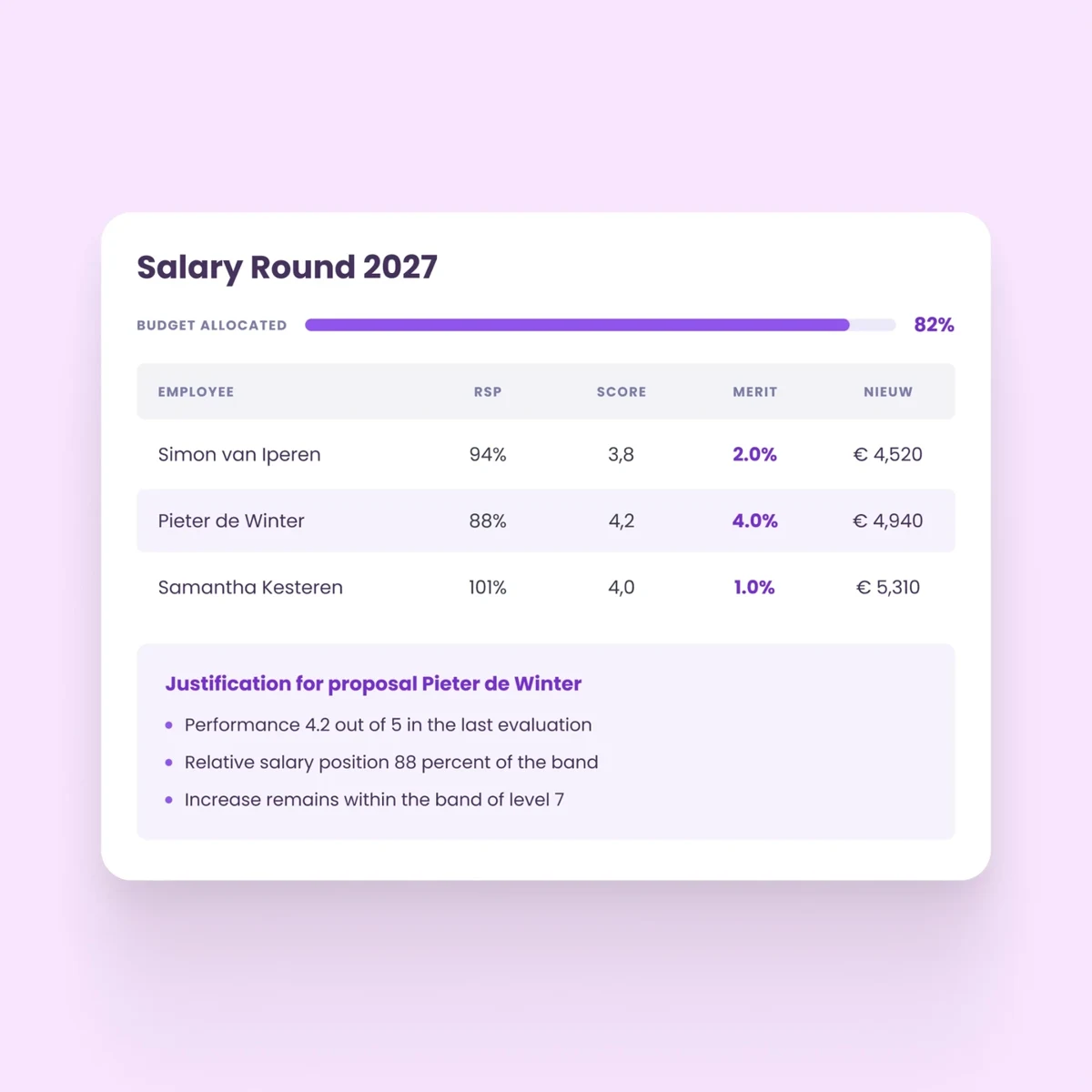
A sound remuneration policy includes provisions for starting salaries, incremental increases, performance-related increases, variable pay and the annual salary review cycle. It also sets out who is authorised to make decisions, how exceptions are approved and how you check that the rules are applied consistently.
How do you use the salary structure during the salary review cycle?
During the annual salary review cycle, you compare current salaries with the applicable salary bands. You then determine which employees are eligible for an increase and how the proposed adjustments fit within the available budget.
Check whether managers are using comparable criteria and whether the increases create new, unexplained pay differences. By recording decisions centrally, you can trace why a salary was adjusted at a later date.
Read also how to organise a compensation review cycle → in a structured way.
The role of compensation and benefits
A salary structure is part of compensation and benefits: the full set of arrangements covering salary, variable pay and other terms and conditions of employment. Base salary should therefore align with the wider remuneration policy, including arrangements for bonuses, pensions and additional allowances.
Make clear which elements are included in the salary bands and which are managed separately. This helps you compare total remuneration packages fairly and consistently.
Managing a salary structure with software
Salary structure software helps you manage job grades, salary ranges and related data centrally. As organisations grow, it becomes increasingly difficult to track different salary bands, exceptions and changes in separate spreadsheets.
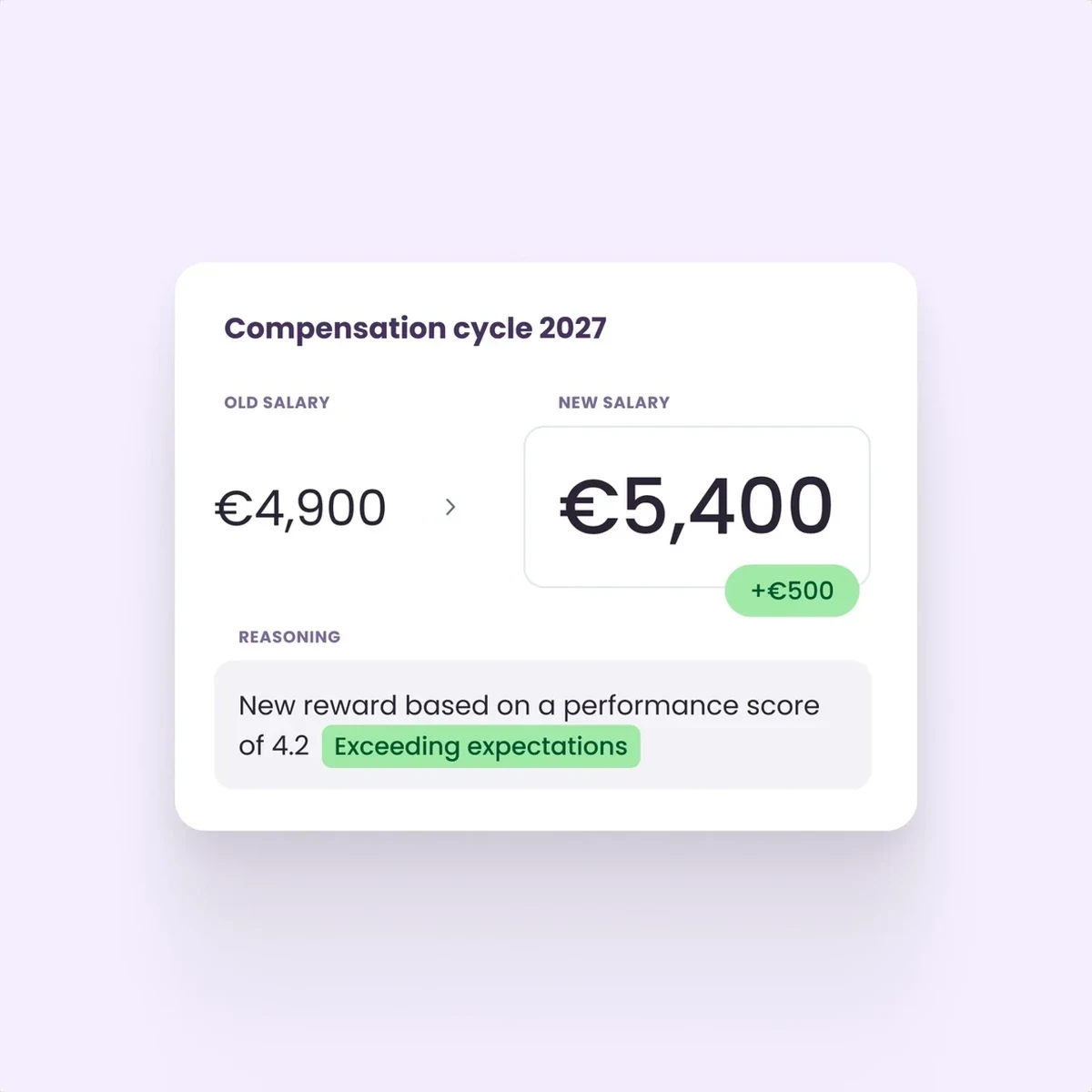
A central overview makes it clear which roles belong to which job grades and which salary ranges apply. You can also maintain the link with job profiles and job levels when roles or responsibilities change.
Connecting job architecture and salary structure
With Learned's salary structure software, you can connect your salary structure to the roles and levels within your organisation.
This creates a coherent overview in which job classification forms the basis for salary bands. It helps HR and managers understand the structure and coordinate changes more effectively.
From salary structure to remuneration decisions
As well as managing salary ranges, you need insight into how employees are actually remunerated. This includes current salaries, positions within salary bands, pay differences and proposed salary increases.
With Learned's remuneration software, you can analyse remuneration data and prepare salary decisions in a more structured way. This connects your job architecture, salary structure and annual remuneration cycle.
The aim is not to automate remuneration decisions entirely, but to support HR and managers with reliable information and clear decision-making criteria.
Frequently asked questions about the salary structure
Is a salary structure mandatory?
Not every Dutch employer is specifically required to have a document called a 'salary structure'. However, collective labour agreement (CAO) provisions may set requirements for salary bands and job classification. In addition, the Dutch pay transparency bill includes obligations for objective, gender-neutral job evaluation and classification.
What is the difference between a salary structure and CAO salary bands?
A salary structure provides a complete overview of how pay is organised within an organisation. CAO salary bands are salary bands established under a collective labour agreement (CAO). Where a CAO applies, your salary structure must comply with the applicable CAO provisions.
How many salary bands do you need?
The number of salary bands depends on job evaluation and differences in job size within your organisation. There is no mandatory or ideal number. Above all, make sure you can substantiate the classification and the differences between bands.
Do you have to share salary bands with employees?
The Dutch pay transparency bill provides for more extensive disclosure obligations regarding pay criteria and pay levels. This does not mean that all individual salaries must be made public. However, employers must be able to explain more clearly how roles are remunerated and which criteria apply.
What should you do if someone's salary exceeds the band maximum?
First, check whether the role has been classified correctly and why the salary exceeds the band maximum. You can then explore an appropriate transitional arrangement, taking into account existing contractual rights, CAO provisions and equal pay. Document how future salary increases will be handled.
Conclusion: a sound salary structure starts with the value of roles
Developing a salary structure starts with a clear job architecture and objective job evaluation. By then linking roles to appropriate salary bands and transparent rules for salary progression, you create a pay structure that is easier to explain and manage. This also lays an important foundation for preparing for the Dutch pay transparency legislation.
Would you like to gain insight into your salary structure and pay differences?
Discover how to connect your job architecture, salary structure and pay policy.
Schedule a demoOntvang de nieuwste HR-tips
Krijg 1 keer per maand onze tips, e-guides en templates direct in je mail.

Related articles
Discover more about this topic