

In the rapidly evolving labor market, setting development goals within an organization is of crucial importance. It forms the core of individual growth, team development and achieving broader organizational objectives. In this blog, we will delve deeper into the importance of development goals, how they can be established within an organization and the benefits they bring for both employees and the organization as a whole. Development goals are important to ensure employee engagement. Many employees want to have a goal to work towards.
The importance of development goals
Development goals are objectives that individuals or teams set to improve their skills, knowledge and performance. These goals play a crucial role in promoting growth, innovation and success. Here are some reasons why development goals within an organization are essential:
- Direction and focus: Development goals provide clear direction and focus for employees. They define what needs to be achieved and help set priorities.
- Personal growth: Setting development goals encourages employees to continuously learn and grow. This contributes to their professional development and expands their skills.
- Team development: Development goals can also focus on improving team performance. They promote collaboration and help build a stronger and more cohesive team.
- Supporting organizational goals: Development goals must be aligned with the broader objectives of the organization. In this way, they contribute to realizing the company's strategic vision.
Setting effective goals
Formulating effective development goals for an organization is a crucial step in promoting growth, improvement and success. Here are four important steps to achieve this:
- Analyze the current situation: Start with a thorough analysis of the current state of the organization. This includes assessing strengths, weaknesses, opportunities and threats (SWOT analysis). By getting a clear picture of where the organization stands, you can better understand which areas need development.
- Determine strategic objectives: Identify the long-term goals and strategic priorities of the organization. What does the organization want to achieve in the coming years? These objectives may relate to growth, profitability, market share, customer satisfaction or other key performance indicators.
- Connect development goals with strategic goals: Ensure that the organization's development goals are closely aligned with strategic objectives. This means the goals should contribute to realizing the overarching vision and mission of the organization.
- Formulate SMART goals: Formulating development goals using the SMART framework provides clarity and precision to the organization's objectives. By making a goal Specific, Measurable, Acceptable, Realistic and Time-bound, expectations and the path to success are clearly defined.
Developing effective development goals for an organization thus requires a thorough analysis, a strong connection with strategic goals and the formulation of measurable objectives. These goals should enable the organization to realize its vision and adapt to changing market conditions.
Examples of development goals
Setting development goals is a powerful tool for stimulating both personal and professional growth. To formulate effective development goals, the SMART framework can be a valuable tool. SMART stands for Specific, Measurable, Acceptable, Realistic and Time-bound, and it helps make goals concrete and achievable. Here are some examples of SMART development goals:
1. Improving Time Management
Time management is of great importance because it helps to work more efficiently, reduce stress and increase personal productivity. Good time management enables individuals to manage their tasks more effectively and find a better balance between work and private life.
Example: Reduce the time spent daily on email communication from two to one hour per day.
2. Leadership Development
Leadership development is essential because competent leaders are crucial for inspiring and leading teams to success. It improves performance, promotes a positive corporate culture and increases the likelihood of achieving organizational objectives.
Example: Increase team satisfaction by 10% through monthly feedback sessions and improvements based on feedback.
3. Personal Growth
Personal growth is of crucial importance because it enables individuals to increase their skills, knowledge and self-awareness, leading to a better quality of life and more career opportunities. It stimulates self-improvement, resilience and greater personal satisfaction.
Example: Expand knowledge in digital marketing by completing an online course and obtaining a certificate within four months.
4. Project Management
Project management is essential because it enables organizations to work more efficiently and effectively when planning, executing and completing projects. Good project management improves project outcomes, minimizes risks and optimizes resource usage, contributing to organizational success.
Example: Reduce project costs by 10% through better budget management and more efficient resource usage.
Learned: the ultimate choice for working on development goals
Learned offers advanced options for setting development goals. Whether it is a short-term objective to sharpen a hard skill, or you have a multi-year plan to work towards your ambition. With Learned you can set goals in no time, easily track progress yourself and discuss them frequently in your performance cycle.
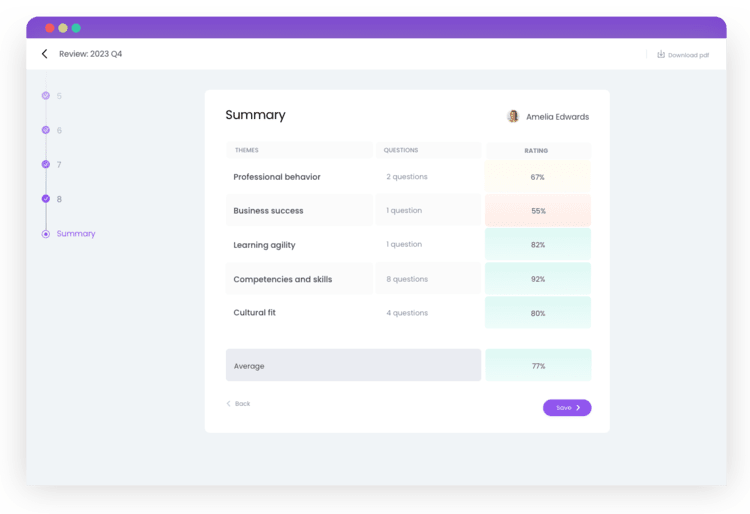
In every evaluation, it becomes clear how the employee scores on the various themes.
Our HR software helps you conduct objective evaluations. By creating multiple measurement moments per year based on different themes – for example: the fit with your culture and achieving goals, you gain objective insight into your low and high performers. Try Learned free for 14 days!
Ontvang de nieuwste HR-tips
Krijg 1 keer per maand onze tips, e-guides en templates direct in je mail.