

Business objectives are concrete goals and targets that a company sets to realise its vision, mission and strategy. Companies can use OKRs (Objectives and Key Results) to define and achieve objectives. This promotes direction, focus, performance measurement, motivation, engagement, collaboration, resource prioritisation, flexibility and performance improvement. When setting up business objectives, it is important to formulate them specifically and measurably, involve employees and aim for challenge and stretch. These best practices contribute to effective and impactful objectives that support a company's performance and success. Or do you want to get started right away? Try Learned free for 14 days and discover how to effectively set up and pursue business objectives.
What are business objectives?
Business objectives are concrete goals and targets that a company sets to realise its vision, mission and strategy. They serve as guidelines to measure a company's performance and success. Business objectives can cover various aspects. Examples include financial goals (e.g. revenue growth, profitability), operational goals (e.g. efficiency improvement, quality control), market-oriented goals (e.g. market share, customer satisfaction) and socially responsible goals (e.g. sustainability, social engagement). These objectives are often formulated using the SMART framework: Specific, Measurable, Acceptable, Realistic and Time-bound. Pursuing business objectives helps a company achieve the desired growth, competitive advantage and long-term success.
Applying business objectives with OKRs
Companies often work with Objectives and Key Results (OKRs) as a methodology to define and achieve business objectives. Objectives are ambitious, inspiring goals that indicate the company's direction. Key Results are measurable outcomes that contribute to achieving those goals. OKRs are regularly updated and shared within teams, creating a transparent and focused approach. They promote the alignment of individual goals with those of the company, stimulate engagement, and increase accountability. Through regular evaluation and adjustment, companies can improve their performance and make progress faster.
What are the benefits of working with business objectives?
Properly setting up and communicating business objectives can bring various benefits. We have listed the most important ones for you.
1. Direction and focus
Objectives provide clarity on the desired direction and enable the company to focus on what truly matters.
2. Performance measurement
Objectives establish measurable criteria to assess performance and celebrate successes. They provide a frame of reference for measuring progress and identifying gaps.
3. Motivation and engagement
Well-defined objectives inspire and motivate employees, increasing their engagement and productivity.
With Learned, you can implement continuous short employee surveys with a few questions per week in the same time as an annual employee survey. This gives you real-time insight into employee engagement all year round and you immediately see the effect of your HR initiatives. Download our free e-guide now and discover how engaged your employees are.
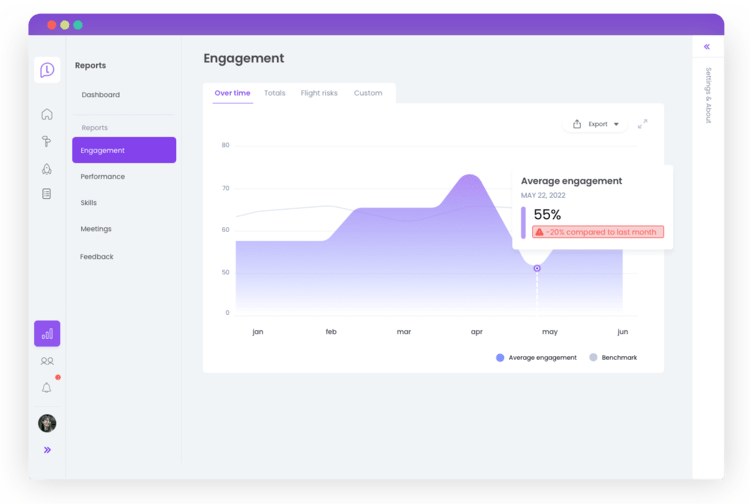
Image explanation: In this example, you can see the power of continuous short employee surveys. Due to a negative situation in April, you see a sharp drop in employee engagement in May. Thanks to frequent measurements, you can take immediate action on this.
4. Collaboration and alignment
Objectives promote collaboration and alignment within teams and departments, breaking down silos and stimulating joint efforts.
5. Resource prioritisation
Objectives help prioritise resources so they are effectively allocated to the most important initiatives and projects.
6. Flexibility and adaptability
Well-structured objectives are flexible and can be adapted to changing market conditions, making the company more agile.
7. Performance improvement
By setting challenging objectives, employees are stimulated to improve their performance and find innovative solutions.
Best practices for setting up your business objectives
Do you also want to start setting up business objectives within your organisation? Then keep the following in mind:
- Specific and measurable: Formulate objectives as specifically and measurably as possible. This ensures clarity and makes it possible to objectively measure progress. For example, use concrete figures, percentages or deadlines to define the goals.
- Involve employees: Ensure that employees are involved in the objective-setting process. This increases their involvement and responsibility, and contributes to a greater sense of ownership. Also encourage regular communication and feedback to ensure objectives remain relevant and aligned with changing needs.
- Aim for challenge and stretch: Set objectives that are challenging but achievable within the set time. By challenging employees, you stimulate innovation and growth. At the same time, it is important to allow room for adjustments and flexibility, so objectives can evolve as circumstances change.
By following these best practices, a company can formulate effective and impactful business objectives that support the performance and success of the organisation.
Achieve your business objectives faster with Learned
With the Learned platform, you can set up your business objectives fully according to the OKR methodology. This way you can cascade objectives to teams and individual employees. Create optimal alignment and ensure goals are achieved faster. Curious about how business objectives work in Learned? Read more about the role of Performance Management in setting up business objectives and optimise your business objectives.
Ontvang de nieuwste HR-tips
Krijg 1 keer per maand onze tips, e-guides en templates direct in je mail.

Related articles
Discover more about this topic