


It sounds ideal and easy, combining the performance review and appraisal meeting so you're done in one go. You see your employee every day anyway, so you know perfectly well how they're performing. It saves time, is efficient and you can tick something off your to-do list. Or is this actually not such a good idea?
Combining a performance review and appraisal meeting
In practice, it often happens that people combine the performance review and appraisal meeting. In fact, it comes down to the performance review not being conducted. The advantage is the time saved, because as a manager your to-do list is incredibly long. However, there are quite a few disadvantages to skipping a performance review. Both the purpose and the format of the meetings differ from each other. First of all, it's important to distinguish the purpose of the meetings.
What is the difference between the performance review and appraisal meeting
Because the performance review and appraisal meeting can look very similar, let's examine the similarities and how the appraisal meeting differs from the performance review.
The performance review
This is a two-sided conversation between the manager or supervisor and the employee. The conversation may occur more than once a year, but normally falls once a year in the HR cycle. The conversation is informal in nature, meaning both parties can give feedback. The employee's opinion is central. In the performance review you discuss:
- The current situation of the employee;
- completed projects of the employee;
- the employee's performance;
- collaboration between employee, colleagues and manager;
- how to further develop;
- feedback for the organization and manager.
This conversation has no impact on: employment conditions or salary (increase).
The appraisal meeting
In this meeting, the manager or supervisor 'assesses' how the employee performed in the past year. The appraisal meeting is formal in nature and traditionally has one-way traffic. The manager sends information and the employee receives. In the meeting you discuss the following with the employee:
- employee performance (business results);
- development the employee showed;
- possible reward (salary increase);
- assessment of the employee's way of working.
Why is skipping the performance review such a bad idea?
All too often it's forgotten that a performance review is the ideal moment to ask for feedback about the manager's functioning. It's naturally not just about the employee's own performance. During this moment, the employee can give tips and praise about the manager's leadership; an opportunity to take their own functioning to a higher level.
Additionally, there's a good chance the employee will be quite surprised if during the appraisal meeting it turns out the assessment is (partly) insufficient when no feedback or improvement points were given during the year. At that point, the employee can no longer do anything to improve their performance.
In the case where an employee is actually doing well and there are no remarks about their functioning, it's quite disappointing to hear that only once a year. Appreciation and attention are, after all, very important for personal growth and development of an employee and the motivation to continue doing their work well.
Research conducted by Gartner on the impact of abolishing performance reviews indicates that employee engagement drops significantly (-6%) when performance reviews are not conducted.
Why not combine the performance review and appraisal but adapt them?
Combining the performance review and appraisal meeting is not a good idea, that much is clear. So what can you do to streamline these conversations and give employees sufficient room for personal development?
Breathe new life into the appraisal cycle with 'the good conversation', have frequent discussions with your employees about development and goals and switch to 'the new appraisal'. The starting point of this form of appraisal is that the traditional performance review and appraisal meeting are replaced by a continuous dialogue between employee and manager.
The focus is on the employee's strengths and making employees responsible for their business goals and development. You do this by conducting modern development conversations.
These conversations between manager and employee about career, skills, development, goals and sustainable employability take place up to four times a year. With an HR cycle centered on this continuous dialogue, you know what's going on and can provide constructive feedback in a coaching role rather than just assessing.
IT company Tensing sees an increase of no less than 34% in the number of goals set after implementing Learned: "Achieving the goal immediately gives people more motivation to start with a new goal. We also see this reflected in the use of Learned. We see that employees log in on average between five and ten times a month!"
The result of a continuous dialogue
From research conducted by Gallup among companies that have implemented a continuous dialogue, we know that this modern form of appraisal can deliver enormously positive results.
Companies that invest in a continuous dialogue where manager and employee continuously engage in conversation see employee engagement increase by up to 280%. This high level of employee engagement leads to less absenteeism and more job satisfaction. It also results in optimally developed employees who perform better. And that's what Learned stands for!
Watch a video demo of the Learned platform or create a free trial account here.
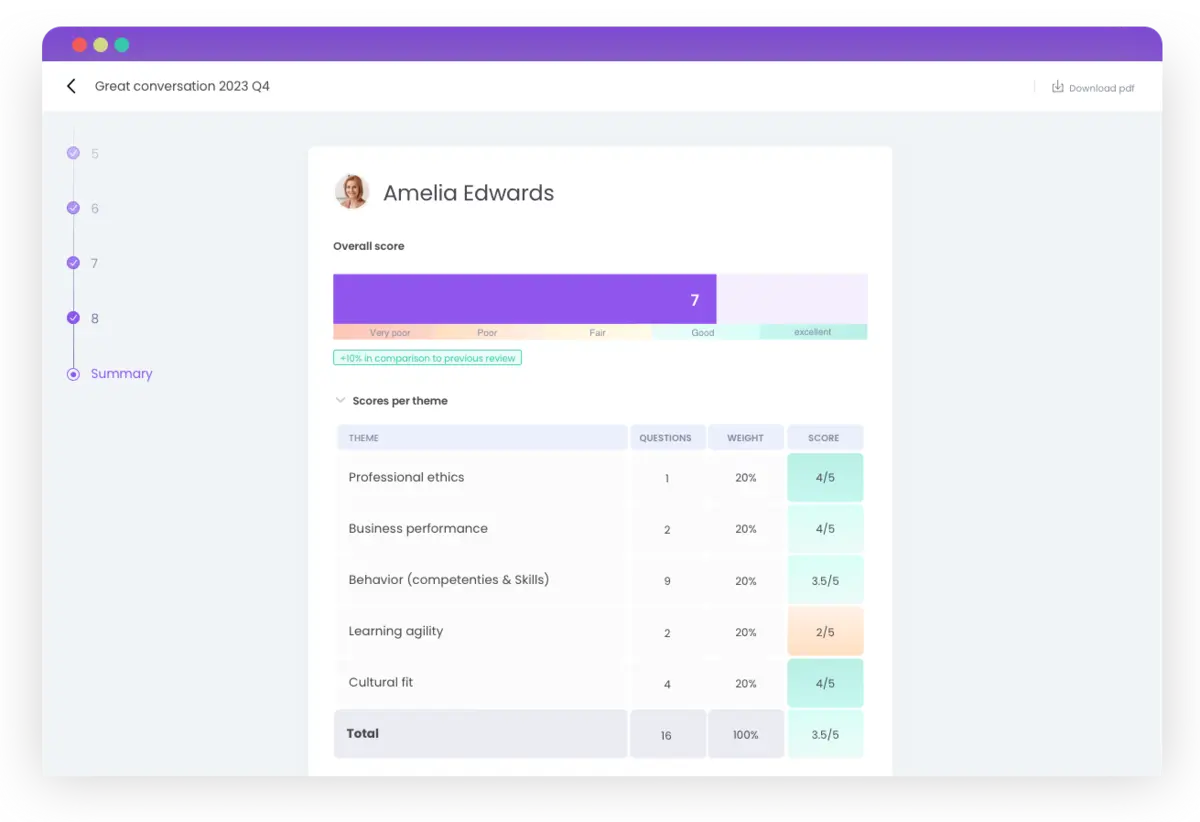
Design a fully personalized HR cycle with multiple evaluations and 90°, 180° or 360° feedback on different themes.
Ontvang de nieuwste HR-tips
Krijg 1 keer per maand onze tips, e-guides en templates direct in je mail.



![Performance appraisal: 10 key questions to ask [+ template]](https://www.learned.io/wp-content/uploads/2023/09/Frame-154-1.png)