

Personnel management forms the backbone of every successful organization. Due to increasing competition and a constantly evolving labor market, effective personnel management has never been so important. But how can your organization meet these challenges and elevate your personnel management to a higher level? This is where personnel management software comes in. With advanced tools and technologies, organizations can optimize their HR processes, increase efficiency, and adapt to the rapidly changing labor market.
What is personnel management?
Personnel management, or HRM (Human Resource Management), is essential for business growth and development, with strategic personnel management becoming increasingly important. It is not just a response to current needs, but also anticipating future challenges and opportunities. This requires the proactive development of human capital to gain competitive advantage by closely aligning HR practices with business objectives.
Various aspects of personnel management are important, such as recruitment and selection for finding the right people, training and development for enhancing competencies, performance appraisal for insight and reward structures, and talent retention to create a motivating work environment.
Components of personnel management
Personnel management encompasses a range of tasks and goals that are both strategic and operational in nature.
Operational:
These tasks are aimed at building a competent and motivated workforce that contributes to organizational objectives.
- Recruitment and selection
- Training and development
- Performance appraisal
- Compensation management
- Talent retention
Strategic:
From a strategic perspective, personnel management goes beyond just operational tasks. This requires close alignment of HR practices with overarching business strategies.
- Planning future staffing needs
- Anticipating changes in the labor market
- Developing talent to maintain competitive advantage
Within personnel management, various measurable goals are pursued. Examples include reducing employee turnover, improving productivity per employee, increasing employee engagement, shortening recruitment cycle times, and improving the quality of new hires.
Trends and outlook
Within personnel management, there are constant trends influencing how organizations approach personnel management. Some key developments include the growing focus on diversity and inclusion, the rise of flexible working, and increasing attention to employee experience.
Diversity and inclusion
Organizations strive for a diverse and inclusive work environment to leverage the benefits of different backgrounds, perspectives, and experiences. This inclusivity movement goes beyond just hiring diverse employees and also involves creating a culture where everyone feels valued and heard.
Flexible working
In addition, the shift towards flexible working has gained enormous momentum, partly due to technological developments and the COVID-19 pandemic. Organizations are increasingly offering options for working from home, flexible hours, and shared workspaces.
Employee experience
Another important trend is the growing attention to employee experience, where organizations focus on creating a positive work environment to attract, retain, and motivate talent. This includes, among other things, improving the work environment, offering career development opportunities, and promoting a healthy work-life balance.
These trends illustrate the continuous evolution within personnel management, driven by social, technological, and economic developments.
How to choose the right personnel management software?
When selecting personnel management software, there are several important considerations:
Functionality
Ensure the software aligns with the specific needs and goals of the organization, such as recruitment and selection, training and development, performance appraisal, or compensation management.
User-friendliness
Choose a software solution that is intuitive and easy to use for both HR professionals and employees to promote adoption within the organization.
Integration capabilities
Ensure the software can seamlessly integrate with existing systems, such as payroll software, to guarantee smooth data exchange.
Pricing
Weigh the cost of the software against the functionality and value it offers, and consider investing in a solution that supports the organization's growth.
Thorough evaluation
Conduct a needs analysis, compile a list of essential features and requirements, request demos and trial versions, consult references, and review user reviews to make an informed decision.
Personnel management with Learned
Not optimally utilizing talent and the departure of high-performing employees can be very costly. You can prevent this by evaluating your employees more objectively, thereby making development, promotions, and compensation more transparent. With Learned, we see that more than 200 of our customers achieve 13% higher employee performance and a 128% increase in internal mobility after an average of 12 months, resulting in 18% higher satisfaction and 14% lower turnover. Do you also want to achieve these results for your organization? Try Learned for free for 14 days and discover it for yourself.
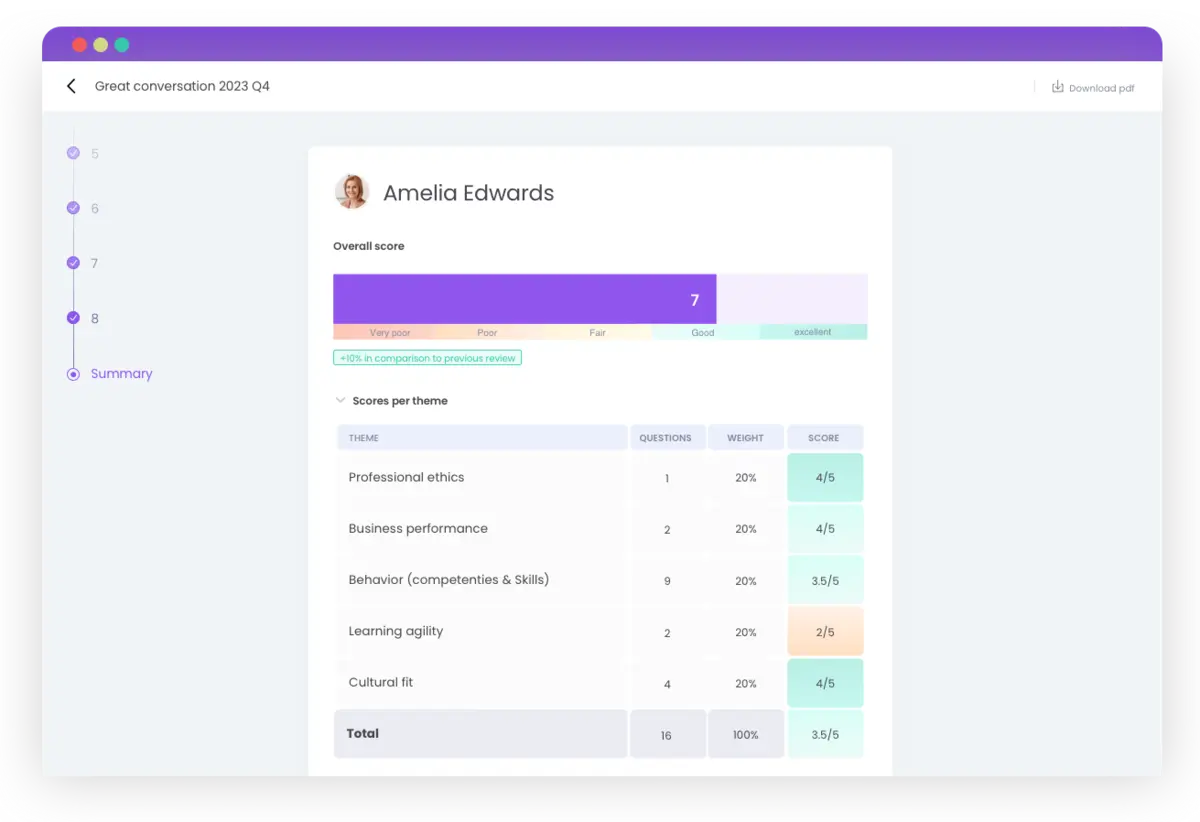
Design a fully personalized HR cycle with multiple evaluations and 90°, 180°, or 360° feedback on various topics.
Ontvang de nieuwste HR-tips
Krijg 1 keer per maand onze tips, e-guides en templates direct in je mail.