

The 1-on-1 meeting is a powerful tool for effective communication and collaboration between managers and employees. They provide a structured opportunity to listen, give feedback, and set goals, which is essential for growth and development.
👉 Would you rather get started right away with conducting 1-on-1 meetings? Then download our free template!
Why are one-on-one meetings important?
- Building relationships: The one-on-one meeting helps build strong working relationships between managers and employees.
- Feedback and development: they provide a platform for giving constructive feedback and discussing growth opportunities.
- Goals and performance: one-on-one meetings enable employees to set goals and discuss their progress.
- Problem solving: they provide the opportunity to solve problems and challenges.
- Engagement and satisfaction: employees who regularly have one-on-one meetings usually feel more engaged and satisfied.
How do you conduct an effective one-on-one meeting?
- Preparation: both managers and employees should prepare for the meeting by setting topics and goals.
- Active listening: actively listen to what the other person has to say and ask follow-up questions.
- Giving feedback: be honest and constructive when giving feedback.
- Setting goals: jointly identify measurable goals and action plans.
- Follow-up: ensure that discussed actions are followed up and evaluated.
- Open dialogue: encourage openness and honest communication.
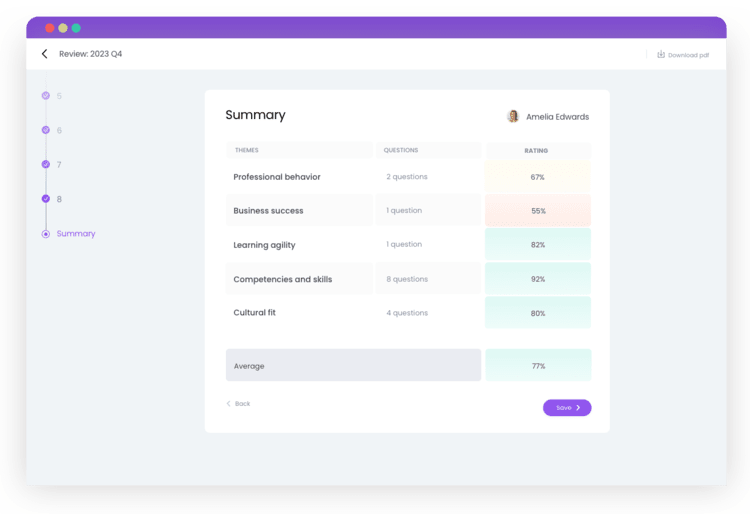
Learned facilitates objective evaluations. By creating multiple measurement moments per year based on different themes – for example: the fit with your culture and achieving goals, you gain objective insight into your low and high performers.
Example questions for the one-on-one meeting
Here are five categories with example questions for a one-on-one meeting covering various professional topics. These questions are designed to explore career growth, project progress, feedback, team dynamics and well-being, and to foster a productive exchange between colleagues or managers. Choose the questions that best suit the purpose of the meeting and the needs of those involved.
Career and development:
- Where do you see yourself in five years in your career?
- Which skills would you like to develop?
- Do you have recent achievements you are proud of?
Work projects and tasks:
- Can you tell me about the project you are currently working on?
- Are there challenges you are currently facing?
- What goals do you have for this project?
Feedback and improvement:
- Do you have suggestions for ways we can improve our work or collaboration?
- Is there anything you need help or support with?
- What feedback do you have for me as a manager/colleague?
Team and collaboration:
- How do you feel about our team dynamics? Are there improvements you would like to see?
- What do you enjoy most about working with this team?
- Do you have ideas to improve team performance?
Work-life balance and well-being:
- How do you find the balance between work and private life?
- Are there specific challenges in this area you are dealing with?
- What do you do to take care of yourself outside of work?
The role of the one-on-one meeting in talent development
One-on-one meetings play a crucial role in talent development. They enable managers to understand the needs and ambitions of their team members and provide support for their professional growth. With the right tools, such as Learned, one-on-one meetings can be managed and recorded even more effectively to optimize employee development.
A positive impact on the workplace
One-on-one meetings create a positive impact on the work environment. They show that the organization values its employees and their growth. Through regular and meaningful conversations, teams can thrive, achieve goals and develop.
Discover the power of the one-on-one meeting with Learned
To enable managers to conduct great one-on-ones, we have developed an e-guide to recognize the low and high performers in your organization.
By downloading this FREE e-guide, you can take action for low performers and express appreciation for high performers. This prevents turnover among high performers and helps low performers become high performers too.
Ontvang de nieuwste HR-tips
Krijg 1 keer per maand onze tips, e-guides en templates direct in je mail.

Related articles
Discover more about this topic