

In this blog, we will delve deeper into what talent development entails, why it is crucial for both individuals and organizations, and how to set up an effective talent development program. Would you rather start immediately with identifying your low and high performers? Then download our free e-guide 'Map low and high performers with objective evaluations'.
What is talent development?
Talent development is a strategic approach to identifying, nurturing, and enhancing the skills, knowledge, competencies, and potential of employees. It is aimed at empowering individuals to promote their professional growth, which ultimately contributes to organizational success.
Some misconceptions about talent:
- Talent is innate and doesn't need tracking
- You either have talent or you don't
- If you have talent, everything else follows automatically
Why is talent development important?
- Improved performance: talent development enables employees to improve their performance, directly contributing to organizational productivity and effectiveness.
- Engagement and satisfaction: employees feel valued and engaged when they are given opportunities to develop, which increases employee satisfaction and engagement.
- Talent retention: organizations that invest in talent development are more likely to attract and retain top talent, which reduces recruitment and training costs.
- Innovation: employees who can develop are often more inclined to generate new ideas and stimulate innovation.
- Leadership: talent development identifies potential leaders and provides them with the resources and opportunities to develop leadership skills.
How to set up an effective talent development program
- Identify objectives: set clear objectives for the talent development program and ensure they align with the business strategy.
- Needs assessment: identify the specific needs and goals of employees and the organization as a whole.
- Create learning plans: develop customized learning plans for individuals based on their needs and goals.
- Training and development: offer training, mentorship, coaching, and other development opportunities to employees.
- Evaluation and feedback: regularly measure employee progress and provide constructive feedback to support their development.
- Continuous improvement: an effective talent development program continuously evolves to meet changing needs.
With the e-guide 'map low and high performers with objective evaluations' you can map your employee performance. With these insights, you can see who the low and high performers are within your organization.
What are examples of talents?
Creative talents:
- Graphic design
- Copywriting
- Innovative problem solving
- Presentation design
- Creative thinking
Social talents:
- Team leadership
- Conflict resolution
- Networking
- Empathy
- Negotiation
Technical talents:
- Software development
- Data analysis
- IT management
- Cybersecurity
- Technical support
Analytical talents
- Financial analysis
- Strategic planning
- Market research
- Project management
- Critical thinking
Entrepreneurial talents
- Taking initiative
- Risk management
- Business acumen
- Decision making
- Customer orientation
How can Learned help with talent development?
With our advanced HR software, companies can effortlessly design customized learning paths, closely track employee progress, and effectively evaluate. Our platform promotes a culture of learning and growth, stimulating employees to continuously acquire new skills and develop, resulting in more competent and motivated teams and a significant competitive advantage in a fast-changing business environment. In short, when it comes to boosting employee development and building a learning organization, Learned is the ultimate choice.
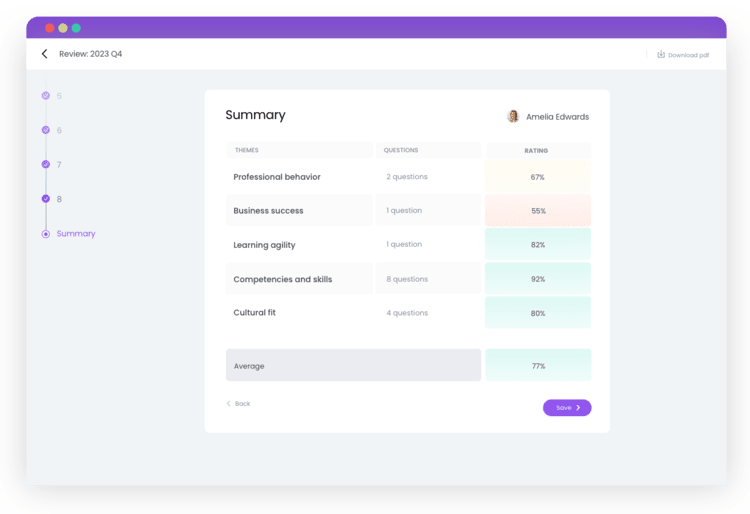
Learned facilitates objective evaluations. By creating multiple measurement moments per year based on different themes – for example: the fit with your culture and achieving goals, you gain objective insight into your low and high performers.
Image explanation: Each evaluation provides insight into how the employee scores on the different themes.
Ontvang de nieuwste HR-tips
Krijg 1 keer per maand onze tips, e-guides en templates direct in je mail.

Related articles
Discover more about this topic