

More and more companies want to increase the number of feedback moments and strive for a real feedback culture. They have discovered that an appraisal method based on one annual review does not contribute to employee performance, development, and satisfaction.
But how do you actually create a feedback culture in the workplace? Read on to find out.
What is a feedback culture?
A feedback culture is a work environment where an employee feels safe and comfortable to frequently ask for and give feedback. Feedback encourages employees to engage in dialogue with each other and largely determines the atmosphere at work. Additionally, goals are achieved faster when employees continue to develop on the job and can thus collaborate better with other colleagues.
Feedback can be divided into 2 categories: (1) feedback during appraisal and review rounds and (2) spontaneous feedback that can be used between conversations to provide on-the-job feedback.
A constructive way to use feedback during the review round is by giving 360-degree feedback. With this, employees actively ask for feedback from colleagues, managers, and even external (clients).
The benefits are much higher employee engagement, because you focus on their growth and development.
💡 Want to know how to measure, interpret, and improve engagement, so you retain the best talent? Download our e-guide 'Real-time insight into the employee engagement of your high performers'
What is the added value of a feedback culture?
By providing constructive feedback during one of the development conversations throughout the year, the end-of-year review will not come as a surprise. When employees receive constructive and positive feedback on behavior and performance, they continue to develop. This in turn means employees perform better, which is not only good for the employee but also for the organization.
Research by Gallup (How millennials want to work, 2016) and Deloitte (2018 Millennial Survey) shows that new generations place much more value on ongoing conversations, alignment with business strategy, and continuous feedback.
New generations like Millennials want to receive feedback more frequently. They are constantly curious about whether they are doing well or not. This generation is used to communicating more directly. Having grown up with likes, dislikes, and reviews, it makes sense that they also feel the need to give and receive feedback at work.
Feedback is no longer synonymous with negative criticism but increasingly enables people to work on personal development and growth.
Ensuring qualitative feedback
Using different models or templates can help ensure qualitative feedback. For example, you can use the 'Start, Stop, and Continue method' for giving feedback in a positive, constructive way. The goal is to exchange feedback based on three principles that focus on the positive aspects of the employee. What should someone start doing, stop doing, and continue doing?
If you want to give specific feedback on certain behavior and its effects, you can use the 4G feedback method.
The 4G feedback model consists of these four G's:
- Behavior (Gedrag): factual specific behavior of the other person
- Consequence (Gevolg): the effect of someone's behavior on the environment
- Feeling (Gevoel): what does the other person's behavior evoke in you?
- Desired (Gewenst): Name the behavior you would like to see.
Giving feedback is a powerful method to increase employee performance and engagement. At the same time, it is also one of the most difficult activities in the workplace. Whether as a manager to a team member or to a direct colleague. Many find giving feedback challenging and nerve-wracking.
Use supportive HR software to create a culture of continuous feedback
A successful feedback culture stands or falls on the continuity of soliciting feedback. With HR software like the Learned platform, you make it quicker and easier to integrate a feedback culture into your company culture.
Use online tools to actively stimulate employee development so they can actively ask for feedback and set their own goals. This creates responsibility and ownership.
Our Performance Management tool contributes to a more frequent exchange of feedback, thanks to a continuous dialogue about job satisfaction, performance and behavior.
Learned's 2021 user survey shows that up to 65% more feedback is given through the use of our HR software. Also, more than 80% of respondents indicate having more insight into skills and capabilities by using Learned. This means much more engaged employees, better anticipation of potential problems, and more job satisfaction.
To achieve this, Learned helps you innovate your HR cycle, and you design your ideal feedback form based on goals, core values, competencies and skills. For each question type, you determine which form of feedback you want to apply; 90-, 180- or 360-degree feedback or even feedback from external parties (such as clients).
👉 Curious how you can use Learned's Performance Management software in your organization? Watch our video demo here
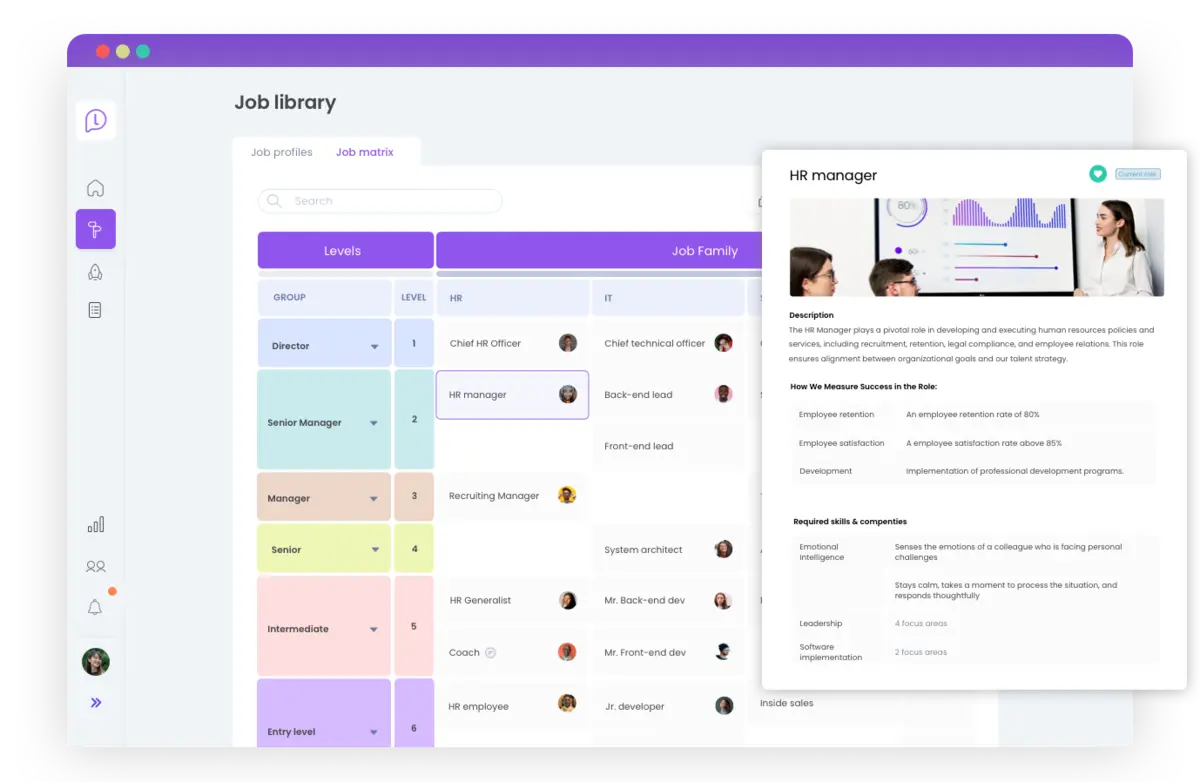
With Learned's AI, you can easily generate a skills-based job framework based on market data. This makes evaluations objective and career opportunities transparent.
Ontvang de nieuwste HR-tips
Krijg 1 keer per maand onze tips, e-guides en templates direct in je mail.

Related articles
Discover more about this topic