

In this blog we discuss four important challenges of remote performance management. We also address the solutions we have developed together with our own clients. Would you rather get started with remote performance management for your organisation right away? Download the free e-guide: Design a modern conversation cycle in 5 steps.
What is remote working?
Remote working, also known as teleworking or working from home, refers to the practice where employees carry out their work outside the traditional office environment. This can be at home, in a café, a co-working space or any other location that is not the usual workplace. Thanks to advances in technology, such as fast internet connections, cloud computing, and communication tools like video conferencing and chat applications, working remotely is more accessible and efficient than ever before. For HR professionals and managers, this form of work offers unique opportunities and challenges in the areas of recruitment, personnel management, and maintaining company culture.
The effect of Corona on remote working
Before the Corona crisis, many companies were already working on replacing their traditional performance management cycle with a continuous dialogue. As a result of mandatory remote working, this trend has accelerated. In 2020, digital support for HR processes rose from 7th to 4th place on the list of most important themes for HR professionals in the Netherlands. Consultancy firm Berenschot found that as many as 82% of HR professionals indicate they expect major changes in their organisation due to technological developments as a result of this crisis.
One of the main reasons companies are accelerating their investment in remote performance management is that many managers before the corona crisis employed a leadership style of "management by walking around". Managers were often literally on the office floor. This gave managers the ability to ad hoc steer on performance and behaviour. In the remote situation, managers are asked to manage their employees from a distance. This means that self-evident working methods suddenly need to be revised.
Advantages of working remotely
For employees:
- Improved work-life balance: Employees can more easily pick up children from school or attend medical appointments without using valuable leave days.
- Reduced stress and travel time: By integrating remote working into your organisation, you eliminate the daily commute, saving employees valuable time and stress.
- Increased autonomy and control: Employees can adapt their work environment to personal preferences, such as background music, temperature and ergonomics.
- Improved health and wellbeing: Remote working can also improve wellbeing. Employees have more flexibility to prepare healthy meals, exercise regularly and take sufficient rest between tasks.
For employers:
- Increased productivity: Research by CfPB, TU Delft and Eindhoven called 'We Work From Home' shows that home workers rate their productivity at 7.7 on average, while office workers rate theirs at 6.7.
- Larger talent pool: By not depending on a fixed location, employers can recruit from a worldwide talent pool, significantly increasing the chance of finding the perfect candidate.
- Cost savings: When employees largely work remotely, you can save a lot on expensive office spaces.
- Lower absenteeism: The threshold of commuting causes people to call in sick more quickly. With the option of working from home, people choose to work from home when they feel unwell instead.
Disadvantages of working remotely
For employees:
- Isolation: The lack of personal contact with colleagues can lead to feelings of isolation and loneliness. This can have a negative effect on your employees' mental health and ultimately even lead to absence.
- Work-life balance: It can be difficult to keep work and private life separate, as there is no clear beginning and end. This can cause you to work late into the evening more quickly, increasing the risk of burnout.
- Self-discipline: Without the structure of an office environment, it can be challenging for some employees to stay motivated and productive.
- No promotion: Because employers are less aware of the performance of employees working from home, remote workers have less chance of promotion.
For employers:
- Communication and collaboration challenges: Without regularly seeing each other physically, it can be harder to ensure effective communication and collaboration between team members.
- Maintaining company culture: It can be challenging to maintain a strong company culture when employees don't see each other often.
- Security risks: Remote working can lead to increased security risks, especially when employees access company data via unsecured networks.
- Monitoring engagement and performance: With the loss of social interaction, it becomes even harder to determine how engaged your employees are and how they perform.
With Learned you implement continuous short surveys with a few questions per week in the same time as an annual employee survey. This gives you real-time insight into employee engagement all year round and you immediately see the effect of your HR initiatives. Try Learned free for 14 days!
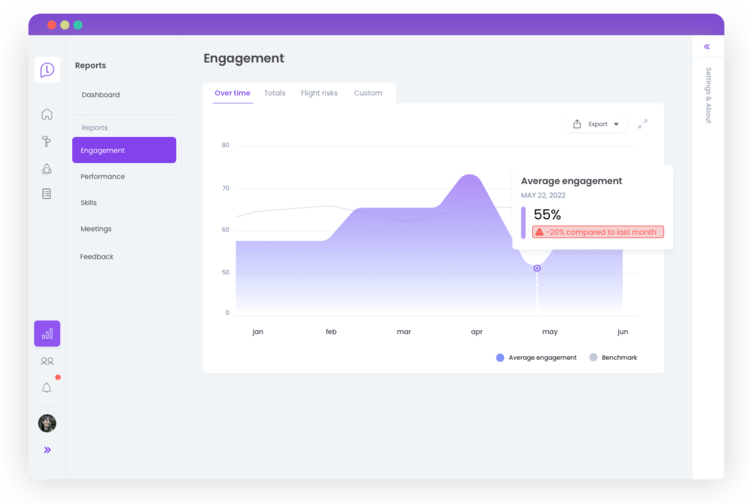
Image explanation: In this example you can see the power of continuous short surveys. Due to a negative situation in April, you see a sharp decline in employee engagement in May. Thanks to the frequent measurements, you can take immediate action.
Tips to make remote working a success
Tip 1: Invest in technology
Ensure all team members have access to the necessary tools and technologies, such as video call software, collaboration platforms and secure VPN connections.
Tip 2: Promote communication
Encourage regular communication by scheduling fixed times for team meetings and using chat applications for daily interaction.
Tip 3: Set clear expectations
Ensure employees know what is expected of them in terms of working hours, tasks and results.
Tip 4: Support flexibility
Recognise that employees may need flexible working hours, especially when dealing with time zones or personal responsibilities.
Tip 5: Cultivate a strong company culture
Organise (virtual) team-building activities and ensure an inclusive culture where everyone feels valued, regardless of their location.
Tip 6: Offer a budget for home workplaces
Recognise the importance of a comfortable and ergonomic home workplace for employees' health and productivity. Consider offering a budget or allowance for purchasing quality office chairs, desks, and other essential office supplies. This not only shows you take your employees' wellbeing seriously, but also helps prevent physical complaints such as back pain. By investing in your employees' home workplaces, you promote a healthier work environment and underline the importance you attach to their comfort and productivity, even remotely.
Learned: modern performance management focused on remote working
In recent years there have been many developments in performance management software. At Learned we have developed a platform that helps companies implement a modern performance management cycle. With tools for Goals (OKRs) we help managers align clear goals with their team members and steer on output. We also offer tools for 1:1 meetings and feedback. This helps managers stay in continuous conversation with their employees and monitor their engagement. By facilitating managers in adapting their management style and steering on output, we see companies succeed in increasing employee engagement and performance.
Curious about more information on a modern conversation cycle with 'goals (OKRs)', a 'continuous dialogue', and stimulating a 'feedback culture'? Download the free E-guide: Design a modern conversation cycle in 5 steps. In it we discuss practical tips on how you can create a modern performance and conversation cycle that optimally responds to remote working.
Ontvang de nieuwste HR-tips
Krijg 1 keer per maand onze tips, e-guides en templates direct in je mail.