

We are facing a historically tight labor market. The risk of high employee turnover is significant, as many employees are approached to "defect" to other organizations. That's why more and more companies are coming up with the most creative ideas to retain employees, from smoothie bars to movie nights. So it's not surprising if you ask yourself: how do I retain my employees?
In this blog, we will explain what employee turnover is, how to calculate it, what the hidden costs are, and we will give you 10 tips that will help you prevent or reduce high turnover.
💡 Curious about the costs of employee turnover within your organization? Download the e-guide (calculator) to easily calculate the hidden costs of turnover
The meaning of employee turnover
Employee turnover is the departure of employees within an organization. This includes both natural and desired as well as undesired turnover. Employee turnover can, for example, be the result of an employee retiring, the expiration of a temporary contract that is not renewed, or an employee resigning.
What is 'desired' turnover?
Does the employee have low performance and little tangible knowledge? Then it can be beneficial for the company that this employee leaves the position and is replaced by someone more suitable. Once the employee leaves, we call this desired turnover. Additionally, in most cases, employees who retire fall under desired turnover.
What is 'undesired' turnover?
Does the employee perform well and possess a lot of knowledge that is difficult to transfer? When such an employee leaves the company, this is called undesired turnover. This often comes as a surprise to the employer. Although the cost of sick leave can also be significant, this does not fall under turnover. For this, the employee must first leave the company.
What is the difference between internal and external turnover?
When an employee leaves the organization, we call this external turnover. But there are also employees who change positions within the organization or receive promotions. These fall under internal turnover. With the current labor market as we know it, external undesired turnover in particular provides insight into the employment quality of the organization.
The influence of the labor market on employee turnover
The expectation is that the percentage of employee turnover is now much higher than average, because we are dealing with a historically tight labor market. One of the causes is the aging population, but sick leave also reached a record high of 6.3% at the beginning of 2022 (CBS, 2022). The current shortage and record number of vacancies makes it more attractive for employees to look for another job (CBS, 2022).
Engaging the new generations is a challenge
According to the figures, the younger generation in particular frequently changes jobs:
- Millennials who don't feel heard at work are 21% more likely to leave their employer within one year (Deloitte, 2022).
- Nearly a quarter (24%) of Millennials plan to leave their employer within 2 years (Deloitte, 2022);
- Gen-Z'ers who don't feel heard at work are 9% more likely to leave their employer within one year (Deloitte, 2022);
- 4 out of 10 Gen-Z'ers plan to leave their employer within 2 years (Deloitte, 2022).
Is the labor market shortage structural?
The labor shortage seemed to have been resolved by the large rounds of layoffs that recently took place. These were a consequence of the energy crisis in our country. According to Matthijs Bouman, journalist at the Financieel Dagblad, the labor shortage has been going on for much longer. He claims that there has been higher unemployment and fewer vacancies for twenty years. According to him, this is due to the many recessions in this century. He advises to continue investing in personnel and automation. The UWV also expects that the labor shortage will decrease somewhat in 2023, but that it is a structural problem that will continue to exist in the coming years.
What is the average employee turnover?
The average employee turnover was still at 18% in 2017 according to the American SHRM. In the Netherlands, only data is available from CBS about outflow per sector rather than total turnover. A healthy turnover rate is around 10%. Are you well above this? Then your organization has high turnover.
Connection to prevent turnover
A higher chance of turnover occurs when employees don't feel connected to their employer. This is evident from the GITP figures: an engaged employee is 87% less likely to leave. Want to know how to increase your employees' engagement? Scroll down for 10 tips to help you increase employee engagement.
Calculating employee turnover costs
To determine whether action is needed, it is important to calculate the costs of employee turnover.
👉 Read more here about how to calculate your organization's employee turnover.
10 tips to prevent employee turnover
There are many factors that can reduce undesired employee turnover. We give you the most important and most effective solutions.
1. Review your employment conditions
It's the foundation of every job: the employment conditions. Salary is the most determining factor here, because without salary, the job would turn into a volunteer position. So make sure you clearly communicate the salary with your (new) employees. Is the salary average or above average? Then it can become binding for the employee. One in five employees (19%) stays with the same employer if they grow their salary by more than five percent next year (Visma-Raet). Can you completely reduce turnover with salary scales? No, but in combination with other employment conditions, such as working days, flexible working hours, hybrid working, a bonus system, pension schemes, courses, and by stimulating healthy behavior, you as an employer can make a good start. For example, 50% of employees stay longer with their current employer if they implement a four-day work week for the salary of a full-time work week (Visma-Raet).
Transparent compensation helps with recruitment and retention. Download the Salary Transparency Act Checklist and see where you stand now!
2. Let employees work hybrid
Due to the increase in hybrid working, it is more difficult to ask staff to work full-time in the office. More and more organizations are requiring this, but the chance of turnover increases as a result. The majority of workers (70%) want to combine office work with working from home, and 20% don't even want to return to the office at all (FNV, 2021). So offer working from home as an option. But be aware: there is then a greater challenge in stimulating contact between employee and manager. Millennials in particular have a strong preference for a coach rather than a manager (Gallup, 2016). And when they have a coach, loyalty increases so that 68% of millennials stay with the company for more than 5 years.
Automation among the younger generation
Patrick de Jong, System Engineering Manager at Palo Alto Networks Netherlands, advises automating tasks as much as possible. "Students often also deal with machine learning and AI. They want to do something with it and they like to see it on the work floor."
3. Improve your job postings
You can bring in a talent, the connection with the team is there, and yet the new employee leaves. How is that possible? It could simply be that the job posting didn't match the actual position and company. International research among 9,000 employees shows that 91% already consider leaving the company within a month (Robert Half, 2018). Prevent disappointments and communicate clearly via the job posting about the role, conditions, and colleagues.
To prevent employee turnover, be honest about:
- the role;
- the working hours;
- the salary;
- the benefits.
Tip: include the salary in the job posting. More and more companies are doing this.
4. Communicate clear expectations
A lot of frustration can arise when an employee doesn't know if they are 'doing well'. By clearly communicating expectations, you build trust with your employee. This is particularly important for the younger generation: millennials and Gen-Z'ers have a strong need for a coach from the moment they start. Organizations increasingly choose to design a job framework based on skills.
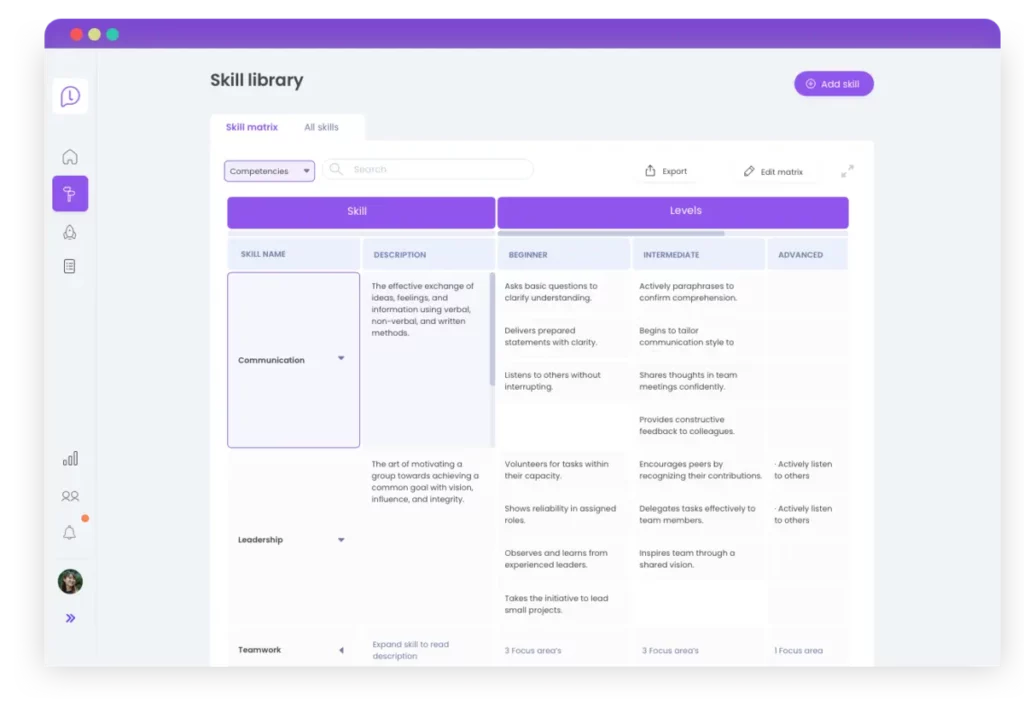
Design a skill-based job matrix for your organization
Give employees insight into what is expected in their role and where they can develop using a modern skill-based job matrix.
- Learned offers profiles for more than 4,000 positions with 100,000 skills in total;
- You can easily customize the profiles to your organization;
- Use your job matrix for objective development conversations, career paths and a data-driven learning offering.
5. Provide effective onboarding programs
From the previously mentioned study by recruitment consultancy Robert Half, in which 9,000 international employees participated, it became clear that 9 out of 10 employees consider leaving their new employer during their probationary period. Ultimately, 33% of employees actually resign during their probationary period (Jobvite, 2018). Proper onboarding can prevent employee turnover. By providing sufficient clarity, the employee knows where they stand. Good onboarding can give the employee enough support to start working independently. You can also motivate the employee to connect with colleagues. By doing this at the beginning, you stimulate engagement.
Create your own onboarding programs
Professionalize the onboarding of new colleagues or help employees who are moving to another position quickly settle in. With Learned, you create onboarding programs for your organization and/or specific roles.
- Easily create a structured path with information & activities for streamlined onboarding;
- Help managers save time by digitizing onboarding and prevent them from having to explain things repeatedly;
- Have the end of probation period discussion take place and record it in Learned. Monitor the progress of participants in their onboarding path.
6. Conduct conversations focused on development
Room for personal development is an important binding factor for employees. Many organizations receive feedback from the Employee Satisfaction Survey (ESS) or exit interviews with departing employees that they should pay more attention to employee development.
The HR conversation cycle offers the opportunity to regularly reflect on employee development. Research shows that employees who spoke with their manager about their goals and successes in the past six months are up to 2.8 times more likely to be engaged at work (Gallup, 2020). Employees whose manager is willing to listen to their work-related problems are 62% less likely to experience burnout (Gallup).
💡 Want to know more about implementing a modern conversation cycle? Also read: 'How to set up a modern HR cycle'
Conduct modern performance reviews with a focus on development
Encourage managers to actively work on their employees' development throughout the year. Learned helps with templates and a skill-based functional framework to enable every manager to conduct a quality development discussion.
- Help managers conduct the performance review with the relevant competencies and knowledge areas for the employee's position;
- Managers and employees immediately see what learning opportunities are available to help the employee;
- As an HR manager, you retain an overview of the conversations and the development needs of the employees.
7. Let employees make an impact and contribute to the organization
If it is not clear to the employee how they can contribute to the organization, engagement will decrease. Among the young generation in Europe, 69% prefer a fun job over a top salary (Young Capital & Utrecht University). So it is important to make clear how the employee can have an impact. Yet a quarter of employees (28%) are not aware of their company's organizational goals (Protime, 2017).
Give employees insight into their contribution to organizational goals
- Easily set goals for the organization, teams and employees;
- Employees visually see how their goals have impact;
- As an HR manager, you maintain oversight of progress.
User research Learned HR software – (Q3) 2021.
- 8 out of 10 users found it easier to prepare and conduct conversations;
- 6 out of 10 users conduct more conversations;
- 8 out of 10 users find conversations more valuable.
8. Provide continuous feedback and compliments
Of all working people in the Netherlands, 15 to 20% say they experience no recognition, attention or reward (Sparkler, 2022). Yet receiving feedback is extremely important. About 75% of all HR professionals indicate that feedback plays a role in stimulating behavioral change. Feedback is also important for gaining insight into employees' development potential and needs (69%), as input for assessment and performance reviews (68%), and as a tool to increase employee engagement (67%) (GITP & Pi Company, 2019).
Prevent surprises in the evaluation conversation through continuous feedback
With automatic reminders, Learned helps your managers provide feedback and compliments to their team members throughout the year. Create a feedback culture and prevent feedback from being saved up until the evaluation conversation.
9. Stimulate development in the current role or internal mobility
94% of all workers want to stay at a company if a good learning and development program is offered (LinkedIn, 2019). The need for learning is especially great among the younger generation. LinkedIn research found that about a quarter of Millennials and Gen-Z'ers say 'learning' is the biggest reason that makes them happy at work. And more than a quarter (27%) said the reason for their departure was the inability to grow and learn. So make growth opportunities visible from the start and stimulate internal mobility. Employees stay about 41% longer at their company if it regularly hires internally (LinkedIn, 2020).
Give employees insight into their career perspective within the organization
Stimulate people to actively work on their development. Learned gives employees insight into skills and knowledge areas to develop within their current role. Additionally, Learned matches the employee's profile with all available positions within your organization.
- Concrete insight into what to develop in the current role or for the next step;
- Employees have insight into career paths within the organization;
- Connect your learning offering and stimulate the use of your learning resources.
10. Continuously measure workplace happiness
Does an employee constantly arrive late to work? Or do you notice they are demotivated? Perhaps you're not sure if they are being sufficiently challenged. An employee's behavior gives off signals. Employee turnover cannot be completely prevented, but it can be predicted. Use an annual employee satisfaction survey or even weekly short pulse surveys to measure sentiment.
Real-time insight into your employees' engagement
With Learned's engagement add-on, you can continuously measure engagement with short pulse surveys in addition to the annual survey.
- Measure sentiment on 6 important drivers of employee engagement;
- Real-time insight into your team's engagement;
- Show that you listen. Create action plans and communicate them directly with your team.
Ontvang de nieuwste HR-tips
Krijg 1 keer per maand onze tips, e-guides en templates direct in je mail.