
Performance reviews. They are often experienced as time-consuming and subjective. But why is this? And how do you ensure these conversations are perceived as fair and objective? We explain how it can be done differently.
What is a performance review?
A performance review is a formal moment where you as a manager look back at an employee's performance. This often happens at the end of the year. You assess how someone has performed against the agreed goals. This conversation often has consequences for salary or a possible promotion.
The difference between a performance review and an appraisal meeting
The difference with an appraisal meeting? It's mainly in the tone and purpose of the conversation. An appraisal meeting focuses on collaboration, mutual expectations and development. A performance review is one-way: the manager gives an assessment.
The performance review is therefore less of a conversation and more of a one-sided evaluation of someone's performance.
What should a performance review meet?
Common criticism of the performance review is that it too often becomes a 'condemnation meeting'. This is caused by:
- The conversation is experienced as one-sided;
- Past performance is judged without anything having truly been discussed in the interim.
It is therefore better to turn the performance review into an evaluation meeting. You do this by not passing judgment once a year, but by keeping the conversation going. A continuous dialogue, in which goals, expectations and results are transparent for both employee and manager. This way, you can objectively evaluate, develop, and reward based on concrete data and behavioral examples.
💡 To ensure clear expectations, you can define them as skills, competencies, goals, and KPIs in a job profile.
A modern performance review therefore meets a few important conditions:
- Transparent criteria: Make it clear in advance what will be evaluated – for example, based on skills, goals, and core values.
- Objective substantiation: Use concrete behavioral examples and data, instead of evaluating based on gut feeling.
- Equal expectations: Ensure that employees and managers have the same understanding of the results and goals.
- Timely preparation: Collect input continuously, such as during feedback moments or progress meetings, so that the conversation is not an isolated event.
- Room for reflection: Also give the employee the opportunity to reflect on his/her own performance.
In this way, the performance review becomes a logical continuation of the past year's collaboration – not an isolated judgment, but an opportunity to look forward together.
Turn evaluations into a solid basis for reward. With the Wage Transparency Act Checklist, you can see which steps are still missing!
Tips for conducting modern performance reviews
Do you want to make the performance review a valuable and motivating moment? Then it is important to transform the traditional performance review into an evaluation conversation. Not a one-way street, but an open dialogue in which you and your employee look back and forward together. These are our tips for a modern performance review:
1. Ensure a continuous dialogue. Don't let the performance review be the first time performance is discussed. Regular check-ins in the form of a continuous dialogue ensure transparency about the performance, development goals and career opportunities of your employees.
2. Make expectations and goals clear. Regularly discuss progress on goals and skills. This way everyone knows where they stand and there will be no discussion about what is "good".
💡 With a skills-based job profile, your employees always know which skills are required in their specific role.
3. Use data and feedback. Regularly discuss progress on goals and skills. This way everyone knows where they stand and there will be no discussion about what is 'good'.
A performance review becomes stronger with objective input: have the goals been achieved? Which skills have been developed, and how was that development experienced by colleagues? Also record what agreements you make for the future. This way you build an honest and well-founded conversation cycle step by step.
4. Focus on development. Reviewing doesn't just have to be about past performance. Also look ahead: which skills does someone want to develop? Where are the growth opportunities?
5. Leave room for personal input. A modern performance review is not a monologue. Ask how the employee experienced the year themselves and what, according to them, could be improved.
6. End with concrete follow-up steps. Do not pass judgment, but make the conversation practical. Think of a development plan, an adjustment in role or tasks, or discussing career opportunities.
How do you measure the outcome of a performance review?
A good conversation is a great start. But to truly say something about performance, development or reward, you also need to objectively measure what was discussed.
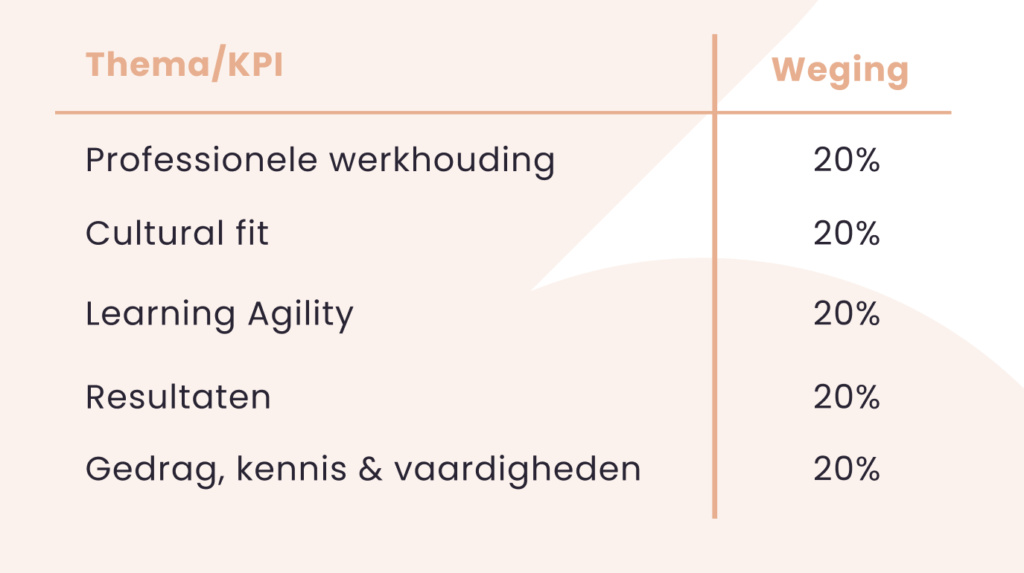
This starts with using clear assessment criteria. Per criterion, you give a score on a fixed scale, for example 1 to 5. You can then weigh those scores.
This makes the performance review not only fairer but also more concrete and better substantiated.
Which questions do you ask in a performance review
To conduct a modern performance review, it is important to ask the right questions. This gives team members insight into the themes that influence their evaluation, and allows you to guide them on concrete points they can improve.
At Learned, we use 5 themes that guide an objective and transparent performance review: job satisfaction, performance, development, learning goals and organizational feedback. These are the best questions to ask per theme 👇
Job satisfaction:
- How did you experience your workload in the past period?
- What were the most inspiring projects and/or activities that gave you the most energy?
Performance:
- What are 3 achievements you are proud of?
- What were the biggest obstacles to your learning goals and how did you resolve them?
Development:
- Which talent do you want to develop further in the coming period?
- What new skills do you want to learn in the coming period?
Learning goals:
- What were your three biggest learning goals from the past period and did you achieve them?
- Will your learning goals for the upcoming period remain the same?
Organizational feedback:
- What would you like to see improved within the organization, and how?
- Describe the collaboration with your manager/team/direct colleague in 3 words and indicate in which areas the collaboration can be improved.
👉 Curious about more example questions? Download the e-guide for 25+ example questions for the performance review
Ontvang de nieuwste HR-tips
Krijg 1 keer per maand onze tips, e-guides en templates direct in je mail.

Related articles
Discover more about this topic