


A talent review: it doesn't sound like a typical HR term and that's correct. Originally from naval tradition, it has become a widely used method for companies and HR teams to determine whether they still have the right people 'on board'.
What is a talent review?
A talent review – or fleet review – is an HR meeting where management and supervisors come together to map the strengths, competencies, and potential of staff.
The talent review is an important part of strategic workforce planning.
Together you determine whether people are in a position where their talents are best utilized, which employees perform best, and who is eligible for promotion.
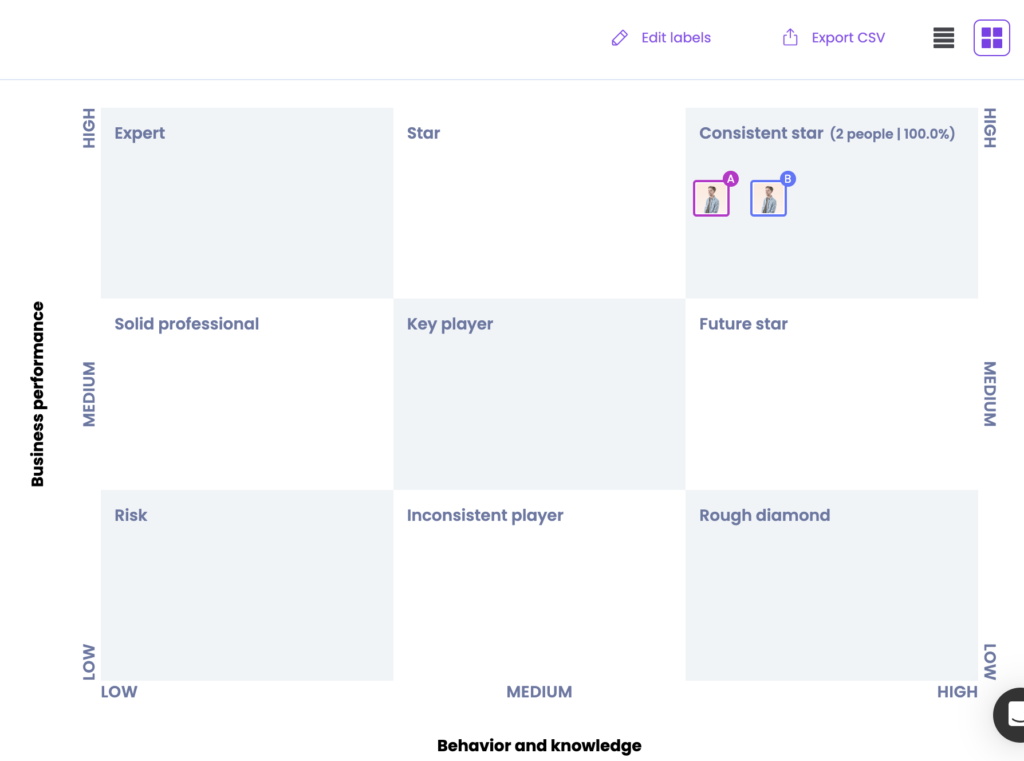
To visualize the talent review, you often use a 9-grid matrix.
Example of a talent review
Benefits of a talent review in HR
A fleet review, together with the 9-grid, is a tool for strategic workforce planning in HR.
These are other useful purposes for which you can use it:
- Determine who the best performers are (high-performers), and who qualifies for a promotion
- Insight into employees who show great potential (high-potentials)
- Determine who qualifies for a salary increase
- See if someone is a fit for the role and has the right function level
- Determine which employees are underperforming and contributing less to goals
- Discuss whether employees could benefit from extra coaching or guidance
- Determine what guidance employees need for their development
- Determine if a high-potential employee is ready for more responsibility, or for a talent development program
- Brainstorm development goals for employees with high potential
So it is also about designing an action plan to improve people's performance. How to do that is shown below.
The talent review and the 9-grid
We already mentioned that for talent management in HR, a talent review is often conducted with the help of the 9-grid.
The 9-grid model is a way to specifically visualize performance and potential, while a talent review is a broader evaluation of your entire workforce.
Steps of a talent review
Organizing an HR fleet review requires careful planning and execution. Here is a step-by-step guide to conducting an effective HR fleet review:
Step 1: Preparation
- Define objectives: Determine what you want to achieve with the fleet review. This can range from identifying high potentials and succession planning to assessing current performance and competencies.
- Establish criteria: Set clear criteria and evaluation standards for assessing employees. It helps if you have already defined these criteria, e.g., in a skills-based job profile.
- Collect relevant data: Gather all relevant information about employees, such as performance reviews, manager feedback, training history, and career ambitions.
Step 2: Execution
- Organize assessment meetings: Schedule meetings with team leaders and HR professionals to discuss the collected data.
- Evaluate employees: Use the established criteria to assess each employee. This can be done with a 9-grid model where you classify employees based on their performance and potential, but you can also create a competency matrix.
- Identify development needs: Identify specific development needs or action points for each employee.
💡 For your evaluation, it is important to assess employees as objectively as possible. Always conduct a fleet review with multiple stakeholders (not just HR and the manager), and make sure it is based on a fair evaluation process in which you have continuously collected feedback from multiple people (360-degree feedback).
Step 3: Develop action plan
- Make strategic decisions: Based on the evaluations, decide on promotions, succession, development plans, and any personnel changes.
- Create Personal Development Plans (PDP): For employees with identified development needs, create a PDP that aligns with their career ambitions and the needs of the organization.
- Feedback and coaching: Provide constructive feedback to each employee and offer support through coaching or mentoring.
Step 4: Follow-up and monitoring
- Implement the action plans: Put the development plans and strategic decisions into action.
- Track progress: Monitor the progress of individual development plans and the impact on the organization as a whole.
- Evaluate and adjust: Regularly evaluate the effectiveness of the fleet review and adjust the process where needed to better support the objectives.
A successful HR fleet review requires an open and honest communication culture, strong management commitment, and a clear focus on employee development and growth.
👉 Want to get started? Download our e-guide 'Mapping high and low performers'
Ontvang de nieuwste HR-tips
Krijg 1 keer per maand onze tips, e-guides en templates direct in je mail.

Related articles
Discover more about this topic


![Strategic workforce planning: how to approach it [+example]](/images/blog/hero-09.png)