

What is HR analytics?
HR analytics, also known as people analytics, is a strategic approach that uses data and statistics to gain insight into an organization's workforce. It involves collecting and analyzing data about employees, such as performance, retention, absenteeism, and recruitment, to identify trends and patterns. With HR analytics, organizations can make data-driven decisions about talent recruitment, retention, and development. These insights enable HR professionals to improve the effectiveness of HR initiatives, solve problems, and increase overall business performance and employee satisfaction. Download our free e-guide to gain important insights about your employee engagement.
Applications of HR analytics
Integrating HR analytics is increasingly on organizations' agendas. But how and where do you best apply it? You can approach this in various ways. First, it is essential to collect relevant HR data, such as performance, absenteeism figures, recruitment sources, and training results. Then, advanced analytical techniques, such as statistical models and machine learning algorithms, can be used to analyze this data and discover trends and patterns. This way, the organization can gain insight into bottlenecks, opportunities, and the effectiveness of HR initiatives.
HR analytics can be used to predict future staffing needs, identify high-potential employees, improve recruitment and selection, and optimize training programs. Additionally, it can help identify factors that influence employee satisfaction and retention, and proactively address problems.
The role of tooling in HR analytics
As you can see, HR analytics is all about processing large amounts of data. That's why tooling plays an important role. By effectively deploying the right tools, you can process much more information correctly than a human ever could. These tools can include data warehouse systems, business intelligence tools, and advanced analytics software.
With the right tooling, HR professionals can efficiently collect data from various sources, such as HRM systems, time tracking systems, performance reviews, and surveys. It also enables them to visualize data in clear dashboards and reports, making trends and patterns easier to understand.
Furthermore, tooling makes it possible to perform advanced analyses, such as predictive models and machine learning, to identify future trends and needs. It facilitates the interpretation of results and data-driven decision-making for talent management and HR strategies.
The proper use of tooling optimizes HR analytics implementation, accelerates data analysis, and helps organizations extract valuable insights from their personnel data to better anticipate needs, retain talent, and improve overall performance.
Gain new insights with HR analytics in Learned
By setting up your complete Talent Management strategy in Learned, you collect large amounts of data as an organization. The Learned platform therefore also offers various reports and dashboarding to interpret and visualize this data correctly. This way, you gain new insights and Learned helps you make strategic decisions.
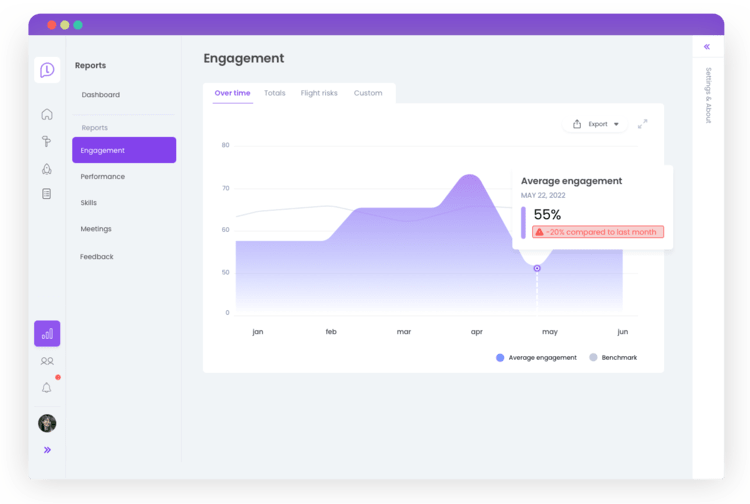
With Learned, you implement continuous short employee satisfaction surveys with just a few questions per week in the same time as an annual survey. This way, you maintain real-time insight into your employee engagement throughout the year and see the direct effect of your HR initiatives. Try Learned free for 14 days!
Image explanation: In this example, you can see the power of continuous short surveys. Due to a negative situation in April, you see a sharp decline in employee engagement in May. Thanks to the frequent measurements, you can take immediate action.
Ontvang de nieuwste HR-tips
Krijg 1 keer per maand onze tips, e-guides en templates direct in je mail.

Related articles
Discover more about this topic