

A job profile describes what someone in a role needs to be able to do, know and achieve to be successful. It is the foundation for recruitment, performance reviews, development and compensation. Yet many job profiles are outdated, too vague or simply a list of tasks. In this blog, you will learn what makes a good job profile, what it should include and how to create one in five steps, with an example.
Last updated: 29 October 2026
What is a job profile?
A job profile describes a role in terms of its purpose, responsibilities, required skills and competencies, and the results (KPIs) against which someone is assessed. It shows what good performance in that role means.
Together, all job profiles form an organisation's job architecture: an overview of all roles, their levels and how they relate to one another.
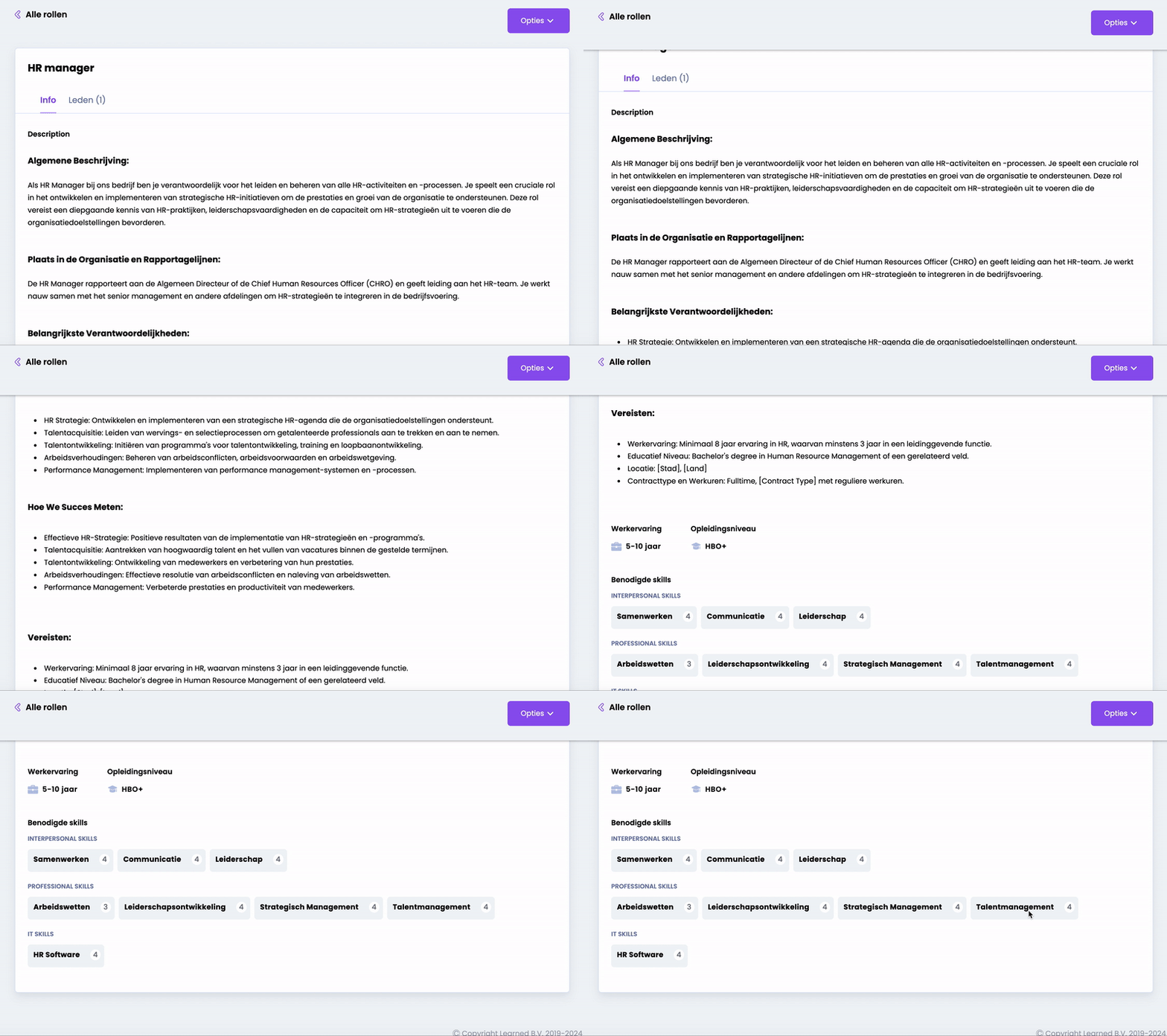
Example of a job profile
This is what a skills-based job profile for an HR manager looks like:
| Component | HR manager example |
|---|---|
| Purpose of the role | Ensure that the organisation attracts, develops and retains the right people |
| Position | Reports to the director and leads the HR team |
| KPIs | eNPS score of X, employee turnover below X%, performance review cycle 100% completed |
| Competencies | Communication, coaching, change management, analytical thinking |
| Hard skills | Employment law, HR analytics, knowledge of job evaluation |
| Level | Specialist |
Job profile, job description or competency profile?
These terms are often used interchangeably, but they are not the same:
| What it includes | Use | |
|---|---|---|
| Job description | Tasks and responsibilities | Mainly job advertisements and employment contracts |
| Competency profile | Required behaviours and competencies | Development and assessment of behaviour |
| Job profile | Purpose, position, KPIs, competencies and skills | Recruitment, performance reviews, development and compensation |
A job profile therefore has the broadest scope. It includes the competency profile, as well as the results and knowledge associated with the role.
What do you use a job profile for?
You need a good job profile for almost every HR process:
- Clear expectations: employees and managers know what good performance means. The National Employer Report 2026 shows that almost one in three employees does not know what their manager expects of them.
- Recruitment and selection: the job profile forms the basis for your job advertisement, allowing you to select candidates based on the skills that really matter.
- Objective assessment: you assess people against the KPIs and behaviours in the profile, rather than impressions.
- Development and career paths: employees can see which skills they need for their next step. Read more about career paths.
- Fair compensation: job profiles are the foundation for job evaluation and a salary structure.
A skills-based job profile
Traditional job profiles focus on tasks, responsibilities and hierarchy. But tasks change quickly, especially now that AI is taking over more and more work. And a task list says little about how well someone performs.
A skills-based job profile looks at what someone needs to be able to do, rather than the tasks they need to carry out. It combines:
- Competencies (soft skills): transferable behaviours, such as collaboration, communication or leadership.
- Knowledge and technical skills (hard skills): role-specific knowledge, such as employment law, programming or financial analysis.
- KPIs: the measurable results that indicate success.
This type of profile stays relevant for longer and makes assessment and development tangible.
What should a job profile include? Checklist
Keep the profile concise and consistent. Use the same structure for every role.
The basics
- Job title: a clear, recognisable name.
- Purpose of the role: why does this role exist, and how does it contribute to organisational goals?
- Position in the organisation: who does the role report to, and does it involve managing others?
- Decision-making authority: which decisions can someone in this role make?
Results and skills
- KPIs: measurable results, for example, "X projects delivered on time".
- Competencies: no more than five to seven, described as specific, observable behaviours at the level of the role.
- Hard skills: role-specific knowledge, experience and technical skills.
Optional
- Education requirements: only if a qualification is legally or practically required, as for a nurse or lawyer.
- Job level: the role's position within the job architecture and its corresponding salary band.
Leave out a detailed task list. Tasks quickly become outdated and lead to discussions about what does and does not fall within the role.
Creating a job profile in 5 steps
Step 1. Define the purpose and position of the role
Start by asking why the role exists. What should someone in this role achieve, and how does that contribute to the goals of the team and the organisation? Also establish where the role sits within the organisation.
Step 2. Define the competencies and skills
Choose the competencies and hard skills that really make a difference. Describe each competency as observable behaviour so that everyone has the same understanding of terms such as "proactive". Keep the total to a maximum of ten. A competency matrix helps you define levels for each competency.
Step 3. Establish how you will measure success
Define two to four KPIs for each role. For example:
- Project manager: percentage of projects delivered on time and within budget
- Developer: number of tickets completed without bugs
- HR manager: eNPS score and employee turnover rate
Defining KPIs requires knowledge of the role. Involve the manager, but also agree on how you will avoid subjectivity.
Step 4. Determine the level
Assign the role a level within your job architecture, such as operational, independent, specialist or strategic. This allows you to compare roles and link them to a salary band. A job matrix makes these levels clear.
Step 5. Check the profile against day-to-day practice
Share the draft with the manager and employees who currently hold the role. Ask:
- Do you recognise your work in this profile?
- Are these the KPIs that really matter?
- Are any skills or competencies missing?
This makes the profile realistic and gives it support from those involved.
How do you create job profiles: yourself, with AI or with software?
| Approach | Advantages | Disadvantages |
|---|---|---|
| External agency | Methodical and well-founded | Expensive, and profiles quickly become outdated after delivery |
| AI tools such as ChatGPT | Fast and easy to do yourself | Generic output and separate documents that you need to maintain yourself |
| HR software | All profiles in one place, linked to employees and performance reviews | Requires initial setup |
With job architecture software such as Learned, you can create skills-based job profiles with AI support, keep them up to date and link them directly to evaluations, development and compensation.
Want to try it yourself? Download the e-guide to creating a skills-based job profile, with or without AI.
Job profiles and pay transparency legislation
With the introduction of pay transparency legislation in the Netherlands (the Dutch implementation of the EU Pay Transparency Directive), employers must be able to explain why someone earns what they earn. This requires an objective, gender-neutral system of job evaluation and classification. Up-to-date job profiles with clear levels, skills and KPIs provide the foundation: without good profiles, you cannot compare roles or justify pay.
Keep job profiles up to date
Roles change as a result of growth, new technology and AI. Agree to review profiles at least once a year, for example after the performance review cycle. If managers or employees notice that a skill or KPI is no longer accurate, ask them to report it immediately so that HR can update the profile.
Frequently asked questions about job profiles
What is a job profile?
A job profile describes the purpose of a role, its position in the organisation, the required competencies and skills, and the KPIs against which someone is assessed.
What is the difference between a job profile and a job description?
A job description mainly describes tasks and responsibilities. A job profile is broader: it also includes competencies, skills and measurable results.
What should a job profile include?
The job title, purpose of the role, position, decision-making authority, KPIs, competencies and hard skills. You can optionally add education requirements and the job level.
How many competencies should you include in a job profile?
Keep it to five to seven competencies and a maximum of ten competencies and skills combined. Including more makes the profile difficult to navigate and use for assessment.
How often should you update a job profile?
At least once a year, and immediately if a role changes significantly, for example due to a reorganisation or new technology.
What is a skills-based job profile?
A job profile based on the skills and competencies needed to succeed, rather than a list of tasks. It stays relevant for longer and makes assessment and development tangible.
Ontvang de nieuwste HR-tips
Krijg 1 keer per maand onze tips, e-guides en templates direct in je mail.

Related articles
Discover more about this topic