
![Competency matrix and skill matrix: how to use it [+ example]](/images/blog/hero-20.png)
One of the most important roles of HR is to help employees develop further – and thus utilize the maximum potential of everyone in the organization. A useful tool for this is the creation of a competency matrix or skills matrix.
But what exactly is a competency matrix, what does an example look like, and how do you create one? You can read about that here.
But what exactly is a competency matrix, what does an example look like, and how do you create one? You can read about that here.
Want to get started with a skills matrix right away? 👉 Download this template with 38 soft skills, described behaviorally
What is a competency matrix? [+example]
A competency matrix (also called skills matrix) is a visual overview of the skills, competencies and knowledge of employees in an organisation – or within a team.
The overview such a matrix provides helps HR and managers to better steer development, growth and efficiency.
The overview such a matrix provides helps HR and managers to better steer development, growth and efficiency.
What do you put in a skills or competency matrix?
A competency matrix is a table in which you list:
You can also focus on the skills for a single position, but then you would be talking about a job profile or competency profile.
The skills you list can be a mix of technical skills, soft skills, knowledge, certifications, and other relevant qualifications for a position. 👇
- (Along one axis) The different positions and roles in a team, department, or organization
- (Along the other axis) The corresponding skills
- (In the table) Each employee's level in those skills
You can also focus on the skills for a single position, but then you would be talking about a job profile or competency profile.
The skills you list can be a mix of technical skills, soft skills, knowledge, certifications, and other relevant qualifications for a position. 👇
Example of a competency matrix
This is an example of a skills matrix for the Marketing Manager role:
The matrix shows the required skills along one axis and the different employees with that role along the other, indicating their skill levels.
This easily shows you:
The matrix shows the required skills along one axis and the different employees with that role along the other, indicating their skill levels.
This easily shows you:
- who performs best in a given role
- which skills certain employees can further develop
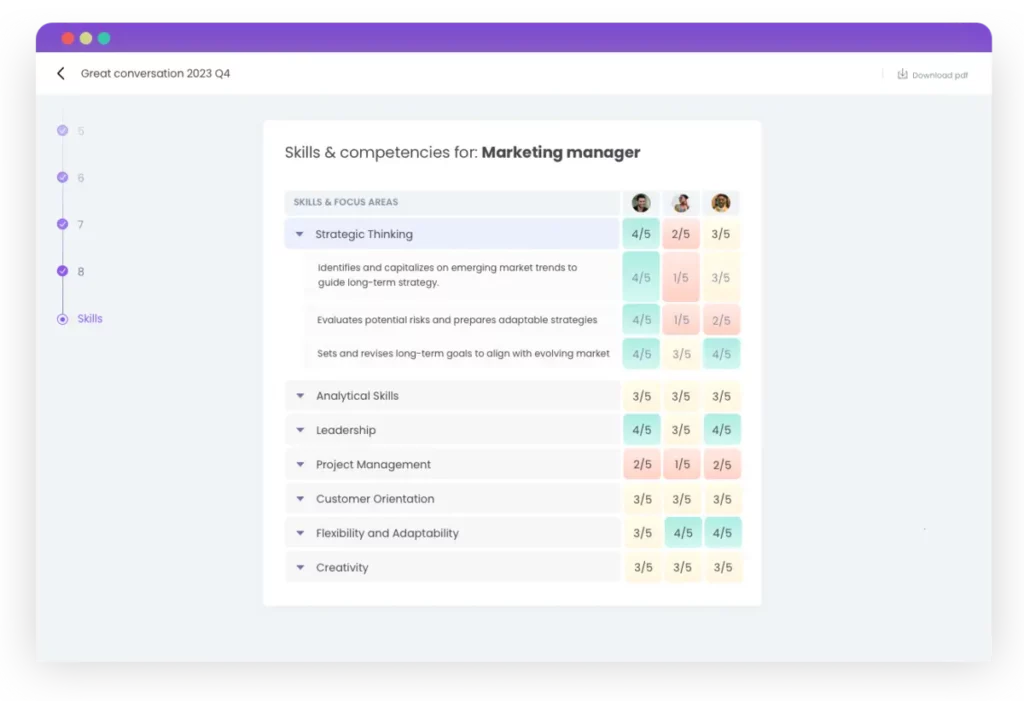
The matrix contains the skills needed to perform this role well along one axis (horizontal, in the rows), and the different employees with the Marketing Manager function and the extent to which they possess the required skills along the other axis (vertical, in the columns).
This makes it easy to see:
This makes it easy to see:
- who performs best in a specific role
- which skills certain employees can further develop
The difference between skills and competencies
Competencies or skills are often used as general terms. But precisely speaking, competencies are a combination of knowledge, skills, experience and personal characteristics that enable you to successfully perform tasks. Together they form everything you know, are, understand and can do.
a) Competencies (soft skills)
You can also see competencies as soft skills: interpersonal and behavioural skills. They indicate how someone performs tasks and communicates and collaborates.
Soft skills are also called 'transferable' skills because they are portable.
🧠 Examples: communication skills / problem-solving / project management / leadership skills
Soft skills are also called 'transferable' skills because they are portable.
🧠 Examples: communication skills / problem-solving / project management / leadership skills
b) Professional skills (experience/knowledge)
Professional skills are job-specific and range from technical knowledge to experience with specific methods or processes.
They are also called hard skills or job-specific skills.
🧠 Examples: financial analysis / backend software development / working with specific machines or software tools / developing marketing strategies
They are also called hard skills or job-specific skills.
🧠 Examples: financial analysis / backend software development / working with specific machines or software tools / developing marketing strategies
c) Technical skills (tools and technologies)
Within professional or 'hard skills' you can create a subcategory of technical skills. These are the practical, often software-related skills needed to perform specific tasks.
🧠 Examples:
🧠 Examples:
- knowledge of a programming language like Node.js
- ability to work with design tools like Adobe Illustrator
What do you use a competency or skills matrix for?
1. Clear expectations
By using the matrix for job profiles and evaluations, both employees and managers can see exactly which skills are expected and at what level. This prevents ambiguity and ensures that everyone pursues the same goals.
2. Fair, objective Performance Management
A competency matrix easily shows you which skills employees can develop further.
Use these skills and competencies as a basis for job profiles, and then consistently incorporate them into evaluations and 1-on-1 discussions. This ensures that:
If you also use 360-degree feedback, you'll be working towards as much objectivity as possible in evaluations.
Use these skills and competencies as a basis for job profiles, and then consistently incorporate them into evaluations and 1-on-1 discussions. This ensures that:
- managers know on which objective criteria they can base their people's performance
- employees in the same position are evaluated consistently, based on the same skills and competencies
- employees gain control over the competencies they can develop, and have insight into their progress
If you also use 360-degree feedback, you'll be working towards as much objectivity as possible in evaluations.
3. Insight into skill gaps
In a matrix you can easily compare employees' current levels with the requirements of their role or a future position they want to grow into.
This way you can identify a skill gap: which skills can employees still develop? Based on those skill gaps, you create a development plan.
This way you can identify a skill gap: which skills can employees still develop? Based on those skill gaps, you create a development plan.
4. A personal growth path for every employee (great for retention!)
If you have identified the skill gaps and development needs, you can set up a career path or growth path for each employee. You do this using a function matrix with job levels.
This is very motivating and contributes to talent retention, as employees know how they can grow within the organization – and clearly see what steps they need to take to do so.
This is very motivating and contributes to talent retention, as employees know how they can grow within the organization – and clearly see what steps they need to take to do so.
5. Strategic workforce planning & succession planning
In a skills matrix, you have a clear overview of each employee's strengths.
That's why a matrix also has great advantages for strategic workforce planning:
This allows you to determine who is ready for a promotion, who needs guidance to prepare for a vertical career move, but also who might be better suited for a different role (horizontal transfer).
You can also use a matrix for succession planning, so you are always prepared for future needs within the organization.
That's why a matrix also has great advantages for strategic workforce planning:
- You can easily compare the levels of different employees for a certain competency (e.g., leadership or professional skills such as financial analysis)
- You can easily see who performs best in a certain role
This allows you to determine who is ready for a promotion, who needs guidance to prepare for a vertical career move, but also who might be better suited for a different role (horizontal transfer).
You can also use a matrix for succession planning, so you are always prepared for future needs within the organization.
Creating a competency matrix: 3 steps
Creating an effective competency matrix starts with a solid foundation: skills-based job profiles. This ensures that you can assess and develop your employees in a consistent and objective manner.
Step 1: Get the foundation right
The first thing you need to do is to create a job framework that is based on skills and competencies.
Such a job framework contains for each role within the organization a detailed overview of:
Each of these competencies is then linked to the level: which specific competencies and behaviors are needed to be successful in a role? You determine the desired level of competencies and skills for a position, and that level is expressed in concrete behavior.
Such a job framework contains for each role within the organization a detailed overview of:
- The required competencies (soft skills)
- The technical skills (hard skills)
- The desired level, expressed in behavior
Each of these competencies is then linked to the level: which specific competencies and behaviors are needed to be successful in a role? You determine the desired level of competencies and skills for a position, and that level is expressed in concrete behavior.
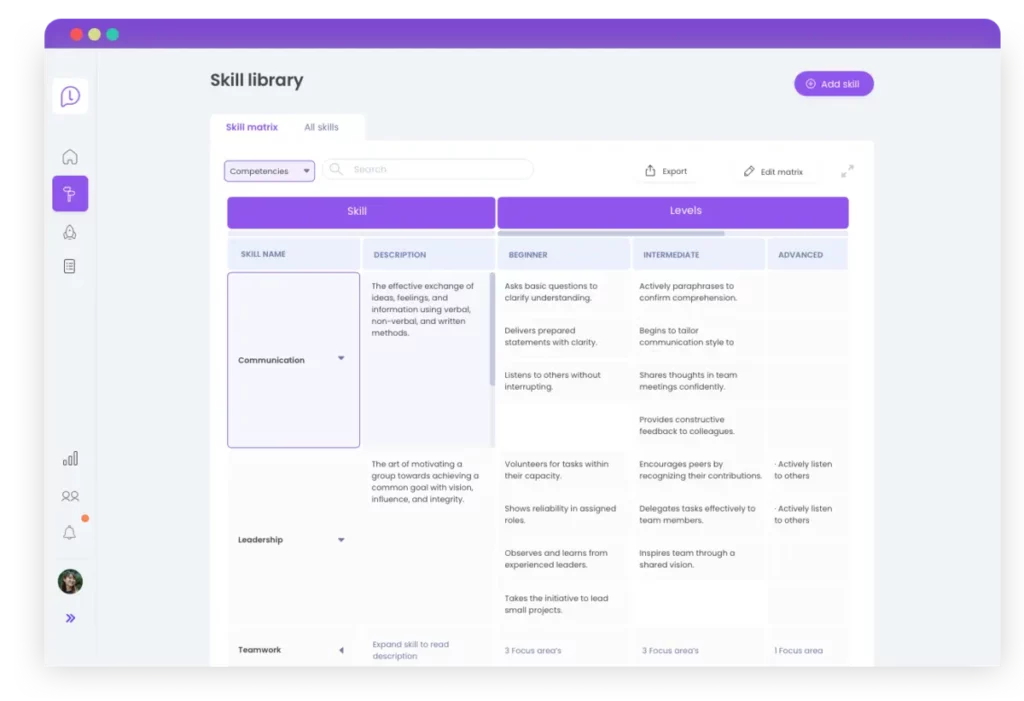
Tip 💡 In Learned's software, we have already pre-written the behavior at different competency levels for 2000 job profiles in our Job Framework. We do this with the help of AI.
Step 2: Determine how many levels to measure
The next step is to determine the levels at which you want to measure skills and competencies. There are 2 options.
These come from the so-called TMA method:
At Learned, we apply these levels specifically for competencies (soft skills such as leadership, communication, or problem-solving ability).
With these five levels, you can work for technical skills or professional knowledge ( such as software development, financial analysis, or marketing strategies).
4 levels
These come from the so-called TMA method:
- Generic level: basic skills that everyone within the organization must master.
- Operational: skills needed to successfully perform daily tasks.
- Tactical: skills that are important for coordinating and managing teams or projects.
- Strategic: skills that are essential for determining the course of the organization and making long-term decisions.
At Learned, we apply these levels specifically for competencies (soft skills such as leadership, communication, or problem-solving ability).
5 levels from beginner to expert:
- Beginner: Basic knowledge and limited experience.
- Competent: Able to perform simple tasks under guidance.
- Professional: Can work independently and has a good understanding of the subject matter.
- Advanced: Possesses in-depth knowledge and can guide others.
- Expert: Has extensive expertise and is considered an authority within this field.
With these five levels, you can work for technical skills or professional knowledge ( such as software development, financial analysis, or marketing strategies).
Step 3: Fill in competencies for each employee
Once the job framework and levels are set, you can fill in the skills matrix with each employee's level.
Do this based on objective evaluations using 360-degree feedback. This means not only the manager, but also the employee and colleagues provide input.
The result is a well-founded, fair assessment of current skills within your team.
Do this based on objective evaluations using 360-degree feedback. This means not only the manager, but also the employee and colleagues provide input.
The result is a well-founded, fair assessment of current skills within your team.
Bonus tip! 💬 Keep updating the competency matrix
That's what you do by integrating the competencies into your Performance Management cycle. Ensure that employee competencies and levels are continuously evaluated in development discussions with managers.
This way, you keep your finger on the pulse and can quickly respond to changing business needs. This not only keeps the matrix up-to-date, but also strengthens the continuous development of your employees.
This way, you keep your finger on the pulse and can quickly respond to changing business needs. This not only keeps the matrix up-to-date, but also strengthens the continuous development of your employees.
Getting started with competencies in your organisation
What skills and competencies exist for different job profiles?
If you want to get started creating a skills or competency matrix for your organisation, we'll help you on your way!
If you want to get started creating a skills or competency matrix for your organisation, we'll help you on your way!
👉 Download our template with 38 soft skills, expressed in 5 levels with concrete behavioural examples
Ontvang de nieuwste HR-tips
Krijg 1 keer per maand onze tips, e-guides en templates direct in je mail.