

A job framework is an overview of all job profiles in your organization. Of course, you can create it because you have to and then put it on the shelf. But you can also use a job framework as a basis for your HR processes, creating value for your organization.
With a realistic job framework, you contribute to achieving strategic goals and help employees develop further. And it doesn't have to take a lot of time: you can use AI! How to create such a framework, read here.
What Is a Job Framework?
You can see a job framework as a blueprint of your organization. It is a structured system that provides an overview of all job profiles and roles in the organization.
This creates insight into the organizational structure and clarifies:
- how responsibilities are divided
- which department (or job family) a function falls under
- how different functions are connected
A job framework also makes it easier to establish salary structures and career paths. In short, it provides overview and clarity within an organization.
Example of a Job Framework
Every organization has different functions, so every job framework looks different. This is an example:
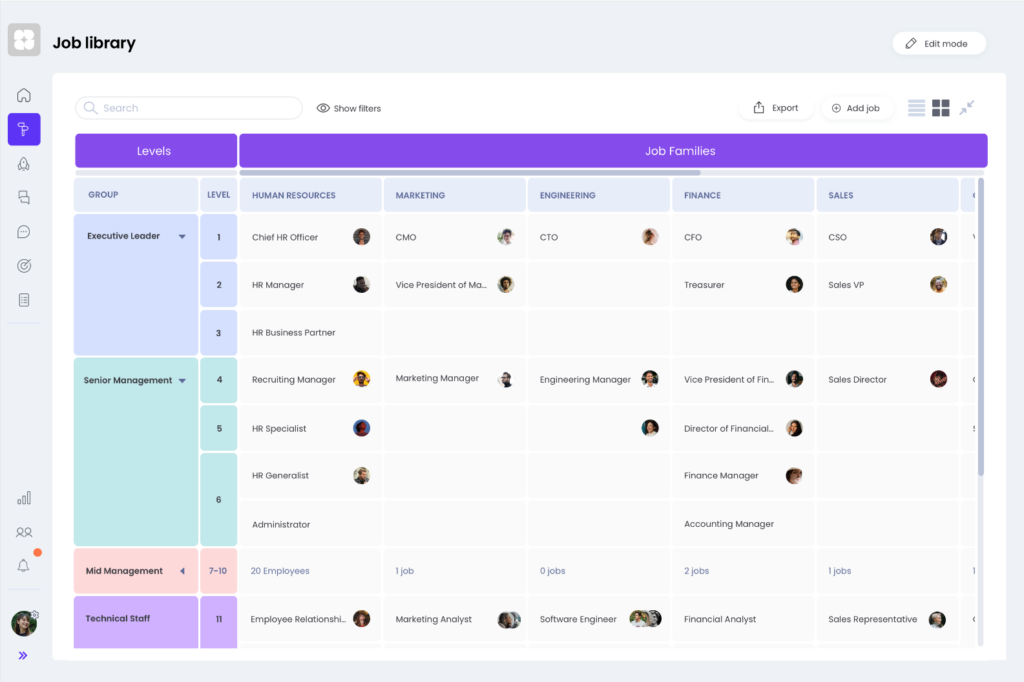
You can see several different components in it, such as levels and job families: we will explain these further.
What Components Make Up a Good Job Framework?
In a clear, complete job architecture, you will find the following components:
- The functions or job profiles: the name and description of each individual function.
- Job families or the different departments within your organization: you group functions into families, such as 'Human Resources', 'Production', 'Marketing' or 'Accounts Receivable'. This makes it easier to compare functions within the same field.
- Job levels: based on the complexity, seniority, and responsibilities of a function, you can create a ranking of different levels.
You can choose to systematize seniority levels by dividing all functions in your job architecture into the same number of levels, for example 3, 4, or 5. Then you can also assign standard names to those levels, such as from beginner to expert or ascending 'Junior – medior – senior'.
The job architecture also helps determine your organization's salary structure. Job levels and job families are often linked to salary scales to ensure consistency and transparency in determining salary levels.
👉 Looking for an overview of all skills and competencies in your organization? You can create one in a skills or competency matrix
Benefits of a Job Framework
As you can see from the clear structure: a job framework creates clarity. It does this not only for you as HR, but when set up properly, for everyone in the organization.
A well-constructed job framework can be used for these purposes:
- You provide clarity about what you expect from employees in a certain function.
- Recruitment: with the job profiles in your framework, you map out which knowledge and skills are needed in a function.
- Transparency about compensation when you link salary bands to different function levels.
- Assessment of someone's performance: a job profile forms the basis for performance evaluation.
- Development and growth opportunities: with function levels and skills-based job profiles, you provide clear insight into what someone needs to be ready for the next function. This enables career paths.
Setting Up a Job Framework in 8 Steps with AI
1. Create an Overview of All Functions in Your Organization
This also gives you insight into tasks that need to be done but may not yet be included in the right job profile.
2. Determine the Job Families
Then you start clustering functions to create a job framework: you group functions into a number of families or groups.
Usually these job families correspond to the departments in your organization.
A simple example: if you have a Head of Production, Sales and Administration, those are the 3 job families you want to classify functions into (besides management).
3. Apply Function Levels
Next, you determine the levels at which you want to measure employee skills and competencies.
At Learned, we use the 4 levels from the TMA method:
- Generic: basic skills that everyone in the organization must master.
- Operational: skills needed to successfully perform daily tasks.
- Tactical level: mastering the skills for coordinating and managing teams or projects.
- Strategic: possessing the skills for determining the organization's course and making long-term decisions.
4. Map Your Organization-Wide Values
This is the first step towards creating job profiles: we always recommend including the 'fit' with your core values in a job profile.
This ensures you recruit and evaluate based on more than just tasks or performance, but also look at how someone's behavior fits within your organizational culture.
5. Determine Required Competencies & Skills
You now map out all required competencies, a combination of soft skills and technical skills:
- Required competencies (soft skills)
- Technical skills (hard skills)
- The desired level, expressed in behavioral descriptions
You then link each competency to the level appropriate for a function. There are 2 ways to determine the required competencies:
a) Through interviews with employees and managers
b) With the help of HR software and AI
6. Determine How You Want to Measure Success
Then it's time to establish the goals or KPIs (key performance indicators).
In a modern job profile, you record more than just a description of tasks, but also look at the concretely measurable criteria that determine whether someone performs well in a function.
For example: Q1 sales figures, number of tickets per hour or NPS score.
7. Create a Draft Job Framework
The real work: now you combine all the information about job profiles – values, skills, competencies and KPIs – with information about job families and levels. Together, these form the first version of your job framework.
You can choose to create a job framework yourself, for example in an Excel file. But it is much clearer and more efficient to use job framework software.
- Then you can easily share job profiles with managers and employees
- You easily adjust your framework and keep it up-to-date
- You can easily compare requirements for similar functions
- You easily create career paths in job framework software
8. Verify Job Profiles with Employees and (Team) Managers
Of course HR is involved in creating job profiles and a job framework, but make sure you also collect feedback from the employees who perform the functions. With their input, you create realistic job profiles.
- Do employees recognize themselves in the skills and competencies in their job profile?
- Which goals and KPIs are important for managers for team success?
- Are the levels in your framework correct, or are there perhaps functions missing?
Bonus Tip: Create Career Paths Based on Your Job Framework
Use your job structure for Performance Management – in other words: to stimulate internal growth and development.
This increases employee motivation, keeps everyone engaged, and prevents turnover! Because for the modern employee, knowing how you can develop in your job is one of the main reasons to stay with an organization.
👉 Discover more benefits of Performance Management for employee retention here
Finally: Use a Job Framework as the Basis for Your Evaluation Process
The most important thing to remember? If you truly want to add value in your HR processes, integrate a job framework into your HR cycle.
You do this by using the skills, competencies and KPIs from job profiles as the basis for your conversation cycle and evaluation process.
- By bringing the competencies and KPIs from the job profile into every conversation between manager and employee, you base feedback, evaluations and performance on measurable results and concretely observable behavior.
- You make your Performance Management or evaluation cycle objective.
This ultimately helps employees and managers to provide or receive the right coaching, grow internally and get the most out of their jobs!
Ontvang de nieuwste HR-tips
Krijg 1 keer per maand onze tips, e-guides en templates direct in je mail.

Related articles
Discover more about this topic