

What is constructive feedback
At Learned, we strongly believe in exchanging constructive feedback. This is a valuable communication tool that helps with the growth and development of individuals and teams. It involves providing specific, objective, and useful information about someone's performance or behavior, with the intention of promoting positive change. Constructive feedback is uplifting, honest, respectful, and focused on improvement. It emphasizes both strengths and areas that need improvement, and offers concrete suggestions and solutions. By giving constructive feedback, leaders and colleagues can create a positive work environment that stimulates growth, motivation, and better performance. This leads to greater engagement among your employees and thus a lower turnover rate. Download our e-guide on 'real-time insight into the employee engagement of your high performers' to discover how to measure, interpret, and improve engagement, so you retain the best talent and save costs.
Learned facilitates objective evaluations. By creating multiple measurement moments per year based on different themes – for example: the fit with your culture and achieving goals, you gain objective insight into your low and high performers.
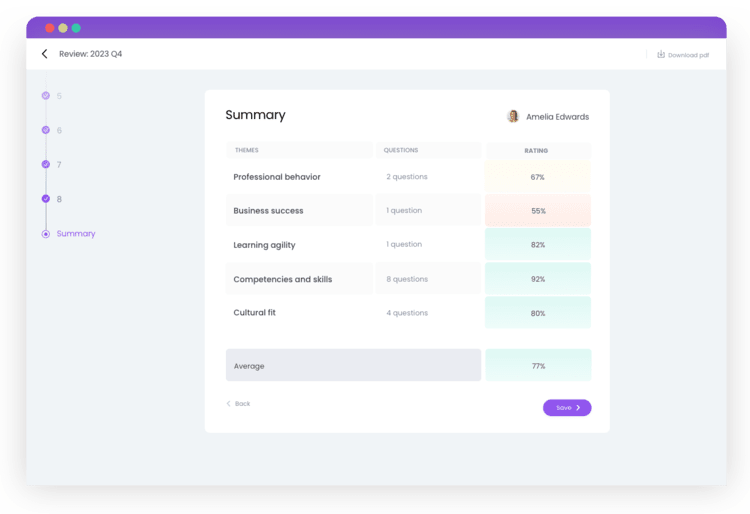
Explanation: Each evaluation provides insight into how the employee scores on the different themes.
Difference between constructive feedback and negative feedback
Constructive feedback sounds simple, right? But why does exchanging feedback still often go wrong? Constructive feedback is often confused with negative feedback. Negative feedback differs from constructive feedback in that it mainly focuses on emphasizing problems, mistakes or shortcomings, without paying much attention to possible solutions or growth.
Negative feedback can be loaded with criticism, general condemnations or insults. It can damage relationships and reduce motivation and engagement. Constructive feedback, on the other hand, aims to help the recipient improve, learn and develop.
Examples of constructive feedback
- "You did great work during the presentation. You presented the information clearly and used engaging examples to support your points. I think it would be even more effective if you spoke a little slower, giving the audience time to absorb everything. Keep up the good work!"
- "I appreciate your effort to meet deadlines and your accuracy in completing tasks. However, I noticed you tend to take on too much sometimes, which causes stress and affects quality. Perhaps we can create a better plan together."
- "I want to thank you for your creative ideas during our team meeting. You really contributed to the brainstorming process. I think it would be even more effective if you structured your ideas a bit more. Great work and let's collaborate to make your ideas even more powerful!"
Do's and don'ts of constructive feedback
These examples seem simple, but the techniques used can be applied to many situations. There are certain do's and don'ts when exchanging constructive feedback.
Do's:
- Be specific and objective: Focus your feedback on concrete examples and behaviors, rather than using general terms.
- Offer solutions and support: Constructive feedback is not just about identifying problems, but also about providing possible solutions.
Don'ts:
- Don't become defensive or personal: Avoid making personal attacks. Feedback should focus on behavior or performance, not the person.
- Don't give vague or general feedback: Feedback should be specific and actionable.
The role of tooling in exchanging constructive feedback
Over the past years, we've seen a trend where it has become increasingly common to exchange feedback using software tools. These tools provide a structured and documented way to give and receive feedback, preventing misunderstandings. They also facilitate the feedback process by often providing templates, rating scales and comment fields. Moreover, these tools promote transparency and engagement as feedback can be given by multiple stakeholders. Finally, they enable remote feedback, allowing distributed teams to collaborate more effectively.
Create a culture of constructive feedback with Learned
Exchanging feedback has never been easier with the Learned platform. Within a few clicks, you've sent a new batch of tips&tops to your colleagues and team members. Ideal for quickly processing feedback after completing a project or a colleague's presentation. Additional benefit? All feedback you record in Learned is shown as a 'memory aid' when preparing for your next meeting. Try Learned free for 14 days and discover how easy it is to give constructive feedback with Learned.
Ontvang de nieuwste HR-tips
Krijg 1 keer per maand onze tips, e-guides en templates direct in je mail.