

Performance Management is important in the modern labor market because today's employees want to develop their skills and knowledge. If you offer them that challenge and development opportunities internally, they will be less likely to look for career opportunities elsewhere.
But what exactly does modern Performance Management entail? And how do you ensure fair, objective performance reviews to keep your employees engaged?
Here you can read about the benefits of Performance Management – and discover practical tips for integrating it into your HR processes.
👉 Want to get started with Performance Management right away? Design a modern HR cycle with our free e-guide.
What is Performance Management?
Performance Management encompasses the continuous process and all discussions to evaluate employee performance and coach them to further improve their work. In doing so, you establish performance goals that are aligned with your organization's strategic objectives, as well as the personal development goals of employees.
It is also referred to as human or people Performance Management (PPM) – in Dutch prestatiemanagement or prestatiebeheer.
In practice, Performance Management consists of these processes:
- Defining goals
- Measuring performance
- Giving feedback
- Developing skills
- Adjusting behavior
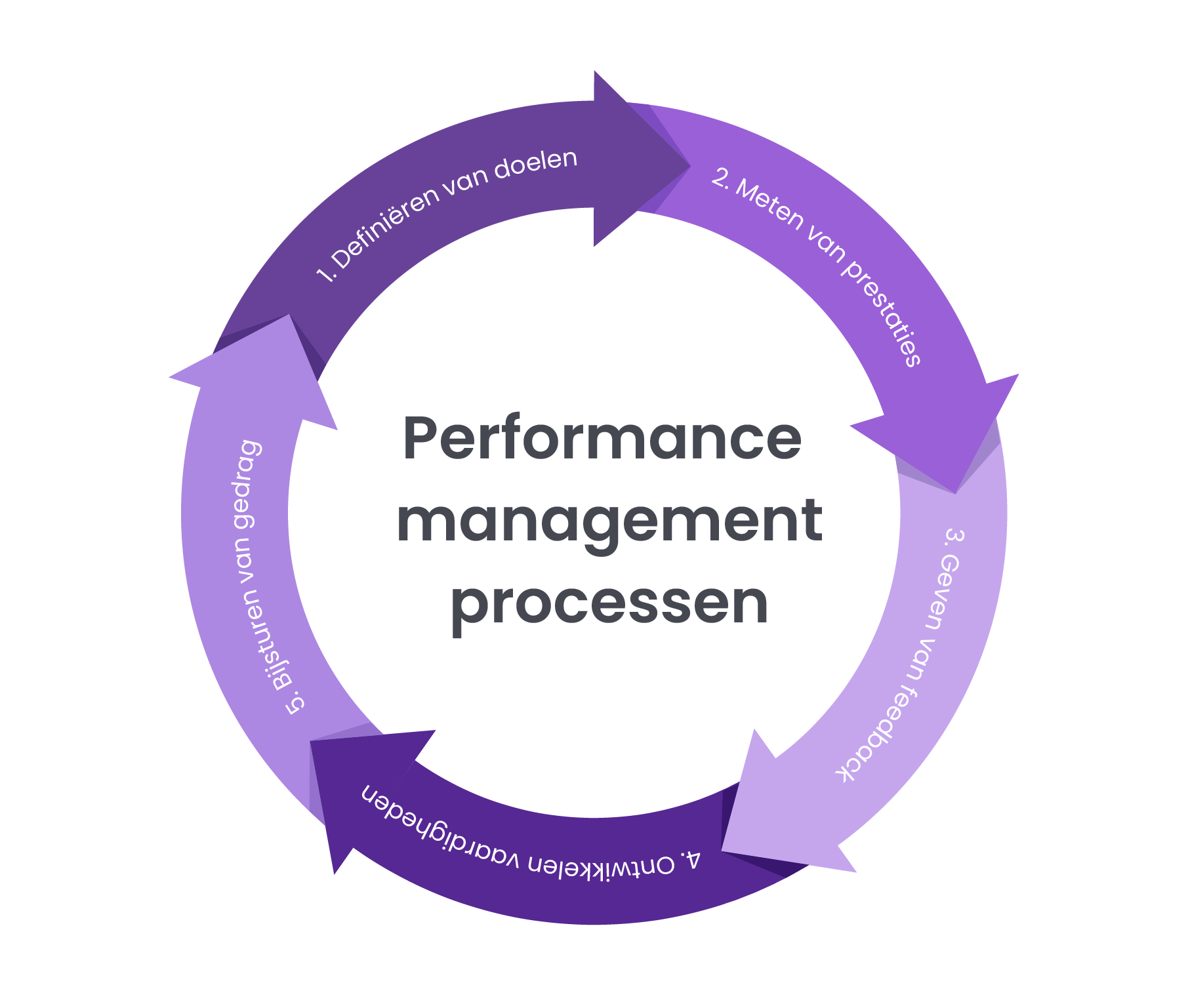
In short, Performance Management is thus formed by the discussions from your HR cycle, but it is more than that.
It also consists of the ongoing, data-driven process to measure and improve your organization's results based on the discussions between employees and managers. Another indispensable component is the guidance of managers who coach their team members to improve their performance.
Thus, a Performance Management process ensures the continuous improvement of an organization's results, but it also helps to develop talent and increase engagement.
💡 Curious about what exactly Performance Management consists of? Discover all components of a Performance Management model
A modern definition: competency-driven Performance Management
Performance Management is therefore more than setting goals based on performance indicators or KPIs, and then evaluating whether employees have achieved them.
In the modern HR conversation cycle, Performance Management is seen as an ongoing process in which managers coach their team to perform as well as possible. It contributes to the growth and development of individual employees, so that it goes hand in hand with the growth of the organization.
But to measure how employees perform and to guide them well in their development, you do need a certain degree of objective criteria.
That is why we at Learned envision a modern Performance Management process based on competencies. According to such a competence-driven or objective way of talent management, you measure someone's performance and development based on:
- Concrete achievements, results or KPIs
- Competencies ('hard' skills or knowledge)
- Behavior (soft skills)
And in addition, you can track the performance and development of employees based on how well someone fits the organization: in our software for Performance Management, we do this based on (1) work ethic, (2) fit with the work culture and (3) learning speed or learning agility.
You then incorporate these objective 'measurement instruments' into all parts of your HR cycle:
- Your job framework: instead of job descriptions, you draw up competency-driven job profiles
- The criteria that determine when employees perform well (the norm)
- The evaluation and development interviews, so that they follow the same objective structure for the same function
💜 Want to know more about our method? Download our model with 5 steps for objective Performance Management
Benefits: why Performance Management matters
1. You stimulate development and improve internal mobility
The most obvious advantage, already embedded in the definition of 'Performance Management': you help employees to develop further – vertically within their role, or horizontally within the organization.
Because managers are continually in dialogue with employees about their performance but also about their ambitions, it becomes clear:
- Which career steps employees want to take
- Which growth opportunities are available
- What is expected of employees to progress
Moreover, Performance Management is becoming increasingly relevant in a tight labor market. In 2020, 45% of organizations had internal mobility on their HR agenda, according to a Deloitte report.
Tip 💡 You can further promote internal mobility with Performance Management software in which you track employees' ambitions, and give them clear insight into career paths and which skills and soft skills they can improve.
2. You attract more talent
Employees increasingly value the opportunity to grow – also when choosing their employer. According to various studies, growth is one of the most important aspects of work for most people.
The Deloitte Human Capital Trends report shows that 25% of employees consider the opportunity to develop themselves the most important aspect of their work.
In other words: if your organization invests in Performance Management with attention to personal development, you have an advantage in attracting talent.
3. You retain people longer and prevent turnover
With Performance Management you create more internal growth opportunities, and that is a great way to keep employees satisfied and challenged in their work.
Multiple studies show that people who have the opportunity to develop further within an organization often stay longer, and are less likely to look for another position.
According to Betterworks research, 'internal growth' is the second reason employees stay at a company, cited by 41% of respondents, and professional growth is the third reason for leaving their job (after a higher salary and a better position elsewhere).
Additionally, LinkedIn research shows that 94% of employees are willing to stay longer with an employer who invests in their development. Organizations that excel at encouraging internal mobility retain employees for an average of 5.4 consecutive years.
All reasons why 90% of organizations use learning and development as the number 1 strategy in their retention policy (LinkedIn Workplace Learning Report 2024).
4. Growth and development helps you retain younger employees
The importance of development opportunities especially applies to younger generations: learning and development is one of the most important aspects of work for millennials and Generation Z (Deloitte 2024).
And Gen Z values the opportunity to learn in their job even more. A LinkedIn study shows that 53% of Gen Z agrees that Learning & Development helps them advance further in their career – compared to 37% of the generations before them (born before 1996).
5. It benefits the relationship between managers and employees
The modern Performance Management cycle consists of regular conversations, updates and feedback between employees and their managers. This continuous cycle contributes to a stronger working relationship, because there is more room for open communication.
According to Gallup, employees who have regular check-ins with their manager are 3 times more likely to be engaged at work. And employees who receive daily feedback from their manager are 3.6 times more likely to feel motivated to do outstanding work (Gallup 2024).
With a well-designed PM process, you thus strengthen the bond between managers and employees, which leads to higher satisfaction, better performance and lower turnover.
6. Contributing to clear goals increases engagement
In a modern Performance Management cycle, you set clear goals for employee development and performance, aligned with the strategic objectives of the entire organization.
Making goals and expectations transparent specifically increases employees' engagement with their work. Employees who can link their own goals or team goals to those of the organization are 3.5 times more engaged with the organization (Gallup). They understand how their work contributes to the bigger picture and what impact they make – a significant motivator.
And beyond that, simply having growth opportunities has a positive effect on work motivation: 73% of employees experience more job satisfaction thanks to growth opportunities, another Gallup study shows.
Tip 💡 There's a method to align individual employee goals as closely as possible with organizational goals: cascading. Read more in our blog 'Preparing for the annual review: tips and examples'.
Only 2 in 10 employees strongly agree that their performance is managed in a way that motivates them to do outstanding work. – Gallup, 'Re-engineering performance', 2018
Time for a new form of Performance Management
In recent years, there has been much discussion about abolishing performance reviews and stopping employee evaluations.
The reasons for this are:
- The performance review contributes little to improving performance, as it is based on retrospective evaluation. In other words, it is not focused on the future and on development.
- Many employees (and managers) are not satisfied with the traditional performance review: only 14% of workers believe that their current evaluation process encourages them to improve in their jobs.
- Some organizations even completely abandon evaluation, because the classic appraisal interview often consisted of one interview per year based on a five-point scale. This can be seen as subjective, as it is a snapshot, often based on the input of one manager.
At Learned, we see many companies that hold their measurement moments in November and December. But usually, only the performance around that time is considered. The results that employees achieved earlier that year are hardly mentioned. If you have tools to track employee performance throughout the year, the evaluation becomes much fairer.
💡 Want to know more? Also read 'Why you (still) don't want to abolish the performance review'
But despite the subjectivity of traditional performance reviews and appraisals, abolishing them is not the only alternative.
If you want to stimulate employee development, there are also many advantages to maintaining a certain structure in your HR interview cycle.
You can then modernize your Performance Management strategy by increasing the number of measurement moments and counteracting subjectivity as much as possible. How to do that, you can read below 👇
How to modernize your Performance Management cycle: 6 tips
Modernizing your HR cycle and review system is a better choice than abolishing reviews altogether.
The best approach is to ensure that your Performance Management counteracts subjectivity – with multiple measurement moments and one uniform way of reviewing, based on competencies. This way, you collect objective data to substantiate evaluations, promotions and compensation.
But what concrete steps can you take to set up a renewed, objective Performance Management cycle?
1. Set up an HR cycle with a minimum number of conversations
A minimal HR cycle is a simplified version of the traditional HR process, reducing the number of formal conversations. The goal is to emphasize continuous feedback and development, supplemented with a minimum number of formal evaluation moments.
A minimal conversation cycle consists of:
- Clear objectives and expectations for each employee
- A minimum number of formal evaluation interviews, usually 3-4 per year
- In between, ongoing feedback and coaching between manager and employee
By providing regular coaching, managers improve their leadership skills, but above all, they can better guide their team members in their development. Because there are 1-on-1 conversations throughout the year, obstacles, challenges, or development points can be quickly discussed and addressed.
In addition, interim evaluation moments often take less time than formal appraisal interviews. And because many conversations take place (e.g., once every 2 or 4 weeks), you always collect sufficient data about employee performance and development.
👉 Want to know more? Also read: The modern HR cycle: how to set it up based on continuous dialogue
2. Make evaluations objective: competency-driven and continuously measured
A Performance Management system with fair evaluations is important for employee motivation and engagement.
To make evaluations objective, two things are important:
(1) Increase the number of measurement moments;
(2) Improve the substantiation of evaluations – by basing them on concretely measurable competencies.
By incorporating regular feedback and measurement moments, you ensure that managers are always aware of employee performance throughout the year.
This way, you prevent subjective evaluations based on only one snapshot just before the performance review.
The second step is to determine the criteria by which you assess whether employees are performing well. You make these objective, based on:
- Performance or concrete results: has someone achieved certain SMART goals?
- Competencies and behavior ('hard' skills and soft skills)
- Core values: does someone's way of working fit the organization's culture?
The idea is that you also incorporate these objective criteria as topics of interim 1-on-1 (development) discussions between managers and their team members. They can then adjust goals or competencies that are no longer relevant.
💡 Want to know more about our method? Download our model for fair, objective Performance Management
If you want to guide employees as best as possible in their professional development, the evaluation should not depend on only one measurement moment and one criterion. To keep an evaluation relevant and objective, we recommend creating a mix of criteria in the areas of performance, development, and cultural fit.
3. Make rewards transparent
More and more organizations are choosing to reward everyone equally, as this contributes to a more equitable and inclusive work culture.
In an equal pay system, all employees receive the same remuneration for equivalent performance, regardless of their gender, age, ethnicity, or other personal characteristics. This can help reduce inequality and discrimination in the workplace and create a fair, just work environment.
Another advantage of equal pay is that it leads to more motivated and more engaged employees. If everyone receives the same remuneration for equivalent performance, a stronger sense of community emerges – a feeling of 'we do this together' – which can lead to better collaboration and higher productivity within teams.
You can always choose to combine an equal pay system with other forms of remuneration, such as performance-based pay or individual bonuses. In this way, employees who perform above average are still individually rewarded.
Remuneration only becomes explainable if your performance process is correct. With the Wage Transparency Act Checklist, you check remuneration and performance at once!
4. Connect Performance Management with Learning & Development and internal mobility
In some organizations, Performance Management is separate from training and educating employees.
How can you improve growth and development through your Performance Management process?
- Map out the skills and competencies that employees want to develop further, preferably by focusing on their strengths
- Help managers offer relevant training and courses that enable employees to develop their skills and competencies
- Ask about employees' ambitions in development conversations and document their growth opportunities in a personal career path
Tip 💡 Development plan and career path with Learned: we use development conversations to determine the competencies and skills of the employee. These measurements serve as input for the employee's development plan and career path.
5. Continuously measure the engagement of your best performing employees
When it comes to preventing turnover, you primarily want to prevent losing your best-performing employees. Because if high-performers leave, it can lead to a loss of expertise and knowledge, delays, and a decrease in productivity.
Therefore, it is very important to identify your high-performers through Performance Management.
However, it doesn't stop there. Also connect your Performance Management process with continuously measuring employee engagement. Engaged employees are the most important measure for retention.
You can continuously measure satisfaction (eNPS) and engagement through regular, short Pulse surveys. With these:
- You gain a better understanding of the reasons for higher or lower engagement
- You discover systematic patterns and areas for improvement for your organization
- You can quickly come up with proactive solutions to improve engagement
💡 Want to know more? Download our e-guide: 'Identify high- and low-performers with objective evaluations'
6. Make sure you can measure the success of your Performance Management
Make your Performance Management objective with Learned
With Learned's Performance module, you can easily measure employee performance across all roles and departments. This allows you to base appraisals on objective data and well-substantiated feedback.
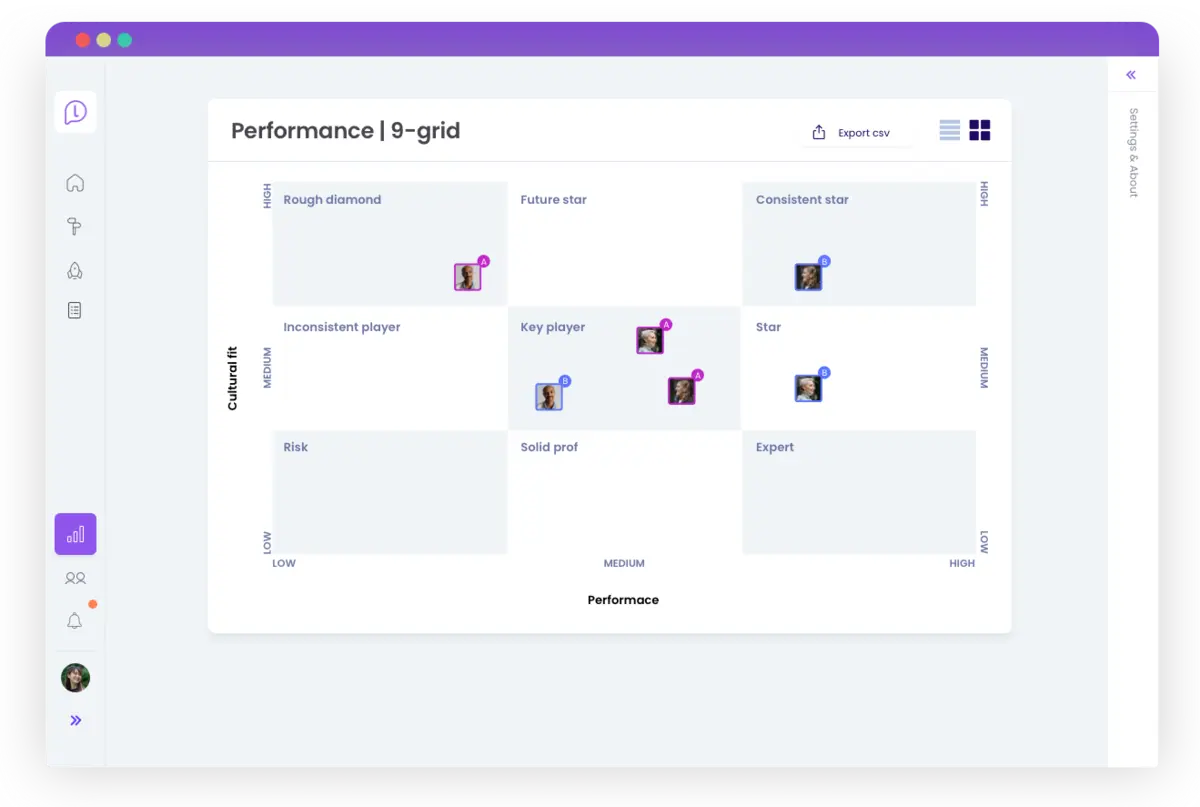
In our HR platform, you get the insights you really need. Such as which high-performing employees you can talk to to keep them engaged with your organization.
👉 Curious what a fair, modern evaluation cycle looks like in practice? Our client Workspace 365 shows how they streamlined their conversations, goals, and evaluations with Learned.
Ontvang de nieuwste HR-tips
Krijg 1 keer per maand onze tips, e-guides en templates direct in je mail.