

Organizational culture is more than just a buzzword. It influences the way employees think, act and collaborate. In this blog, we dive deeper into the meaning of organizational culture, why it is of the greatest importance within a company, and how it can contribute to creating a thriving and successful work environment.
Download our e-guide on 'real-time insight into employee engagement of your high performers' to discover how to measure, interpret, and improve engagement, so you retain the best talent and save costs. This way, you gain continuous insight into how your employees experience the organizational culture.
Meaning of organizational culture
Organizational culture, at its core, is the shared set of values, norms, beliefs and behaviors that define a company's identity. It goes beyond the mission statement on paper and is reflected in the daily interactions and decision-making processes of employees at all levels.
Why is organizational culture essential?
- Guides behavior: Organizational culture acts as a compass for employees, determining which actions and choices are considered acceptable. It guides the way people interact with each other and deal with challenges.
- Attracting and retaining talent: A positive organizational culture is attractive to talented professionals. It not only helps attract new talent, but also retain existing employees who feel connected to the culture.
- Innovation and creativity: An open and innovative culture encourages employees to express new ideas and take risks. This contributes to creativity and innovation within the company.
- Employee satisfaction: Employees who identify with a company's culture are generally more satisfied and engaged in their work.
- Business performance: Organizational culture influences the overall performance of a company. A strong culture can contribute to growth, profitability and sustainable success.
Types of organizational cultures
The Quinn Competing Values Framework, developed by Professor Robert E. Quinn and his colleagues, offers an insightful approach to understanding organizational cultures based on four different cultural paradigms. These cultures are presented as opposing values and norms, but are all relevant within certain organizational contexts. Below, the four main organizational cultures according to the Quinn model are described:
1. Hierarchical culture (Internal focus – control):
In a hierarchical culture, the emphasis is on control, structure and efficiency. The organization is usually strongly hierarchically organized with clear authority and formal procedures. Decision-making is often centralized, and employees are expected to follow existing processes.
Goal: Stability and control.
2. Family culture (Internal focus – flexibility):
The family culture is based on strong relationships, trust and care for employees. There is usually a flat organizational structure and a strong emphasis on teamwork and collaboration. Decision-making can be informal and based on consensus.
Goal: Engagement and harmony.
3. Adhocracy culture (External focus – flexibility):
In an adhocracy culture, the focus is on innovation, adaptability and creativity. Organizations with this culture are often dynamic, entrepreneurial and willing to take risks. There is plenty of room for experimentation and taking initiative. Decision-making can be decentralized and based on expertise.
Goal: Innovation and market orientation.
4. Market-oriented culture (External focus – control):
The market-oriented culture emphasizes competition, results and efficiency. Organizations with this culture are competitive and focused on achieving goals. Decision-making is often results-oriented and focused on measurable performance.
Goal: Competitive advantage and profitability.
The unique aspect of the Quinn model is that it recognizes that no single organizational culture is superior to another. It emphasizes the importance of understanding an organization's current culture and selecting the right culture depending on strategic objectives and the external environment. Organizations can even combine elements from different cultural paradigms to create a culture that best suits their needs.
The Quinn Competing Values Framework helps leaders and organizations analyze, understand and manage their culture, and it provides a valuable framework to facilitate effective change and growth.
Creating a positive organizational culture
Building a positive organizational culture requires commitment and attention. Here are some steps to achieve this:
- Define core values: Identify the core values the company wants to embody. These values should form the foundation of the culture.
- Communicate and model: Leaders should value the culture and model the desired behaviors. Open communication is essential to involve employees in the culture.
- Feedback and engagement: Listen to employee feedback and involve them in shaping the culture. This promotes ownership and engagement.
- Policy and procedures: Ensure that company policies and procedures are aligned with the desired culture. These should support rather than hinder the culture.
- Training and development: Invest in training and development to help employees develop the desired skills and mindset.
How Learned can help safeguard your culture
Organizational culture influences all aspects of business operations. By using the Learned platform, you can continuously measure themes like work enjoyment and workload so you always know how your employees experience the culture. This way you identify problems early and can proactively steer towards a positive organizational culture. Try Learned free for 14 days!
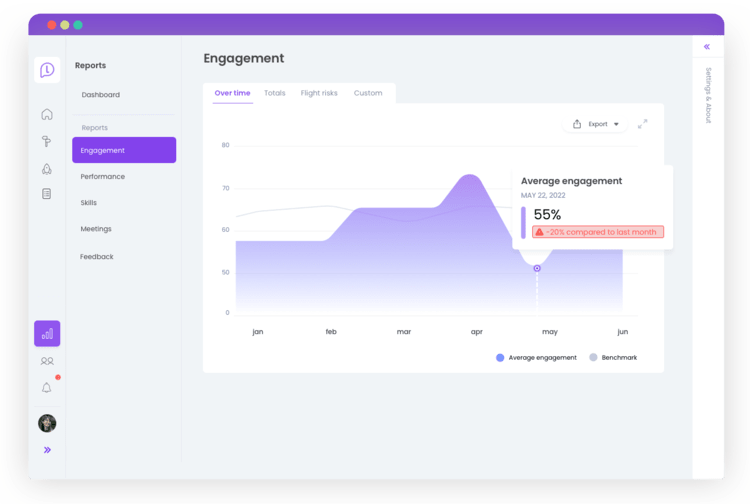
With Learned, you implement continuous short surveys with a few questions per week in the same time as an annual employee survey. This gives you real-time insight into employee engagement all year round and you immediately see the effect of your HR initiatives.
Image explanation: In this example you can see the power of continuous short surveys. Due to a negative situation in April, you see a sharp decline in employee engagement in May. Thanks to frequent measurements, you can take immediate action.
Ontvang de nieuwste HR-tips
Krijg 1 keer per maand onze tips, e-guides en templates direct in je mail.