

What is the new way of appraising?
The New Appraisal has been rapidly gaining popularity in recent years as a method for organizations to renew their HR conversation cycle. It offers a new framework for looking at the assessment of employee performance.
One of the founders of the theory of 'the New Appraisal' in HR is business economist Jacco van den Berg.
His starting point is that he is not against appraisals, but he does believe that the way in which the appraisal is carried out within the performance management cycle needs a refresh. He defines the performance management cycle as managing result agreements and behavior at employee level, in line with the organization's mission, vision and values.
These are the 4 most important principles of the New Appraisal:
1. Focus more on the employee's strengths
In the traditional conversation cycle, when setting development goals, the focus is often only on areas for improvement or 'weak' competencies of an employee. But the New Appraisal views people's development from positive psychology: the emphasis is on someone's strengths, and on building those further. The idea behind this is: it creates more value to turn a 7 into a 9 than to go from a 4 to a 5.
"Servant leaders take a step back, let their employees go without abandoning them. Employees continue to need regular guidance and support from their manager in the role of coach and evaluator." – Jacco van den Berg on the New Appraisal
2. Make employees responsible for their business goals and development
Where the manager's role in the traditional conversation cycle is to determine goals and impose development points, the manager's role in the New Appraisal shifts to that of coach. Of course, there are business goals that need to be achieved, but the goal is to let employees themselves propose how they can contribute to the organizational goals and which skills they can develop to be of even more added value in the future.
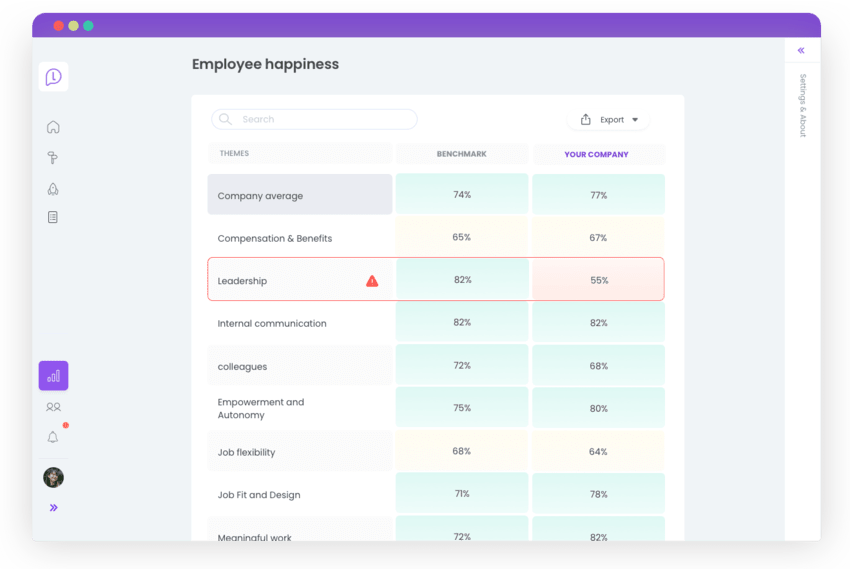
Learned helps you interpret the results of employee surveys and set priorities for improving engagement, by giving you insight into your score compared to similar organizations.
3. Conduct a continuous dialogue about performance and development
One of the most important principles of the new appraisal is to put the employee at the center, so that they can develop with pleasure and excel within the organization.
To achieve this, Van den Berg abandons the traditional cycle of planning, performance, and appraisal conversations: he proposes to have the 'Good Conversation' at a fixed number of moments during the year. This allows managers and employees to regularly discuss goals, development and career.
Both parties follow up these 3 to 4 'good conversations' with a number of more informal 1:1 meetings throughout the year, the so-called 'continuous dialogue'. In this ongoing dialogue, managers and employees talk to each other more frequently, sometimes even every month.
What is the new performance appraisal?
The New Performance Appraisal has been rapidly gaining popularity in recent years as a method for organisations to renew their HR conversation cycle. It offers a new framework for evaluating employee performance.
One of the founders of the theory of 'the New Performance Appraisal' in HR is business economist Jacco van den Berg.
His starting point is that he is not against appraisals, but he does believe that the way in which the appraisal is conducted within the performance management cycle needs a refresh. He defines the performance management cycle as steering on result agreements and behaviour at employee level, in line with the organisation's mission, vision and values.
These are the 4 most important principles of the New Performance Appraisal:
1. Focus more on the employee's strengths
In the traditional conversation cycle, when setting development goals, the focus is often only on areas for improvement or 'weak' competencies of an employee. But the New Performance Appraisal views people's development from positive psychology: the emphasis is on someone's strengths, and on further developing them. The idea behind this is: it creates more value to go from a 7 to a 9, than from a 4 to a 5.
"Servant leaders take a step back, letting their employees go without leaving them to their fate. Employees continue to need regular guidance and support from their manager in the role of coach and evaluator." – Jacco van den Berg on the New Performance Appraisal
How do you implement the new appraisal?
A solid implementation is important to make the New Appraisal a success. Want to know more about integrating the New Appraisal (and a continuous dialogue) into your conversation cycle? Read our blog 'How to set up a modern HR cycle'.
The main challenges
Although we at Learned endorse Van den Berg's vision, we also see various challenges in practice. The most important:
- Appraisals remain (sometimes) necessary. Both Van den Berg and Learned are not against appraisals, but focus on having 'good conversations' that should ensure there are no surprises for the employee at the end-of-year final assessment.
- Employees benefit from a minimal structure. Putting employees in the lead of their career is something we fully endorse. But it is important for organizations to create a minimal structure of 'good conversations' as a framework that guarantees the right level of guidance.
Benefits of the New Appraisal
Although no study has been conducted on the results of 'The New Appraisal', it is plausible to state that renewing the HR conversation cycle through the new appraisal would yield comparable results to the Gallup study on continuous dialogue. Based on this study, the new appraisal could achieve an increase in employee engagement of up to 280%.
In summary, the new appraisal system is a methodology for renewing the traditional HR conversation cycle. With the main goal of putting the employee at the center to allow them to optimally contribute to business results.
Our HR platform helps you implement a continuous HR cycle based on the New Appraisal. 👉 Want to know more? Watch our video demo or try Learned free for 14 days.
2. Make employees responsible for their business goals and development
Where the manager's role in the traditional conversation cycle is to set goals and impose development points, the manager's role in the New Performance Appraisal shifts to that of a coach. Of course, there are business goals that need to be achieved, but the aim is to let employees propose how they can contribute to organisational goals and which skills they can develop to be of even more added value in the future.
Learned helps you interpret the outcomes of employee surveys and set priorities for improving engagement, by giving you insight into your score compared to similar organisations.
☝🏽 In this example, you can see that the theme "Leadership" scores low for this organisation and that the benchmark is much higher: something to improve. On the other hand, the theme "Compensation" also scores relatively low, but the benchmark is also lower. So less priority needs to be given to that.
3. Conduct a continuous dialogue on performance and development
One of the most important principles of the new performance appraisal is to put the employee at the centre, so that they can develop with pleasure and excel within the organisation.
To achieve this, Van den Berg lets go of the traditional cycle of planning, performance and appraisal meetings: he proposes to have the 'Good Conversation' at a fixed number of moments during the year. This allows managers and employees to regularly discuss goals, development and career.
Both parties follow up these 3 to 4 'good conversations' with a number of more informal 1:1 meetings that take place throughout the year, the so-called 'continuous dialogue'. In this ongoing dialogue, managers and employees talk more often, sometimes even every month. This shorter cycle has the advantage that leaders are much closer to the action. They don't only hear about problems after 6 months, but issues are examined more quickly and they can coach employees more instead of just appraising them.
How do you implement the new performance appraisal?
A solid implementation is essential to make the New Performance Appraisal a success. Want to know more about integrating the New Performance Appraisal (and a continuous dialogue) into your conversation cycle? Read our blog 'How to set up a modern HR cycle'.
The main challenges
Although we at Learned endorse Van den Berg's vision, we also see various challenges in practice to consider. The most important:
- Appraisal is (sometimes) still necessary. Both Van den Berg and Learned are not against appraisals, but steer towards having 'good conversations' that should ensure there are no surprises at the end of the year during a final appraisal. This final appraisal is often needed to discuss potential salary increases.
- Employees benefit from a minimal structure. Placing employees in the lead of their career is something we fully endorse. But it is important as an organisation to create a minimal structure of 'good conversations', as a framework that guarantees the right level of guidance. This also ensures that more introverted colleagues get the space to share their ideas and wishes.
Advantages of the New Performance Appraisal
Although no study has been conducted on the results of 'The New Performance Appraisal', it is reasonable to state that renewing the HR conversation cycle through the new appraisal approach would yield comparable results to the study conducted by Gallup on continuous dialogue. Based on this study, the new performance appraisal could achieve an increase in employee engagement of up to 280%.
In summary, the new appraisal system is a methodology to renew the traditional HR conversation cycle. With the main goal of putting the employee at the centre to allow them to optimally contribute to business results. The 3 most important principles are: focus on the employee's strengths, place the employee in the lead, and conduct a continuous dialogue.
Our HR platform helps you implement an ongoing HR cycle based on the New Performance Appraisal. 👉 Want to know more? Watch our video demo or try Learned free for 14 days.
Ontvang de nieuwste HR-tips
Krijg 1 keer per maand onze tips, e-guides en templates direct in je mail.

Related articles
Discover more about this topic