

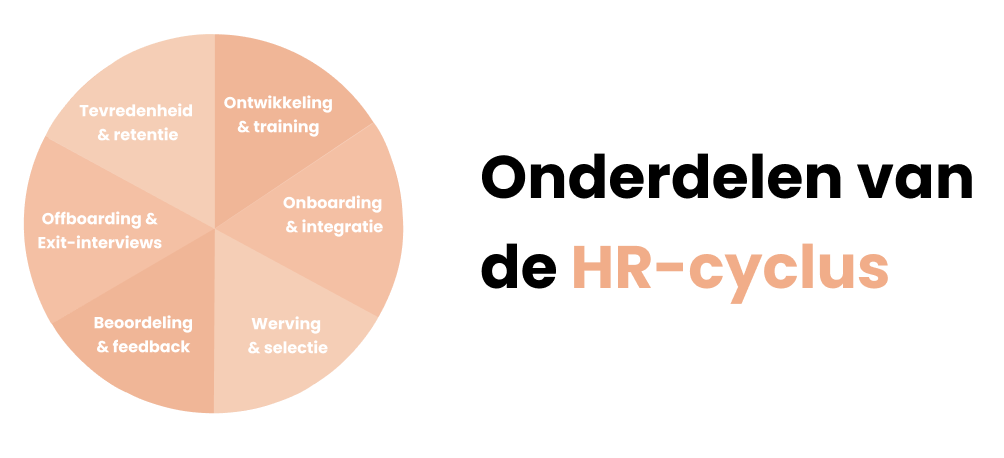
Perhaps it's time to modernize your HR cycle too. Here's how you do it: discover what exactly the modern interview cycle consists of, why you want to renew it, and how to set up your HR cycle in a modern way.
Would you rather get started right away? 👉 Download our free e-guide 'Design a Modern HR Cycle in 5 Steps Yourself'.
What is a modern HR cycle?
The traditional HR cycle
• Planning Meeting (usually at the beginning of the year): translating the organization's objectives into goals for departments, teams, and then for the employee;
• Performance Review (mid-calendar year): discussing progress and the extent to which objectives have been achieved at that point;
• Appraisal Interview (at the end of the year): assessing an employee's performance and evaluating the extent to which goals have been met. Often, compensation, such as whether or not there will be a salary increase, is also discussed.
Some organizations add a fourth meeting:
• Career or Development Talk (usually once a year): discussing the employee's personal development and career goals, future-oriented
The main purpose of the traditional conversation cycle could be seen as defining professional goals and achievements.
And that immediately highlights why the old HR cycle needs updating.
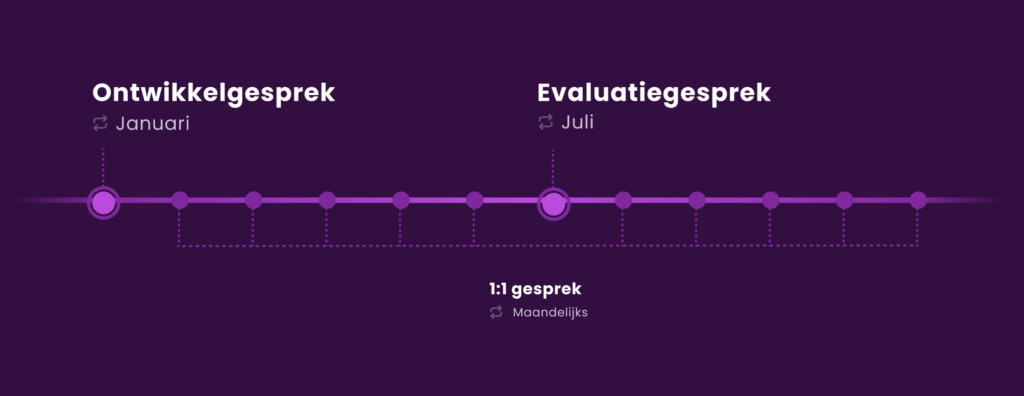
The modern HR cycle
The 3 traditional or formal conversations are based on the organization's perspective and are essentially one-way traffic: company goals are translated into goals for an employee, and then the manager assesses whether the person has made enough progress on those goals.
In short: there is little to no room for personal development or feedback from employees themselves. That is why many companies have renewed their HR cycle in recent years and added conversations for employee input.
The modern conversation cycle consists of at least these 6 components:
1. Combines the formal conversations (planning, performance, and appraisal) + the development conversation into one format, the 'Good Conversation'
2. These formal 'Good Conversations' take place 4 times per year
3. Additionally, there is a continuous dialogue with regular 1:1 conversations between manager and employee (e.g., every 2 or 4 weeks)
4. It is two-way traffic: the employee provides input
5. Future-oriented: all conversations aim to evaluate and look ahead
6. Development-oriented: personal development goals are established for employees, always with a direct link to business goals
Every organization can structure the conversations as they find most effective, and add extra moments where needed – such as an interim 1:1 conversation, development conversation or additional feedback moment.
A continuous dialogue as the basis for modern conversations
This is due to the principles on which the modern conversation cycle is based:
• A continuous dialogue
• The new appraisal
The conversations in the renewed HR cycle are no longer just 3 or 4 fixed 'measurement moments' per year, but consist of a continuous dialogue: they are supplemented in between with informal 1:1 conversations. In these, employees discuss their progress on goals, successes, and any roadblocks with their manager.
And in addition, the purpose of the 3-4 more formal conversations (such as a progress or development discussion) is not only to reflect on the growth, performance, and areas for improvement from a past period, but also to look forward – based on the principles of the Good Conversation:
– What contribution can someone make to team and organizational goals in the coming period?
– Which competencies (soft and hard skills) does an employee want to develop further? And what concrete initiatives can that person take for that?
A second principle for the conversations in the modern HR cycle is the New Appraisal. This evaluation model focuses on developing talents, based on positive psychology. Here too, a continuous dialogue is central, and the responsibility for their development and achieving goals lies with the employee themselves.
Why you need to renew your conversation cycle
The most important part of the traditional HR cycle, the performance review, has existed since 1920 and was developed in the American military. The design stems from a time when one supervisor had to 'manage' a group of workers who performed roughly the same work.
But since then, the nature of our work and the labor market have irreversibly changed.
It is no coincidence that many organizations are considering abolishing the performance review: in the modern world, the traditional conversation cycle no longer works.
This is also reflected in the numbers: multiple studies show that employees and managers are no longer satisfied with the results of the traditional performance review. Only 1 in 5 employees in the US finds their performance review transparent and motivating for better performance (Gallup 2024). Research by Gallup (2024) shows that only 2% of HR leaders are convinced that their Performance Management system effectively inspires employees to improve.
The benefits of a modern conversation cycle
• Employees become more involved in their goals and development, which also benefits their motivation: 73% of employees experience greater job satisfaction due to growth opportunities – according to research by Gallup.
• With development opportunities, you also retain more people. More chances for professional growth is the 3rd reason why employees consider quitting their job (source: Betterworks 2023). And according to research by LinkedIn, a modern conversation cycle reduces employee turnover by 41%.
• Especially younger generations are easier to retain with modern development discussions: learning and development is one of the top 3 priorities for millennials and Gen Z (source: Deloitte 2024).
💡 Want to know more? Read on about the disadvantages of the traditional performance review
Are you also convinced of the benefits of a modern HR cycle?
Then the next step is to set up an HR cycle specifically for your organization. We explain how to do that below. 👇
5 tips to set up a modern HR cycle
1. Determine the frequency of conversations in your HR cycle
Determine how often a conversation with your employees is needed.
Do your organizational goals change frequently and quickly? Then it is smart to hold the Good Conversation four times per year – with weekly or monthly 1-on-1 conversations for follow-up. This way you can timely adjust the employee and adapt employee goals when necessary:
At fixed moments: 'Good Conversations' – reflecting on goals, development and career opportunities
• up to 4 times per year
• combination of planning, performance, and appraisal conversation
• between employee and manager
• both prepare the conversation well
• guideline = accompanying (online) conversation form with questions and topics
Continuous: 1-on-1 conversation – discussing questions, feedback and next steps
• continuous, e.g., monthly or weekly
• follow-up of the Good Conversation
• between employee and manager/coach
• goal = focused on development: progress, performance so far, obstacles, areas for improvement, tips and feedback
2. Give managers a clear structure for good conversations
You can do this using a standard conversation form, such as for a planning meeting, a 1-on-1 meeting, or a form for a performance review.
Tip! 💡 The Learned platform contains more than 10 conversation forms that we also use for discussions with our employees. We based these forms on the best practices of new Performance Management and they are freely available to every user registered as a 'coach'.
For the structure of your formal discussions, you can follow this order:
Conversation structure part 1: evaluating
Regularly reflect on the employee's performance and development in the past period. Managers discuss (1) successes and areas for improvement so far; and (2) look ahead to competencies to develop further.
1. Engagement
Goal: know how someone is doing.
We always start the conversation with the soft side, because we want to know if the employee enjoys going to work, what the reasons are, and what we can improve.
2. Performance
Goal: express appreciation or resolve (potential) problems early, keep goals sharp, and celebrate successes.
Now that we know how someone feels, we look back at the past period. We evaluate goals, result agreements or responsibilities arising from the employee's job profile.
3. Development, competencies and skills
Goal: discover talent (through analysis) and discuss development efforts.
We evaluate personal learning goals and development agreements. These were documented by the employee at the beginning of the quarter. By reflecting on these more often, we implement the lessons learned in daily work.
We look at the (desired) behavior and knowledge level of the employee. For this, we use the required competencies and skills from this employee's job profile. For example, do we see an improvement in skills through the learning goals they are working on? We don't just want to focus on what someone is good at, but also look at how we can turn a '7' into a '9'.
Conversation structure part 2: looking ahead
According to the principles of a modern HR cycle, you then discuss the plans and expectations for the future.
4. Goals
Goal: determine business goals
We look at what the employee wants to contribute to our company's growth in the coming quarter. Think of (new) responsibilities needed for new projects or KPIs.
These questions can help:
• What contribution can the employee make to team and organizational goals in the coming period?
• What would the employee like to develop further?
• What can the employee do to get one step closer to their career step?
5. Career path
Goal: find out where the employee wants to go in their career.
We ask about the employee's ambition. Does the employee want to further develop in their current role with, for example, extra responsibilities, or are they (eventually) interested in a different role within Learned?
6. Development agreements
Goal: together determine which new development goals the employee will work on.
We look at which competencies and skills the employee can further develop, so they can perform even better in their current role or grow towards their future ambition.
7. Employee feedback
Goal: listen to feedback and improvement points about the organization and the functioning of the supervisor/manager.
Finally, we discuss the feedback the employee has for the supervisor and what they would like to see improved within our company. Because development comes from both sides!
3. Don't discuss employment conditions (yet)
The conversations within a renewed HR cycle deliberately do not address employment conditions. In our approach, evaluations and compensation are separate from each other. Of course, you use the assessments from the Good Conversation as input for determining compensation, but we do not align them directly.
At Learned, this means we use our HR cycle to focus on development and do not directly use it to discuss employment conditions. For that, we schedule a separate conversation – namely at the beginning of a new year (in January), or one month before a contract renewal.
4. Use 360-degree feedback for more insight
We integrated these feedback forms into our Learned platform. This allows us to store the employee's answers, colleagues' opinions, and the manager's feedback with a single form.
5. Follow up on conversations in the HR cycle
We use weekly (or monthly) 1-on-1 conversations to discuss:
1. Brief evaluation of the past period
2. Progress on goals
3. Possible obstacles in daily work
Get started: renew your HR cycle in 5 steps
👉 Do you want to see a modern HR cycle not only in theory but also in practice?
In the Workspace 365 customer case, you'll discover how they went from scattered documents to one central way of working with clear frameworks for development and evaluation.
Ontvang de nieuwste HR-tips
Krijg 1 keer per maand onze tips, e-guides en templates direct in je mail.