

Shift
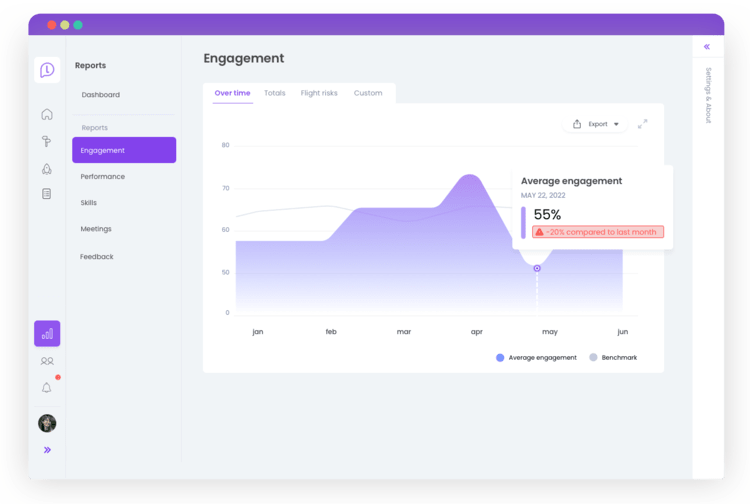
With Learned's Survey software you can implement continuous short surveys with a few questions per week in the same time as an annual employee survey. This way you maintain real-time insight into your employee engagement throughout the year and immediately see the effect of your HR initiatives. Try Learned free for 14 days.
Image explanation: In this example you can see the power of continuous short surveys. Due to a negative situation in April, you see a sharp decline in employee engagement in May. Thanks to frequent measurements, you can take immediate action.
Employee experience
A study by the IBM Institute for Business Value identifies three interacting components of employee experience. A social environment that encompasses all interactions between employees. A work environment for interactions between employees and their tasks. And finally, a physical environment that encompasses interactions with tangible components in the organization. The combined interactions of these three components form the total employee experience. As an organization, you need to respond to this. Sounds simple, right?
Tip 1. Map all employee touchpoints
Anyone with a bit of experience in marketing and sales is familiar with customer touchpoints and the customer journey. Now we reverse the roles and look at all employee touchpoints. That means from application to exit interviews and everything in between. How a new employee is received, trained and guided during their employment are all aspects the employer can influence. All these aspects affect the employee experience. This is where onboarding and Performance Management come into play. Research by HR-Tech guru Josh Bersin (2016) describes a shift within Performance Management from standardized processes to individual people management. This means the entire Performance Management cycle should no longer be a series of administrative tasks, but that an organization should look at the individual employee at all employee touchpoints. He describes this in the last phase of his model as Empowerment. More emphasis on the interests of the employee within the various aspects of employment therefore improves the employee experience. Want to know how your organization can respond to this? Read tips 2 and 3!
Tip 2. Ownership for the employee
We have already established that satisfied employees lead to satisfied customers and therefore good business results. This process can be accelerated by giving employees insight into the organization's objectives and their personal contribution to those objectives. However, an article by MT (2017) shows that over 25% of employees are not aware of organizational objectives. In terms of employee experience, this means there is no good interaction between employees and their tasks. To counter this, more and more companies are working with so-called OKRs. They split organizational objectives and make employees owners of their own piece of the result. By making this visible for everyone, you work as one team towards the collective goal called: success.
Tip 3. Employee experience as company culture
Once you have determined at which points within the organization employee experience matters, you can take the next step. Integrating employee experience into your company culture. Your employee's experience must be rooted in the why of your organization. The most important thing is to ensure an open dialogue with your employees. Let them provide input on all three components of employee experience. Something as simple as the office layout is a good example. After all, this is where most employees spend most of their time. Always keep the social, work and physical environment in mind and allow as much input from employees as possible. When they feel heard, words like 'experience', 'purpose' and 'happiness' will mean a lot more to you.
Ontvang de nieuwste HR-tips
Krijg 1 keer per maand onze tips, e-guides en templates direct in je mail.