

The traditional way of evaluating is well known to many. The manager uses the annual review at the end of the year as the only moment to give feedback. The employee needs to prepare little to nothing and listens to the points during the conversation. Often such an appraisal then feels more like a 'sentencing conversation'.
The employee then probably does too little with the feedback, causing behavior to remain the same and hearing the same feedback at the next review. This vicious circle does not contribute to good cooperation and, more importantly, ensures that employees often do not (further) develop; this is where 360-degree feedback comes in.
👉 Want to get started right away? Download our free template for modern evaluation interviews including sample questions
What is 360-degree feedback?
360-degree feedback is a comprehensive evaluation system in which an individual receives feedback from various people within and sometimes outside the organization. These people can be colleagues, supervisors, subordinates, and sometimes clients or external partners. The goal of this method is to gain a broad and diverse insight into the employee's performance, skills, and behavior from different perspectives.
The system is based on the principle that feedback from multiple sources is more balanced, objective, and valuable, giving individuals a clearer picture of their professional impact and interactions. This versatile perspective helps employees develop self-awareness and recognize which areas need improvement.
Different types of feedback
The distinguishing factor when sharing feedback with colleagues is whether it is one-way, two-way, or multi-directional.
- 90-degree feedback means that only the supervisor provides feedback.
- 180-degree feedback means both the supervisor and the employee provide feedback (two-way traffic).
- With 360-degree feedback, the supervisor, employee, and colleagues are all involved. In the case of 360-degree feedback, it also happens that external parties such as clients or suppliers are asked for feedback. This creates feedback from all directions on the employee's performance.
Research from Gartner in 2018 shows that when colleague feedback is included, the evaluation is up to 14% higher. This leads to motivated colleagues and better mutual collaboration.
When do you use 360-degree feedback?
360-degree feedback is particularly useful in various situations:
- Personal development: It helps individuals identify their strengths and development areas by providing a wide range of perspectives.
- Leadership development: It is crucial for developing and refining leadership skills, as it provides feedback on how leadership styles are perceived by others.
- Team development: It can provide insights into team dynamics and help identify areas for improvement in teamwork and communication.
- Performance reviews: It can provide a more balanced view of individual performance by integrating contributions from various sources.
Pros and cons of 360-degree feedback
Advantages
- Broad perspective: It provides a more complete picture of an individual's performance and behavior.
- Personal development: Employees get the opportunity to grow through constructive feedback from multiple sources.
- Increased self-awareness: Individuals learn how their behavior and performance are perceived by others.
- Promotes open communication: It encourages a culture of openness and transparency within teams and the entire organization.
Disadvantages
- Time-intensive: Collecting and processing feedback can take a lot of time.
- Possibility of softening or hardening feedback: Respondents may moderate or exaggerate their feedback depending on personal relationships.
- Feedback quality: The quality of feedback can vary depending on the expertise and commitment of respondents.
Anonymous or not anonymous?
Most companies that use a 360-degree feedback method work with a written form of feedback. In some organizations, it is customary to provide this feedback anonymously. The idea behind this is that feedback providers often dare to answer more honestly and no friction arises between them.
However, Learned advises against giving feedback anonymously. Anonymous feedback can seem like backstabbing and is often not constructive. By not sending feedback anonymously to the recipient, it contributes to a transparent culture and more engagement. You can have conversations about the feedback given. By asking very concrete questions based on the feedback, it is possible to further develop the feedback and get a clearer picture.
Tips for using 360-degree feedback
How to ask for feedback:
- Keep it manageable: ensure a maximum of 2 to 3 feedback requests per employee.
- Set guidelines in advance: Determine the guidelines for giving feedback in advance. Think of core values that are important within the company.
- Balance: Ensure a good balance between giving positive feedback and points that still need work.
- E-guide: Download the FREE e-guide to map your employees' performance.
Tips for receiving feedback:
Have the employee check in advance whether someone, especially in the case of external parties or clients, is willing to give feedback. Make sure the employee asks concrete questions about the points on which feedback is desired and use, for example, the 3 B's for receiving feedback:
- First of all, it is important to properly understand the feedback — ask follow-up questions if certain feedback is unclear.
- Thanking for giving feedback is important and is often skipped. Giving feedback is not something people naturally like to do and sometimes even find nerve-wracking.
- Assess for yourself what you do with the feedback. Use feedback to develop and make sure you appreciate the feedback at its true value.
"Through a clear explanation of levels and directions, one can very easily and specifically ask for and give feedback. This makes the feedback easier and more complete," says Leonie Koelmans of Fronteer. Fronteer has been working with Learned for a long time and notices a quick and positive adoption of Learned's software within the team.
Let employees also evaluate the supervisor
To fully close the circle of 360-degree feedback, as a manager you can also ask for feedback from employees. This is not so much about the employee themselves but much more about the manager's performance or feedback on, for example, processes or agreements. As a manager, you get a good picture of how you are seen by employees and what you can do to improve your own performance. By actively asking for feedback on processes and agreements, you create a transparent and motivating work climate because employees are encouraged to think of efficient improvements for current work processes.
Step-by-step plan to implement 360-degree feedback
Step 1: Define your objectives
Start by establishing clear goals for the 360-degree feedback session. What do you want to achieve? Is it aimed at personal development, improving team dynamics, or something else?
Step 2: Select participants
Carefully choose who will provide feedback. This should be a mix of colleagues, subordinates, and supervisors, and possibly external parties.
Step 3: Create your questionnaire
Develop a questionnaire that is relevant to the objectives. Ensure that questions are clear, objective, and relevant to the roles and objectives of the feedback recipients.
Step 4: Collect feedback
Use an anonymous and confidential system to collect feedback. This encourages open and honest answers.
Step 5: Analyze the feedback and report on it
Analyze the feedback and compile a report for each feedback recipient. The report should be constructive and focused on development.
Step 6: Create development plans
Work with each feedback recipient on creating personal development plans based on the feedback.
Step 7: Follow-up and support
Provide support and resources for development and schedule follow-up sessions to discuss progress.
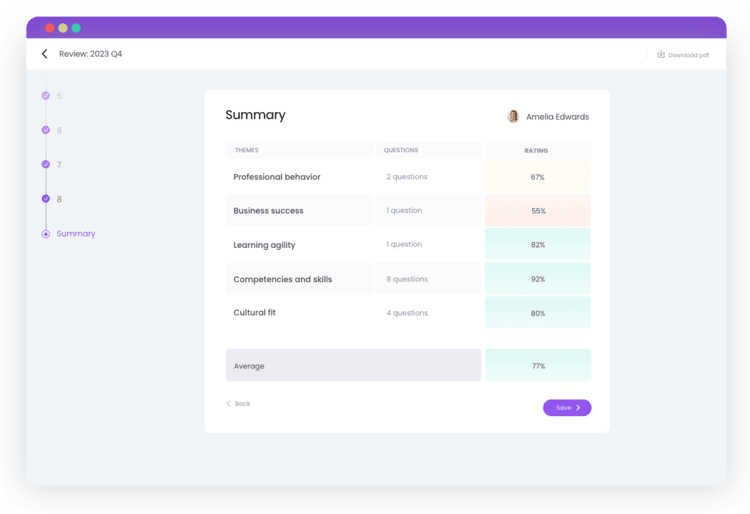
Learned facilitates objective evaluations. By creating multiple measurement moments per year based on different themes – for example: the fit with your culture and achieving goals, you gain objective insight into your low and high performers.
Learned makes giving 360-degree feedback easy
- Easily design your ideal feedback form within our software with feedback based on goals, open questions, or even core values, competencies, and skills.
- For each type of question, you determine which form of feedback you want to apply: 90, 180, 360-degree feedback, or even feedback from external parties (clients, etc.).
- Automatic reminders ensure you no longer have to chase employees.
- All feedback and conversation notes in one central place.
- Signing forms is done digitally — no more paper printouts needed!
Curious which of these best practices can be used in your organization? Watch a video demo of the Learned platform or create a free trial account here.
Ontvang de nieuwste HR-tips
Krijg 1 keer per maand onze tips, e-guides en templates direct in je mail.

Related articles
Discover more about this topic