

A performance review form, used during appraisal meetings, helps objectively and structurally evaluate employee performance. It has various applications, including performance assessment, feedback, goal setting, development and growth, reward and recognition, and documentation. Best practices for creating and using them include specific and relevant performance criteria, fair and objective assessments, consistent scales, regular feedback, encouraging dialogue, offering development opportunities, and documenting the conversation. Want to get started right away with an example appraisal form? Download our free performance review template here and start preparing!
What is a performance review form?
A performance review form that companies often use during appraisal meetings is a structured document that helps evaluate employee performance and behaviour. The form typically contains sections where specific goals and competencies are assessed. This may include productivity, quality of work, collaboration, communication and professional development. The form also provides space for comments and feedback from both the supervisor and the employee. By using a review form, companies can objectively and structurally assess employee performance, identify strengths and address areas for improvement.
Applications of a performance review form
A performance review form has several important applications. We have listed the most important ones for you:
1. Performance assessment
The review form is used to assess employee performance. It enables managers to objectively evaluate the strengths and development needs of employees based on predetermined criteria and objectives.
2. Feedback
The review form provides a structured framework for giving feedback to employees. It enables managers to provide specific examples of performance and make constructive comments about areas needing improvement.
3. Setting objectives
The review form is often used to set objectives for the upcoming period. It enables managers and employees to jointly formulate goals that are relevant to the role and contribute to the broader organisational objectives.
4. Development and growth
The review form can also be used as a basis for identifying employee development needs. By identifying strengths and weaknesses, managers can create targeted development plans to improve employee skills and capabilities.
5. Reward and recognition
Review forms are sometimes also used as a basis for determining rewards and recognition, such as salary increases, bonuses, or promotions. The performance evaluations on the form can play a role in making decisions about rewards and recognizing employees' contributions.
6. Documentation
The review form serves as an important document in HR administration. It provides a written record of the assessment and can be used as a reference point for future evaluations, promotions or employment law issues.
Overall, using a review form in appraisal meetings is a structured and systematic approach to evaluating and developing employees in an organisation.
Components of a performance review form
Although the specific structure and content of review forms may vary between organisations, there are some common elements that are often included. Here is a general explanation of how review forms are structured:
- Personal details: The form usually starts with the employee's personal details, such as name, job title, department and review period. This ensures clear identification of the employee being reviewed and the timeframe of the assessment.
- Assessment criteria: The form usually contains a list of assessment criteria or competencies on which the employee is assessed. These criteria are often determined based on the job description and organisational objectives. Examples include communication skills, problem-solving ability, teamwork, results orientation, etc.
- Rating scales: Review forms often contain a scale or set of rating options to assess employee performance on each criterion. This could be a numerical scale (e.g. 1-5) where 1 represents unsatisfactory, 3 adequate and 5 excellent.
- Overall assessment: This is a summary of the employee's overall performance, usually given as an overall score.
- Signatures: The form is usually signed by both the assessor (usually the manager) and the employee to confirm that the meeting took place and its content was discussed.
Best practices for creating and using a performance review form
When creating and using these forms, there are a number of important things to consider. You naturally want to avoid the focus being solely on filling in the form. Ultimately, it's about the conversation that takes place. Here are our best practices.
1. Be specific
Performance criteria should be specific and measurable. Try to set clear, quantifiable goals so there is no confusion about what people can expect.
2. Make it relevant
Ensure that the performance criteria are relevant to the employee's role. This means they should relate to the tasks the employee actually performs and the goals of the department or organisation.
3. Be fair and objective
Assessments should be based on facts and observations, not personal feelings or biases. Try to provide specific examples of performance or behaviour to support your points.
4. Use a consistent scale
You should perform all assessments using the same scale to ensure fairness and consistency. This means that if you use a rating scale of 1 to 5, you must make it clear what each score means.
5. Ensure regular feedback
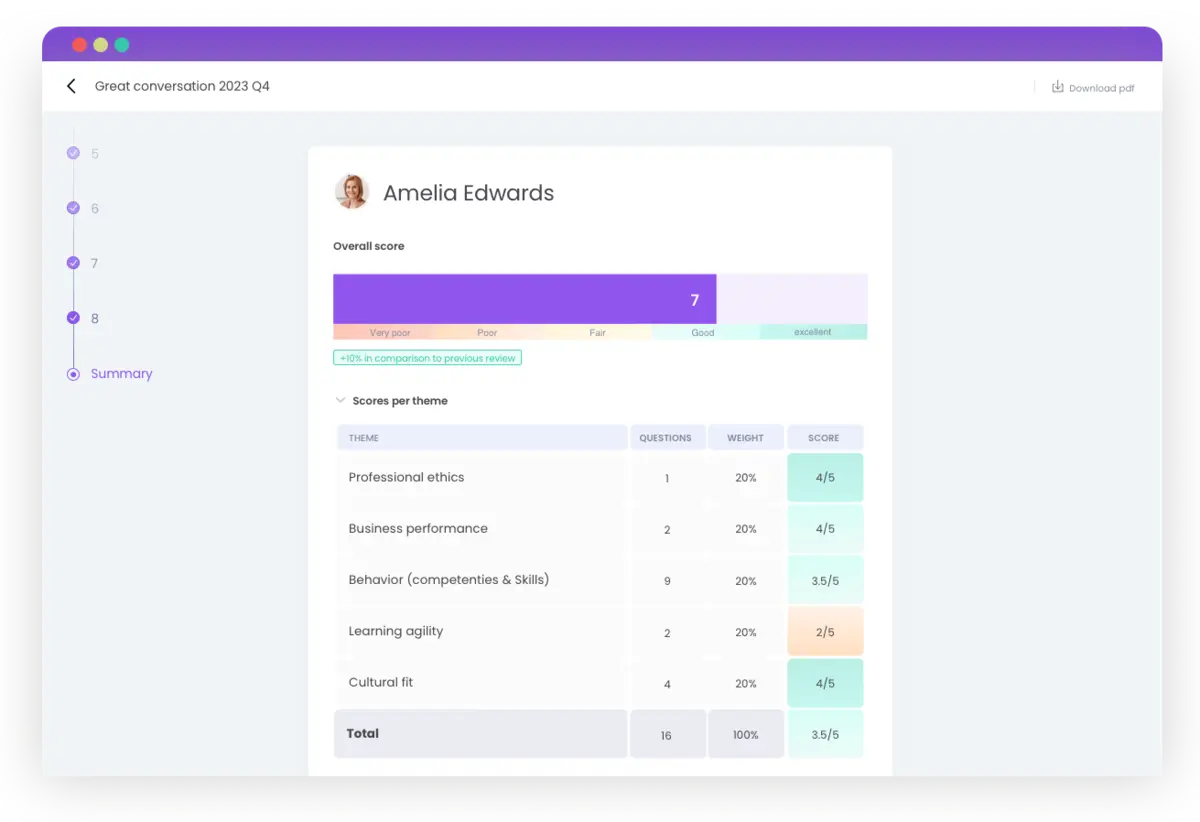
Assessments should not be the only time employees receive feedback. Regular, constructive feedback can help employees continuously improve.
Learned facilitates objective evaluations. By creating multiple measurement moments per year, you gain objective insight into your low and high performers. Try Learned free for 14 days!
6. Value dialogue
The appraisal meeting should be a dialogue, not a monologue. It's important to give employees the opportunity to ask questions, discuss their performance and indicate their own goals and ambitions.
7. Offer development opportunities
Use the assessment as an opportunity to discuss professional development and growth. This can include training, new responsibilities or projects, or other opportunities to learn and grow.
8. Document the conversation in the form
Make sure you document the appraisal meeting so you can later refer to the points discussed. This can also be useful in case of disputes or misunderstandings.
Following these best practices can help ensure your assessment process is fair, effective and useful for both the organisation and employees.
Make assessments fair and objective with Learned review forms
With Learned's standard templates, you can base assessments on objective criteria that measure your employees' performance and competencies. We work with scientifically supported questionnaires and rating scales. The forms also provide space for 90°, 180° and 360° feedback. Curious about Learned's review templates? Click here!
Ontvang de nieuwste HR-tips
Krijg 1 keer per maand onze tips, e-guides en templates direct in je mail.

Related articles
Discover more about this topic