

Assessment is a process in which you evaluate employees' performance, competencies, and behaviour to determine the extent to which they meet set goals. Evaluations focus on the effectiveness of processes, projects, or programmes.
And objective assessment is very important because it ensures fairness, consistency, and justice. This reduces subjectivity and stimulates employee motivation and engagement.
👉 Ready to get started? Download our template with 25+ sample questions for an assessment interview
What is assessment?
Assessment is a process within organisations in which employees' performance, competencies and behaviour are evaluated. The goal of assessment is to enable an objective and systematic evaluation of individual performance, to determine the extent to which employees meet set goals, standards and expectations. Assessments are often carried out using predetermined criteria, such as measurable objectives, skills and behavioural competencies.
Based on assessments, organisations can make decisions regarding remuneration, development, promotion and possible dismissal of employees. The assessment process may vary between organisations, but the aim is always fairness, transparency and objectivity.
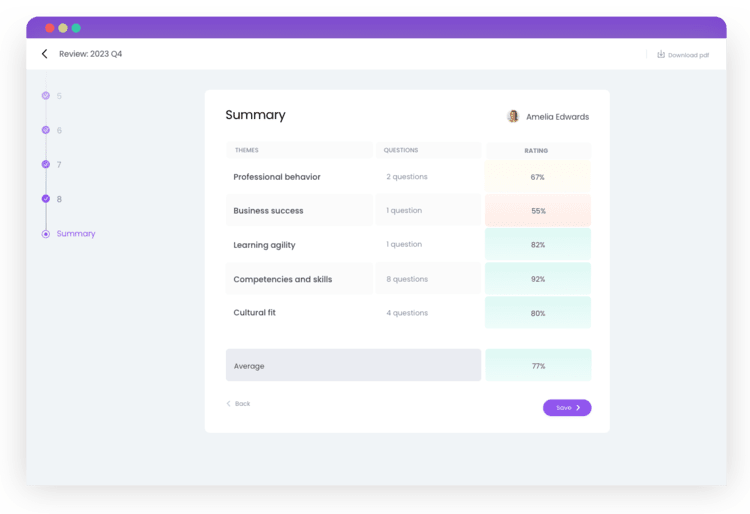
With our Performance Management software, you enable objective evaluations. By creating multiple measurement moments per year based on different themes – from cultural fit to goal achievement – it becomes clear how employees score on the various themes. This gives you objective insight into your low and high performers.
What is the difference between assessment and evaluation?
Assessment and evaluation are two related but different concepts. Assessment relates to evaluating individual employee performance and behaviour, usually with the aim of making decisions about remuneration, development and promotion.
Evaluation, on the other hand, focuses on assessing the effectiveness and success of a process, project or programme as a whole. Evaluations are broader in nature and focus on gaining insight into the performance, efficiency and effectiveness of a whole, while assessments are more focused on individual performance.
Different applications of assessments in organisations
Employees can be assessed in various ways. Some examples include:
- Performance assessment: This involves evaluating an individual employee's performance based on measurable goals, targets and results.
- Competency assessment: This includes assessing an employee's skills, knowledge and capabilities to effectively perform their tasks.
- Behavioural assessment: This evaluates an employee's behaviour and attitude, such as collaboration, communication, customer focus and problem-solving ability.
- Potential assessment: This is aimed at identifying the growth potential and development opportunities of an employee for future tasks and responsibilities.
- 360-degree assessment: Assessments are collected using 360-degree feedback from various stakeholders, including colleagues, managers and subordinates, to gain a more complete picture of an employee's performance.
The actual assessment process and specific assessment criteria may vary between organisations.
The importance of objective assessment
The importance of objective assessment is clear, especially in the context of modern assessment practices. It is important to assess employees on objective criteria because it ensures fairness, consistency, and justice in the assessment process.
Objective evaluation criteria establish a clear standard against which employees can be measured, independent of personal preferences or biases. This reduces subjectivity and creates equal treatment within the organization. Objective assessments promote employee motivation and engagement. They provide clarity about expectations and identify areas for growth.
How to assess your employees on objective criteria with Learned
You can easily organise an assessment meeting with one of our templates consisting of various topics, themes and KPIs.
Ontvang de nieuwste HR-tips
Krijg 1 keer per maand onze tips, e-guides en templates direct in je mail.

Related articles
Discover more about this topic